L'origine de Bert

Get email updates of new posts:        (Delivered by FeedBurner)

Showing posts with label family. Show all posts

Saturday, May 03, 2025

Links - 3rd May 2025 (1 [including Parenting])

Meme - Coleman Bee: "The most satisfying part of this is that its always liberals doing it"
"As more Americans go 'no contact' with their parents, they live out a dilemma at the heart of Shakespeare's 'King Lear'"
Ashley De Silva: "I cut off both of my parents and it's the best decision I have ever made!"

Parenting books aren’t the solution, they’re actually the problem - "My parenting style flapped around like a windsock in a hurricane, as one childcare guru superseded another. Every change of direction eroded what little confidence I had in my own instincts; and this, in turn, kept me scurrying back to the bookshelf in search of guidance. I ended up – as I remain – confused, irresolute and inconsistent. Not just from reading the wrong books, but from reading any at all."

Katharine Birbalsingh: Gentle middle-class parenting can be harmful - "Parenting guidance written by the middle class is destroying child-rearing among the working class, according to a prominent head teacher. Katharine Birbalsingh said parents should stop giving their children choices in food and clothes and should embrace being authority figures. She decried the impossibility of finding traditional parenting books, such as those from the 1960s, that gave parents permission to tell their children what to do and teach them right from wrong. Birbalsingh, who runs Michaela Community School in Wembley and is often described as Britain’s strictest head teacher, also criticised parents who did not teach their children to read and count. “The culture and the language that’s being used means parents feel that they’re not in a position of authority over their child,” Birbalsingh, 52, said. “If you’re looking for books to give you advice on what to do as a parent, it’s almost impossible to access the kind of advice you would have gotten 50, 60 years ago. The stuff you’ll get nowadays will be much more along the lines of gentle parenting, being friends with your children, not holding them to account. It will be written from the point of view allowing them to choose to lead their own feeding. “That same idea goes through everything. So when they’re older in school, is it child-centred learning where the child is leading the learning — or is it the adult who’s the authority in the room leading the learning?” She added: “When it comes to tantrums and teaching them right from wrong — even just that language of teaching them right from wrong — you’re not going to come across that, it will be very much about understanding the child, communicating with the child’s needs.” Books from decades ago would have given parents more agency and more of an understanding of “having dominion” over their child, she said. Modern parents, Birbalsingh claimed, had “been infantilised”. This phenomenon has been partly shaped by parenting literature and general advice... “Middle-class parents might then say, ‘well, that doesn’t happen to us’. If you are able to afford a nanny, or if you have two parents in the home, you might get away with some gentle parenting. But for families that are under financial pressure, social pressure, don’t have two parents in the home, they simply aren’t able to do what you might be able to get away with,” she said. “And the culture that is created by this literature, written by middle-class people — they don’t realise the absolute destruction that it causes for the working-class family.”... Fathers have a big influence by being stricter than mothers but are also more fun and adventurous, she said, although she suggested that either parent could take that role. “There needs to be a different dynamic when you’re bringing up children. There cannot just be one dynamic. It’s the same in school. You’ll always have a good cop and a bad cop with the teachers — it’s a role that we play all the time.” Parents who wanted their child to succeed had to teach them at home, she said. On social media Birbalsingh said she was regularly told by parents: “That’s not my job, that’s the teacher’s job.”
Clearly, she is abusive, favours inflicting trauma on children and deserves to have any kids she might have go no contact and put her in a nursing home

The cruelty of gentle parenting - "Gentle parenting, or conscious parenting, professes to foster compassion and emotional self-understanding in a child. It’s about respecting the emotions of a child and the motivations behind those emotions. If a child has a tantrum, hits, or generally misbehaves, it is because she is frustrated — and a parent’s job is to address the root cause of the child’s frustrations. A child should be understood, never punished. This is because for a gentle parent, children aren’t bad. They aren’t even neutral. They are inherently good. As a mother myself to two teenagers, this is news. Punishment, in the gentle mindset, focuses the attention on an unnatural consequence rather than on the motivations for behaviour. No motivation is bad, because no feeling originates in one’s selfishness, one’s greed, or one’s desire to dominate. Anger and inappropriate behaviour are caused by frustration: the frustration of not being understood, of not being able to accomplish what one wishes, of not being able to freely do what one wants. When a child experiences a curb to their will, the parent needs to offer comfort. Instead of punishment, a child should face the “natural consequences” of her choices. For instance, if a child refuses to go to sleep, this means that she suffers the natural consequence of getting tired and cranky. A natural consequence of my own kids acting cranky is that I might lose my shit on them, but I don’t get the impression that gentle parents are encouraged to act naturally. This brings us back to the insufferable tone of voice that gentle parents all seem to use with children, particularly those millennial mom influencers on social media. My aversion to it is that there is a fake niceness to their wheedling that anyone can see through, including most four-year-olds. It is patronising, and reveals a deep annoyance with children but prohibits any kind of genuine expression of it. One can’t get angry with a child because he is not doing anything bad because he is inherently good. What is needed is to redirect his natural self-expression to a more socially accepted choice, one that will result in Mommy speaking to you with more authentic niceness. Gentle parenting flattens the human experience into a series of choice options, none of which reflect any natural goodness or badness in the child, but which instead represent optimal or less optimal outcomes. This is crude behaviourist psychology, treating the human as a kind of input-output machine. Under this model, gentle parenting ignores the depth and complexity of a child’s soul — including the baseness therein — and, because it ignores it, the technique also fails to nurture the depth of a child’s soul, resulting in, unsurprisingly, children who have shallow souls. A child is denied her full humanity as a moral agent, and treated not as an equal, but as somehow less than fully, richly, terribly human. In short, as the little shits they are, yet having a spark of the divine. Just like Mom... Since gentle parenting has no capacity for talking to a child about wickedness, guilt, and punishment, it also has no ability to speak about redemption... the real problem with gentle parenting is that it removes moral freedom from a child because it refuses to accept the moral depth of a child. Punishment is unnecessary because the child is never bad, merely misunderstood. While gentle parenting concedes that a child’s behaviour might be less or more appropriate, well-socialised, and safe, it doesn’t concede that a child’s motivations might originate in wickedness just as easily as goodness. Nor does it accept that a child’s will should be curbed because it is often corrupted in its desires, not simply frustrated. In neglecting the dark corners of a child’s soul, gentle parenting does children a disservice. For the fact is that most children know that they’re sometimes bad, and that they sometimes do things out of malice, spite, and greed... the job of the parent is not to prevent any potential “trauma”, it is to love the child even when they are bad, and to punish them, and most importantly to forgive them. A child can’t understand the lightness of forgiveness without understanding first that one needs it... Since the age of Shakespeare, most of our great literary villains have had depth, reasons for their villainy, motivations that we can sympathise with, even be attracted to. Yet we can also see that they’re villainous because they choose to be. Shakespeare gives his villains and his tragic heroes dignity by granting them their awful humanity. And he shows that it is only because his villains do wicked things willingly that they can be redeemed... Ironically, it is the avoidance of punishment that may very well cause anxiousness in the child, for the work of making oneself more socially appropriate is never done, but punishment has a fixed term"

Gentle parenting is creating little monsters... and I should know - "From what I’ve seen, the approach seems to produce children who disregard adults and have a loose understanding of consequences - which feels like a concerning crop of bandits to have eventually entering society."

Fishermen unravel family mystery after month at sea - "Two men from the Pacific nation of Kiribati who were lost at sea for a month have managed not only to survive, but to unravel a 50-year-old family mystery.  Uein Buranibwe, 53, and Temaei Tontaake, 26, made headlines late last month when they washed ashore in the Marshall Islands after 33 days lost at sea.  They were more than 600 kilometres from home. Their global satellite positioning system had run out of batteries after they left their island on what should have been an 80km trip to get gas.  Marshall Islands Journal editor Giff Johnson says the men found much-needed food and water on Namdrik Island.  But he also says that one of the men discovered that his uncle, feared drowned at sea 50 years earlier, had also wound up on the same atoll and married into the community."

Sydney ‘science nerd’ may face jail for importing plutonium in bid to collect all elements of periodic table - "Emmanuel Lidden, 24, will have to wait to learn his sentence after breaching nuclear non-proliferation laws by shipping samples of plutonium to his parents’ suburban Sydney apartment.  Lidden pleaded guilty to offences under Australia’s Nuclear Non-Proliferation Act that carry a possible 10-year jail sentence, and is due to receive his sentence from the judge Leonie Flannery on 11 April.  The importation sparked a major hazmat alert, with Australian Border Force (ABF) officials, firefighters, police and paramedics all attending the scene in August 2023."

Analysing speed profiles for the estimation of speed on traffic-calmed streets - "This research examines the speed profiles of individual vehicles on traffic-calmed streets in Christchurch, New Zealand, to provide a better understanding of how drivers react to calming devices over an extended street length and to find ways of estimating speeds along such streets. The results indicate that traffic-calmed streets do not necessarily promote low speed environments. It was found that 85th percentile speeds at long distances from calming devices were 45-55 km/h for horizontally deflected streets and 40-45 km/h for vertically deflected streets. The speed hump and the angled slow point produced the biggest speed reductions, while the 2-way mid-block narrowings caused no significant speed changes. The results also show that drivers have different perceptions of the appropriate operating speed at such devices, as evidenced by variations in speeds at the devices. Standard deviations in speed at speed humps and raised angled slow points were smaller than those at speed tables. For multiple devices, larger spacings produced higher speeds between devices. These findings, along with speed-difference relationships and speed-spacing models developed from this research, can aid in the selection of device type and spacing between devices, to improve the effectiveness of traffic calming."
The claim that narrower streets are safer and people drive slower has mixed evidence supporting it

SUMMARY REPORT-Safety Effects of Using Narrow Lanes and Shoulder-Use Lanes to Increase the Capacity of Urban Freeways - "McCasland evaluated two freeway segments in Houston, TX on which narrower lanes and a narrower outside shoulder were used to create an additional travel lane. Reductions in the accident rate per million vehicle-kilometers (veh-km) were found using a Poisson comparison of means test. Urbanik and Bonilla evaluated similar projects on urban freeway segments in California using a two-sample t-test. Statistically significant changes in the accident rate were found for three of the 10 projects evaluated. Two projects experienced statistically significant reductions in the accident rate, but one project experienced a statistically significant increase. In particular, the entire accident rate increase for this project occurred near the downstream end of the segment. There are concerns that both evaluations addressed accident rate rather than accident frequency and did not compensate for regression to the mean, both of which could have distorted the safety benefits... The analysis results indicate that narrow-lane or shoulder-use-lane projects on urban freeways increase accident frequencies for four- to five-lane conversion projects. Such conversions may increase accident frequencies for five- to six-lane conversion projects as well, but the results for those projects were not statistically significant. Because of the different findings for these two types of conversions, the results obtained are difficult to generalize to urban freeways as a whole.  One possible explanation for the increase in accident frequency on conversion projects is that the added lanes in most of the projects were HOV lanes. Speed differentials between the main lanes and HOV lanes on freeways have the potential to increase sideswipe and lane-changing accidents, although this effect has not been satisfactorily quantified in the literature. The crash type results in this study indicated a nonsignificant increase in sideswipe collisions on the four- to five-lane conversions, but a decrease on the five- to six-lane conversions. If this is indeed true, it may help explain why the results differ between the two classes.  The results also suggest that, at least for the five- to six-lane conversions, the effect of the project may have been to dissipate congestion upstream of the treatment site by removing the treatment site as a bottleneck. It is possible that the effects of the four- to five-lane conversions have been partially because of the displacement of a bottleneck as well. The bottleneck may have been transferred to a location downstream of the treatment site, with a corresponding increase in accident frequency at that location and possibly within the treatment site itself.  In summary, the findings are more complex than expected. Differences may exist in the crash-related effects of lane conversion treatments at four-lane versus five-lane sites. The differences between road classes observed may be explained by differences in traffic operations (e.g., speeds, lane-changing behavior) that could not be analyzed in this study. In addition, the observed increases in accident frequency cannot necessarily be attributed to the use of narrower lanes or the conversion of a shoulder to a travel lane. The use of the added lanes as HOV lanes, which may introduce a difference in speed between adjacent lanes, may be another explanation for the increase in accidents. The analysis results also suggest that the conversion projects may decrease accident frequencies upstream of the project and increase accident frequencies within and downstream of the project because the projects may result in the relocation of a traffic operational bottleneck. These various effects on safety are confounded in the data and could not be separated in this study."

Merissa Hansen on X - "🚨BREAKING🚨 Leaked documents reveal how riots are organized and funded through leftist NGO’s"

Romanticising 'sickness' dooms us to a national cycle of dysfunction - "In a little over a decade, illness and suffering have gone from being a negative whose inconvenience the average person tried to manage and overcome as privately as possible, to the centrepiece of a person’s identity.  Sickness has become a power tool, a game piece to play, and a shield: once you declare your badge of honour in the form of a diagnosis of ADHD or PMT, it’s open sesame. Nobody can counter you because of… neurodiversity or hormones or whatever it may be. No wonder the staggering rates of sickness benefits claimed by young people are breaking Britain’s finances. Somehow, as woke ideology has marched across internet users’ consciousness, phrases like “my trauma” have become utterly commonplace, obscuring, as so many of these overused labels do, the serious traumas of people who have experienced genuinely terrible things, from wars and domestic abuse to the terror and despair of being stalked by a mental illness such as bipolar disorder or schizophrenia. Because the seriousness of some mental states has been lost amid all this froth, emotional wellbeing is packaged up as information to share before communication is to take place. I was struck by an advert for the “I’m OK” bee enamel brooch by the artist Gary Floyd, which encapsulates “the often unexpressed sentiment that many individuals face when asked about their emotional wellbeing… It’s OK not to be OK sometimes.” Really? Who knew?  Experts now worry that amid all this reaching for the I’m Not OK button, TikTok’s myriad of “neurodiversity” influencers encourages people who might be looking for meaning, identity, a place to hang their anxiety and, of course, a bulletproof get-out-‑of-jail-free card to self-diagnose with a disorder.  This is worrying for many reasons, including that in their pure form, such disorders need to be taken seriously with specialist treatment, not just deployed for sympathy points. The case of ADHD is one of the most prominently pushed online, romanticised and rendered “cute”.  Researchers carried out a study with 2,843 undergraduate psychology students on how they perceived the videos. This showed that “people who watched a large number of ADHD-related TikToks also tended to overestimate ADHD’s prevalence by as much as 10 times and think more negatively about their own symptoms”. Scientists expressed concern that the videos – which have had more than half a billion views combined – portray ADHD (and other disorders, such as mild autism) as “lively, loveable and almost entertaining”...  Because of the way the umbrella ideology of “diversity” has spread and embedded itself, there is a pervasive belief that pathology is power. Diversity, after all, is about making sure marginalised groups are not “under-represented” (a spurious term if ever there was one). What this translates to is giving anyone who isn’t “privileged” – namely straight, white, non-trans people – priority in all things so as to stamp down any “systemic” phobias and “isms”.  Translated into the domain of health, it’s obvious where this is going. Just as prioritising tick-box criteria – skin colour, sexual orientation and so on – has been devastating for the quality of education, politics and cultural life, so the celebration of pathology and the zest for auto-diagnosis that it invites is decimating the ability to even interact with other people.  When members of a society are incentivised to cry sickness – an unanswerable claim to being “marginal” too – it becomes impossible to rely on anything operating properly, from the legal system and businesses to hospitals and family gatherings. Because if everyone and everything can be stopped in their tracks by someone’s pain, trauma, disorder or negative feelings – lest the latter be railroaded and the person further traumatised and “unheard” – then nothing can work, no matter how important. Friends can’t speak freely with each other. Plans can be cancelled at short notice for any excuse because “my pathology made me”.  This is vexing enough on the personal level, but writ large over the country as a whole, it is devastating our economy and our spirit. But as Britain groans, the TikTokers are laughing all the way to the bank."

Chris Selley: Two recent elections violated the Constitution, but don't expect consequences - "the court ruled that the $600,000 limit on third-party spending in the 12 months leading up to an election “create(s) an absolute disproportionality in the broader political discourse” that favours political parties over third-party actors. It “deprives voters of a broad range of views and perspectives on issues during a critical period in the democratic cycle,” Justice Andromache Karakatsanis wrote in the majority decision . “This undermines the voter’s right to an informed vote and to meaningful participation in the electoral process.” The decision was cheered by the Ontario Federation of Labour and the NDP alike . Now, Ontario’s government isn’t what you would call slavishly, or even identifiably, conservative. Still, it has been odd seeing Premier Doug Ford’s opponents to his left cheering a decision that invites more money into Canadian politics. They’re usually the ones arguing for less. It was barely a decade ago, and only in her political death throes, that Ford’s predecessor Kathleen Wynne got around to banning corporate and union donations in Ontario — something the federal Liberals, also circling the drain, had done roughly a decade earlier... The Citizens United case landed in U.S. District Court for the District of Columbia in December 2007. The Supreme Court issued its ruling in January 2010, roughly 15 months later. The Working Families Coalition case took more than three years to meander its way through Canada’s pantomime yawn of a justice system. The Supreme Court heard the appeal May 21 and 22 of last year. It took them 10 months to come up with a ruling! It’s routine that Canadian court decisions, especially respecting to government overreach, come down long after they can provide any remedy for the parties involved — and far too late for future politicians to feel any deterrent effect against overstepping their authority. If we’re to be badly governed, and if bad governments are to be badly overseen by courts, could we at least make it quicker?"

Jonathan Kay on X - "The student union at @ubcokanagan (part of @UBC) denied an application for a student Conservative Party Club. And amazingly, the student union’s VP Internal flat out admitted that the decision was made on the basis of partisan political considerations"

Conservative Club ratified after UBC Okanagan Students' Union review - "UPDATE: March 13, 10:20 p.m.
The UBC Okanagan Students' Union Board of Directors met on Thursday evening to review it's decision to deny the Okanagan Conservative Club's application to be an official campus club.   "After careful consideration, the Board has ratified the club, ensuring that the decision was made in alignment with our values of equity, inclusion and respect for all students," said the Students' Union...
UPDATE: March 13, 3:15 p.m.Politicians, campus clubs and members of the public have spoken out to condemn the UBC Okanagan Student Union's (SUO) decision to deny official club status to the UBCO Conservatives Club.   According to an email from the Student Union that was leaked on X, the Conservative Club's application was rejected after "concerns were raised regarding the political stance of the party your club would represent," despite the fact that there is a Young Liberals Club at UBCO.   The directors suggested that the students applying to form the Conservatives Club "take a more neutral stance to ensure inclusivity," saying that the SUO's concerns relate to certain views associated with the political party could make UBCO students feel excluded or unwelcome.  The Young Liberals of Canada Okanagan, are now standing in support of an official campus Conservative Club.  "There is indefensible hypocrisy evident in their supporting our Liberal club to exist. The freedom to express diverse opinions on our campus is crucial. It is important for all of us to be exposed to and challenged by ideas we may not agree with," said the Young Liberals of Canada Okanagan in a statement on Instagram...
Original:
A leaked email posted to X regarding the Student Union at UBC Okanagan has caught the attention of B.C. Conservative leader John Rustad.  On Wednesday night (March 12), Jonathan Kay, an advisor for the free speech union of Canada, posted a screenshot to X of an email from the Students' Union UBC Okanagan (SUO) rejecting a student's application to create their own Conservative Party Club in the union.  The reasons for denying the application for a Conservative Party Club on campus had to do with some directors' concerns with certain views of the party, “particularly regarding the Black and LGBTQ+ communities - could make students from these groups feel excluded or unwelcome.”   It was suggested that the club take a more neutral stance to ensure inclusivity.   The email also stated that there was no appeal process for the board’s decision at this time. However, since the email was leaked it is now being reported that the SUO has been called into an emergency board meeting on the matter.   The email also stated that there was no appeal process for the board’s decision at this time. However, since the email was leaked it is now being reported that the SUO has been called into an emergency board meeting on the matter.   In a SUO release, it stated it remains committed to fostering an inclusive and diverse campus environment where all students feel respected and heard.   The SUO is non-partisan and claims it supports open dialogue and differing perspectives."

_s.a.m.e.m.e.m.e_ on X - "One of the less talked about but craziest parts of the Biden admin was when a clear recession hit in 2022 and there was a full court press from the media asking "what even *is* a recession, anyway?" along with Wikipedia and THE DICTIONARY changing the definition of the word"
Sherman McCoy on X - "The Fallout subreddit removed a post from the _creator of Fallout_ saying that Fallout was not anti-capitalism, but anti-war bc it offended the mods sensibilities Ever since The Last Jedi, Internet content moderation exists for the 5,000 leftmost people in the world. Once they removed the “bots” from The Last Jedi’s RT audience score and replaced it with a fake number they realized they could do anything. Redefine “recession.” Cover up Biden’s senility. Anything."

Guardian Media Group Forced to Apologize, Pay Damages to Douglas Murray over Racism Smear - "The Guardian Media Group was forced to apologize to Douglas Murray on Tuesday for falsely accusing him of “supporting violent racist attacks” during anti-immigration protests in the U.K. last year, after the British author won his libel suit against the media company in a London court."

Douglas Murray on X - "I should have noted that the Guardian group (which had to apologise and retract their falsehoods in court this morning) left X last year because of alleged ‘disinformation’ on this platform…"
Damn Daily Mail and Fox News spreading lies, falsehoods and disinformation!

Basil the Great on X - "In honour of @DouglasKMurray winning against the Guardian Group in court and because they've been sadly missed on X since they left. I thought it time we took a stroll down memory lane and revisit some of the very worst from the Guardian Feel free to add your own 🧵"

Insurrection Barbie on X - "I hate to tell you Democrats, but the economy will be just fine. I guess it’s back to everybody’s Hitler as a campaign strategy for 2026."
Mike Engleman🇺🇲 on X - "It's all they have. Hate, identity politics, and racism."

SYIP extremely overhyped : r/SingaporeEats - "Most cafes here are overhyped.  They're just variations of Melbourne-style coffee served with the same generic Western menu set in Taiwanese or Korean inspired decor with the same Spotify 'cozy cafe' playlist, with the only local touch being an ondeh ondeh cake they probably source from the same place as everyone else."

Different languages, similar encoding efficiency: Comparable information rates across the human communicative niche - "Language is universal, but it has few indisputably universal characteristics, with cross-linguistic variation being the norm. For example, languages differ greatly in the number of syllables they allow, resulting in large variation in the Shannon information per syllable. Nevertheless, all natural languages allow their speakers to efficiently encode and transmit information. We show here, using quantitative methods on a large cross-linguistic corpus of 17 languages, that the coupling between language-level (information per syllable) and speaker-level (speech rate) properties results in languages encoding similar information rates (~39 bits/s) despite wide differences in each property individually: Languages are more similar in information rates than in Shannon information or speech rate. These findings highlight the intimate feedback loops between languages’ structural properties and their speakers’ neurocognition and biology under communicative pressures. Thus, language is the product of a multiscale communicative niche construction process at the intersection of biology, environment, and culture."
i.e. In long winded languages like French, people speak faster

Thursday, October 24, 2024

The Woke Meritocracy

The Woke Meritocracy

"Every level of American education, from earliest grades to elite universities, is informed, to a greater or lesser extent, by two apparently contradictory forces: competition in the name of meritocracy, and identitarian notions of social justice. Meritocracy and wokeness seem to be at odds, particularly in debates about criteria for college admissions or the continued existence of selective public secondary schools. Between those who see meritocratic admissions as giving fair rewards to hard work and ability, and those who demand that schools focus on students’ identities rather than individual performance, there appears little room for compromise.

But the two positions have unexamined common ground, coexisting in the consciousness of students and teachers. At the University of Chicago, where I have taught for three years, I see students combine meritocratic and identitarian ideas in ways that reveal these two apparently antagonistic modes of thought to be not only compatible, but complementary symptoms of our collective failure to think honestly about the real purposes of education.. 

My students have experienced their schooling as both a long, isolating competition and as a continuous solicitation to stage their membership in racial and other identity groups...

In almost every instance, my students come to study at the University of Chicago not because some particular quality about this school (its “nerdy” reputation, location, etc.) appealed to them, but because it was the “highest-ranked” school that accepted them. Once here, they organize their leisure and career aspirations around rankings. Many student clubs require potential members to submit applications and undergo interviews, and students seem to get a certain sadistic thrill from doing to others as the educational system has done to them. Already in their sophomore years, they are applying for internships that will open paths to careers in consulting and finance, which they also perceive in terms of rank—only a few “top” firms in New York, they have learned from peers and parents, are worthy of a bright young person’s ambition.

But many of my students have also learned that, while working themselves to the top of whatever rankings are on offer is the only way to prove themselves worthy of respect, they must combine their ambition with affability. This is not an easy lesson—less socially skilled students often rankle faculty sensibilities by directly asking, even fighting, for a better grade. Too transparent in their striving desperation, they lose out to more Machiavellian peers.

One of my most disturbingly honest students, a young Asian American man who often wore a sweatshirt letting fellow students know he had attended one of the most expensive high schools in the country, told me that his parents had made him “do sports as a kid, so that white people would like me.” Indeed, he had the casual, embodied confidence of someone who had grown up knocking limbs against the sons of old money. He had figured out for himself, he said, to approach English teachers with poignant anecdotes about how much a particular poem had touched him—dazzled by the possibility of living their Dead Poets Society fantasies, how could they give less than an A to such a sensitive, promising young man?

Our elite universities have long had as a primary (although not always explicit) mission to nurture this kind of personality, in which intelligence and ambition are smilingly hidden by a “well-rounded” and not apparently mercenary interest in sports and art. An ingratiating human touch has been part of admissions criteria to elite universities since the early 20th century, when notions of “character” were developed to keep the children of Jewish immigrants from getting into the Ivy League on the basis of mere brainpower. Since then, generations of immigrants have taught their children that their intellectual acumen won’t get them far unless they can also mimic the ideal personality of the American elite...

What is new about education’s turn to woke identity politics is not the fact that administrators and faculty are influencing students’ sense of self, but rather the sort of values that the new ideal personality is supposed to uphold. The contemporary ideal, increasingly, is no longer someone so charmingly personable that others forget he is in fact a ruthless competitor, but a person who so convincingly narrates her having overcome some kind of social injustice that others forget she is in fact a beneficiary of systems of privilege.

My students are experts at performing this kind of self, and their stories of overcoming are almost all about “identity”—stereotyped racial dramas. I realized this when I organized a series of lessons on the theories of Michel Foucault. I had asked students to explain how institutions like the university elicit us to speak ’the truth’ about ourselves, and in doing so reshape who we are. They told me about their college admissions essays, narratives about themselves that both reflected a cunning sense of what their audience wanted to hear, and reached, more deeply than I think students know, into their own souls.

Students of color, particularly from immigrant backgrounds, wrote about the psychic suffering that had been inflicted on them by the dominant white culture. They had stories about having to learn to love their curly hair, their “unusual” names—in short, themselves. College applicants—and Americans generally—are increasingly asked to recount how through great difficulty they have succeeded in taking the self as the object of their love, a stage of narcissism that for earlier generations of psychoanalysts appeared not as a challenging achievement too often thwarted by an oppressive culture, but as a falling back into an infantile condition.

Members of less obviously oppressed groups had variant strategies. A number of Asian American students, for example, told me that they had written their admissions essays to demonstrate that they weren’t “like other Asians,” with narratives of how they had to challenge their strict parents and limited cultural horizons to develop passions for, as one wrote, beat-boxing and hip-hop.

These are not students’ own stories. Many students in my class received tremendous amounts of help on their admissions essays from dedicated tutors at their high schools as well as private writing coaches. Their letters are a collective output, a kind of shared fantasy of the ruling class. They should not be read for their insight into what students are really like, but for the purposes they serve their supposed authors and the society that has trained them to speak of themselves in these terms.

Students told stories that were variations on a theme we often find in modern American culture, in phrases like “black excellence,” or in the endless exhortations to recognize women’s intellectual achievements and potential. In this vision of the world, racism, patriarchy, etc., have long warped our society by obscuring the talents of certain groups. This perspective allows us to reconcile our commitment to meritocracy with our new moral sense that any state of affairs that does not see Black people, women, etc., represented in a given field in at least (but preferably greater than) their proportion of the general population is necessarily racist, sexist, etc.

One obvious wrinkle to this intuition is that centuries of oppression would seem rather likely to diminish the capacities of members of oppressed groups. When I confront students with Simone de Beauvoir’s version of this argument as we read The Second Sex (Beauvoir was concerned to explain why there had been, in her opinion, no female geniuses), they are horrified to find the mother of modern feminism insisting that oppression makes the oppressed objectively “inferior.” Women, still suffering the effects of historical and present-day sexism, are not yet “as good” as men in many fields, Beauvoir claimed. But students, and Americans more generally, prefer to imagine that oppression, however traumatic, in no way deprives the oppressed of merit. Thus, we can both speak of racism and sexism, in ever more dramatic terms, as terrible national problems, without having to imagine that increasing “diversity” in various fields of work will mean any loss of competence.

Stories of heroically overcoming discrimination help us collectively reconcile the apparently antagonistic values of meritocracy and wokeness, but they are no less useful for individual students, who are able to imagine themselves as singular, isolated subjects who have triumphed over vast “structural” inequities. The story of a self that resists hegemonic forces of racism and sexism may seem to oppose, but in fact confirms, the self-image of a successful meritocratic individual. Such a person speaks of herself as the bearer of internal, personal talents, which she deploys through hard work to win the recognition and compensation that are the fair due for her accomplishments. Narratives of triumph over oppression similarly position the subject as winning for herself—this time against a hostile and unfair system—the just rewards of her work. The teller of such a story does not need to—and perhaps, telling such stories so often, loses the ability to—understand herself as the beneficiary of several kinds of privilege or good fortune.

No students get to my classroom without having had a lot of good luck, or without learning how to occlude that luck through narratives of merit and identity. Nearly all of them have been born into wealthy, stable families, and attended excellent primary and secondary schools. Parents, teachers, and classmates pushed them to make the most of their cognitive abilities (another stroke of genetic and environmental fortune) and to develop the sort of personality most congenial to teachers and future employers. None of this was their own doing...

When I ask students to explain how they choose their desired career paths and majors, however, they often answer that these were chosen for them, by their parents, or don’t seem to have been chosen at all, but simply bubbled up into their consciousness from their social milieu. Throughout their childhoods, they complain, they were overscheduled, given almost no free time in which they might develop interests and commitments independent of their parents’ ambitions for them or the notions of adult “success” that were dominant in their family, school, and neighborhood.

Most of them report never having experienced what, before teaching, I thought was an obligatory American rite of passage: an adolescent crisis that pitted them against their parents’ values. My students say their parents are their best friends and surest allies. It’s true that they could never have made it to the University of Chicago without massive, uninterrupted parental supervision, which has left them without an effective sense of personal agency. What they have instead are stories, in meritocratic and woke versions, about how their own efforts and talents lead them as far as my class, and will lead them, after it, to high-paying jobs at the commanding heights of our economy.

Students’ absence of an internal locus of control—a core self whose values they know to be their own, and against which they can measure, and sometimes refuse, the demands of the world—appears even in what may seem to be simple questions of learning and skill, such as their ability to write. After my first year of teaching, troubled by the unclear, disorganized, and utterly unaesthetic papers written by students who had, in theory, received the best (and certainly the most expensive) educations in the country, I tried a new method to inspire them to improve their writing. In my office hours, after confronting a student with the revisions they would have to make to whichever assignment, I would ask them to tell me the last book they had enjoyed reading. My naive expectation was that in response to their answer I could send them off to analyze what had made its author’s writing style seem so effective.

The exercise was a failure. Most students had not read a book for pleasure for years; they had no time. Even in college, away from their parents’ schedules, they kept themselves busy with student organizations that are often indistinguishable from classes (the finance and consulting clubs, membership in which is highly sought after, assign homework and study sessions). They have—or give themselves—no opportunity to read what they like. Without even a sense of their own tastes, they cannot develop their own sense of what it is that makes what they like enjoyable. Instead of a personal sense of their own tastes, and therefore capacity to ask what, beyond the subjectively pleasurable, makes good writing good, students merely have a sense that each instructor has his or her own arbitrary standards, each expressed in terms of rules and rubrics.

Moments of leisure in which people can follow and become curious about their own pleasures are not luxuries but necessities for both the craft of writing and the moral life...

Students write poorly because they have been stripped of agency. What they have instead of an internal locus of control, the ability to form their own personal standards and adhere to them, are stories, usually written by other people on their behalf, about how by dint of hard work and personal talent they have surmounted powerful and malevolent social structures. Such images of themselves, whether expressed in terms of the older meritocratic ideal or its new woke competitor, are a kind of camera obscura in which the students’ real powerlessness, their lack of even the most basic components of private life such as leisure time and personal taste, their total beholdenness to hegemonic social norms, are inverted.

Young people whose self-understandings are organized by narratives about their heroic resistance against racism and sexism, and excellence in the face of adversity, are rewarded by the university—and will be rewarded by employers, media, and other sources of legitimation—for their deft combination of meritocratic and woke discourses. They will have no reason to notice that they are kicking down open doors—that, far from racism and sexism holding back their access to elite spaces, they are being invited in on the basis of their ability to perform triumph over oppression. Given this sort of legitimation, which combines the thrill of transgression with the self-righteousness of moralism, future elites who make sense of themselves and the world through a combination of meritocracy and wokeness likewise have little reason to ask the kinds of questions about what they really want and what is really good that are absent from my students’ relationship to writing.  

This is bad enough for the students, but, unfortunately for the rest of us, they are also our future leaders... we must also be careful not to let urgently necessary critiques of economic inequality allow us to ignore that we cannot avoid having some kind of elite.

Even in an economy organized around meeting the needs of ordinary citizens rather than offering rewards to those imagined to be especially meritorious, there would still be an important and irreducible form of inequality at the heart of our democracy. Only a small number of people at any given time can make the important decisions that shape our collective life...

Beyond the noisy conflict between defenders of meritocracy and their woke opponents, our society has chosen, and continues to choose, to educate its children with the apparent aim of making a class of leaders who are disconnected from any real solidarity to others but unable to think for themselves, combining the worst qualities of individualism and conformism. Students’ test scores and racial demographics dominate our public debates, but ultimately matter less than the implicit moral ideal towards which our institutions teach them to aspire."

Friday, September 20, 2024

Treating Adults and Children Differently

“When a child hits a child, we call it aggression.
When a child hits an adult, we call it hostility.
When an adult hits an adult, we call it assault.
When an adult hits a child, we call it discipline.”

— Haim Ginott, Child Psychologist and Psychotherapist

"When a child doesn't let another child leave his house, we call it bullying.
When a child doesn't let an adult leave his house, we call the adult meek.
When an adult doesn't let an adult leave his house, we call it wrongful restraint.
When an adult doesn't let his kid leave his house, we call it proper parenting."

—  Me

Wednesday, September 04, 2024

Links - 4th September 2024 (1 - Single Parents)

Family Breakdown and America’s Welfare System - "family breakdown fuels poverty. On average, even high school dropouts who are married have a far lower poverty rate than do single parents with several years of college.  But family structure has the biggest impact on children. According to Raj Chetty—the preeminent researcher on the topic of social mobility—having fathers in the neighborhood is a primary factor in predicting upward income mobility for the children in that neighborhood later in life, even when controlling for other variables such as the available schools, race, or ethnicity.  In part, that’s because family structure influences the choices that children will make: controlling for race and parental income, boys raised without their father are much more likely to use drugs, engage in violent or criminal behavior, go to jail, and drop out of school; girls, meanwhile, are more likely to engage in early sexual activity or have a child out of wedlock. Children without a father in the home are even more likely to suffer from mental health problems as adults.   Roy Baumeister and John Tierney’s book, Willpower, details a psychology test, where children can either receive a small prize right away, or receive a larger, more valuable prize 10 days later—if they forgo the smaller prize. En mass, children without a father in the home settled for the initial prize, while children with a father in the home were more willing to wait for the larger prize.   Research by David Autor and David Figlio studied and rejected the idea that these effects are mainly due to dangerous neighborhoods or poor schools. They concluded that “neighborhoods and schools are less important than the ‘direct effect of family structure itself.’” Family breakdown is extremely important if we care about a child’s social mobility—the average child does best with married parents, and, more specifically, with their biological father residing in their home. Yet America’s poor children have relatively few involved or present fathers. That’s because the vast majority of America’s overall marriage decline is concentrated among poor and working-class Americans, leading to a “marriage divide” based on class... As marriage rates fractured among America’s poor and working class, the institution has remained resilient among America’s better-off, who still marry at rates similar to those 50 years ago.  And the collapse of marriage among the working class has coincided with a sharp increase in out-of-wedlock births, often to cohabiting parents—because people see marriage as ideal but unattainable, yet still desire children. It is important to realize that things weren’t always so. The black American family provides a stark example. From 1890 to 1950, black women had a higher marriage rate than white women. And in 1950, just 9% of black children lived without their father. By 1960, the black marriage rate had declined but remained close to the white marriage rate. In other words, despite open racism and widespread poverty, strong black families used to be the norm.  But by the mid-1980s, black fatherlessness skyrocketed. Today, only 44% of black children have a father in the home... One contributor to family breakdown, which soon spread to the poor and working-class white family, may have been welfare expansion... “some programs actively discouraged marriage,” because “welfare assistance went to mothers so long as no male was boarding in the household… Marriage to an employed male, even one earning the minimum wage, placed at risk a mother’s economic well-being.” Infamous “man in the house” rules meant that welfare workers would randomly appear in homes to check and see if the mother was accurately reporting her family-status.   The benefits available were extremely generous. According to Peterson, it was “estimated that in 1975 a household head would have to earn $20,000 a year to have more resources than what could be obtained from Great Society programs.” In today’s dollars, that’s over $90,000 per year in earnings.   That may be a reason why, in 1964, only 7% of American children were born out of wedlock, compared to 40% today. As Jason Riley has noted, “the government paid mothers to keep fathers out of the home—and paid them well.”... In today’s America, four-in-10 families with children receive support from at least one means-tested transfer program. One study found that almost a third of Americans said they personally know someone who chose not to marry due to the fear of losing a benefit."

Fatherless Single Mother Home Statistics | Fix Family Courts - "Many School Shooters are the Product of Broken Homes...
Broken Homes are Leading to Adolescent Epidemics...
37.8% of single mothers are divorced, 41% never married, and only 6.5% widows. Brookings Institute, “Assessing the Impact of Welfare Reform on Single Mothers”, Part 2, 3/22/04...  
The proportion of single-parent households in a community predicts its rate of violent crime and burglary, but the community’s poverty level does not. Source: D.A. Smith and G.R. Jarjoura, “Social Structure and Criminal Victimization,” Journal of Research in Crime and Delinquency 25. 1988.”...  
“After controlling for single motherhood, the difference between black and white crime rates disappeared.” Progressive Policy Institute, 1990, quoted by David Blankenhorn, “Fatherless America: Confronting Our Most Urgent Social Problem,” New York, Harper Perennial, 1996, p.31  
Growing up without a father could permanently alter the structure of the brain, and produce more children who are more aggressive and angry. Children brought up only by a single mother have a higher risk of developing deviant behavior, including drug abuse, new research suggest. Dr. Gabriella Gobbi, McGill Univ. and Francis Bamlico, Center for Addiction and Mental Health, publishing in the journal, “CEREBRAL CORTEX.”...
Two thirds of all children murdered, are murdered by their mother. Source: U.S. Dept of H&HS website ‘Child Abuse Statistics by Relationship’ March 2013
“Girls raised without fathers are more sexually promiscuous, and more likely to end up divorced.” Wade Horn, “Why There Is No Substitute For Parents”, IMPRIMIS 26, No.6, June, 1997
70% of teen births occur to girls in single mother homes. David T. Lykken, “Reconstructing Fathers”, American Psychologist 55, 681,681, 2000...
“America has more than twice as many teenage births as other developed nations.” Isabel V.Sawhill, to House Committee on Ways and Means, Subcommittee on Human Resources, June 29, 1999
There are more than 400,000 teen births annually in the US, most of them to unmarried mothers on welfare.
National Campaign to Prevent Teen Pregnancy.  
The public cost of births to teens 17 and younger is estimated at $7.6 BILLION per year. The children are more likely to be in foster care, less likely to graduate from high school, daughters are more likely to have teen births themselves, and sons are more likely to be incarcerated. Saul Hoffman, Univ. of Delaware... The long-term health effects of broken families were often devastating. Parental divorce during childhood emerged as the single strongest predictor of early death in adulthood. The grown children of divorced parents died almost five years earlier, on average, than children from intact families. The causes of death ranged from accidents and violence to cancer, heart attack and stroke. Parental break-ups remain, the authors say, among the most traumatic and harmful events for children. The Longevity Project ,By Howard S. Friedman and Leslie R. Martin"
Of course, liberals claim that no one chooses to be a single parent. Presumably 41% of single mothers were abandoned by the fathers

Does Single Parenthood Increase the Probability of Teenage Promiscuity, Drug Use, and Crime? Evidence from Divorce Law Changes - "It has long since been established that children raised by single parents are more likely to become sexually active, commit illegal acts, and use illegal drugs at young ages. What has not been determined is whether or not there is a causal effect associated with the disintegration of the family. Would these children have been more likely to participate in ‘deviant’ behavior even if their family structure had remained intact? This study provides evidence in favor of a negative causal impact of single-parent status. Using state-level divorce law changes to instrument for years that the biological father lives in the household, we find that youth who spend part of their childhood/youth living in a household that does not include their biological father are more likely to smoke regularly, become sexually active, and be convicted of a crime."
Since feminists love divorce...

Father Absence and Youth Incarceration - "a sizable portion of the risk for incarceration apparently related to the father's absence from the home could be attributed to other factors, such as teen motherhood, low parent education, racial inequalities, and poverty. Still, adolescents in father-absent households faced elevated incarceration risks. The adolescents who faced the highest incarceration risks, however, were those in stepparent families, including father-stepmother families"

The Real, Complex Connection Between Single-Parent Families and Crime - The Atlantic - "Some academics and advocates, including Cohen here, counter that mass incarceration is actually creating more single-parent families. That argument rests on the questionable assumption that men who are in prison would become reliable presences in their children's lives if freed. Worse, it implies that children—or their mothers—would be better off with a violent father in the house than on their own. There are valid concerns about our harsh drug policies, but the truth is the percentage of prisoners behind bars for drugs is relatively modest... there is a large body of literature showing that children of single mothers are more likely to commit crimes than children who grow up with their married parents. This is true not just in the United States, but wherever the issue has been researched. Few experts, including Cohen, dispute this... To say this is not to "scapegoat" or "blame" women; for one thing, fathers also play a role in the making of single-mother families. For another, blame personalizes what is a huge, global, and multi-causal demographic shift; it's like saying economists are blaming laid-off employees for noting the decline in manufacturing jobs"

The effects of single-mother and single-father families on youth crime: Examining five gender-related hypotheses - "This study examined the effects of the concentrations of single-mother families (SMFs) and single-father families (SFFs) on youth crime. Five hypotheses, including the maternal, same-sex, equality, prevalence and economic disadvantage hypotheses were formulated at the aggregate level and tested using data from 433 Canadian municipalities. Consistent with the prevalence hypothesis, it was found that the concentration of SMFs had a much stronger conducive effect on youth crime than did the SFFs. Also, at high prevalence level, the effect of SMFs was much stronger than its effect at low prevalence level. However, the significant but relatively weak effects of low income in SMFs and SFFs on youth crime offered only limited support to the economic disadvantage hypothesis. The findings suggest that one may need to consider factors and measures that are beyond the economic or financial aspect of the single-parent families."
Of course, liberals will continue to blame poverty for crime and claim that "stigma" is why kids from single parent families commit more crime (if they even admit that kids from single parent families commit more crime)

Single moms spend less time on chores than married moms. I’m not surprised! - "Single mothers have more free time, spend fewer hours on housework, and sleep more than married mothers... There is no need to be seen as constantly cooking, bathing, doing laundry, and cleaning up when no one is watching.There’s also less need to spend a bunch of time nagging—not the kids, but their dad... How many women feel that rather than pester their spouse and end up, at best, with a task half-done or done badly, they should just go ahead and arrange the play date/schedule the doctor’s appointment/make the lasagna themselves?... Could it actually be that single mothers are living more fulfilling lives than they would if they were married? In my experience, yes... the findings in the study held true regardless of income and race"
So, doesn't this mean we don't need to provide single mums with (more) support, since they are happier and sleep less than married mothers?
Somehow the possibility that they just don't care isn't considered - given that men also do housework nowadays this is likely
Given that men have lower standards for housework than women, the claim that married mothers are performing should not be accepted automatically; presumably nagging is considered "housework"

Single Moms: Less Housework, More Leisure Than Married Moms - "The divorced mothers also spent less time on housework and more time sleeping than the married mothers, but the differences were a bit smaller... The cohabiting mothers did the same amount of childcare and housework as married mothers, and they got the same amount of sleep. But they spent lots more time on leisure... Mothers who had extended family members around also spent less time on childcare. (The presence of extended family members made no difference in the amount of time mothers spent on leisure or sleeping.).. I have cautioned many times that when currently married people are compared to unmarried people at one point in time, we need to be careful about interpreting the results. When there are differences between married and unmarried people, we cannot conclude that the differences occur because of marital status. That’s true when the results favor the single people, just as it is when the married people look like they are doing better.  In the study, the married mothers differed from the other mothers in important ways. For example, on average, they tended to be more highly educated, older, white and working part-time instead of full-time. Taking those differences into account did shrink the gap between married and unmarried mothers in the time they spent on leisure activities. But the single mothers still maintained their advantage. That suggests that marital status was important, but it is not definitive evidence for causality."
On Feminist News the feminists were bashing men as usual. But they always like to claim that single mothers have worse outcomes because they have no time, and that they are very stressed so they need more help. So much for that. Plus they only looked at the headline, rather than the article (much less the journal article), so they missed the inconvenient caveats and facts mentioned. And of course this doesn't consider economic specialisation (hours worked was not in there) or preferences in partnerships
Divorced/separated mothers seemed to have less sleep than never married mothers and cohabitating mothers seemed to have even more leisure than never married mothers too, so clearly the presence of a male partner is not the only factor affecting things
Black mothers also spent more time sleeping and in leisure and less time on housework and childcare than white mothers, but good luck to whoever points that out

Five Facts About Today’s Single Fathers - "Most single fathers are divorced
Single fathers are more likely to be white, older, and somewhat better educated, compared to single mothers
Single fathers are more likely to be cohabiting
Single father-families are better off financially than single-mother families
While the research on single fathers is limited, studies show that children in single-father families fare about as well as children in single-mother families on many outcomes, although there are differences"

As single motherhood takes off, American children's chance of success diminishes - "The economist Melissa Kearney has been both vilified and praised for her new book, The Two-Parent Privilege: How Americans Stopped Getting Married and Started Falling Behind.  In the book, released last month, Kearney points out a rather obvious fact: Children raised by two parents have a much higher chance of success than those raised by one. Yet she goes even further to argue that whether parents are married or not impacts their children's success.  Her argument goes against the trend in the U.S.; American children are increasingly being born and raised by single mothers. The U.S. has the world's highest rate of children living in single-parent households, according to a 2019 Pew Research Center study. Almost a quarter, or 23% of U.S. children under age 18, live with one parent and no other adults.  Kearney finds that this arrangement hurts children, widens inequality and ultimately damages society...   Kearney's argument that children who grow up in unmarried households are fighting the odds has progressives miffed and accusing Kearney of stigmatizing single mothers. Conservatives are celebrating her findings as validating their support of marriage. "There are a lot of folks who are uncomfortable with the idea of prioritizing one family type over another," says Kearney, whose research and work as an economist at the University of Maryland focuses on issues that most would consider progressive: poverty, inequality, family and children.  "I'm not prioritizing one. I'm just recognizing the data and the evidence and the reality."...   Kearney says it's easy to assume that Americans are adopting a European lifestyle of raising children in partnerships, living together, free of labels.  "You get a knee jerk reaction from a lot of people like, 'Oh, well, it doesn't matter if they're married as long as they stay together,'" says Kearney. "The problem is, unmarried parents very rarely stay together." In the U.S., she says, unmarried adults who decide to live together do it for a much shorter duration than in Europe. Children in many of these households are more likely to experience two or three parental partnerships by age 15... Research shows that in parts of the country where men's earnings have fallen, so too have marriage rates. Kearney cites sociologists Kathryn Edin and Maria Kefalas, who interviewed 162 single mothers for Promises I Can Keep: Why Poor Women Put Motherhood Before Marriage.  Their book suggests that many women don't marry the father of their child not because they reject the concept of marriage, but because they do not see him as a reliable source of economic security or stability... the link between single parenting, inequality and mobility in America is too strong to deny."
Damn "discrimination" and "stigma"!
So much for reality having a well known liberal bias
To feminists, as always, even more feminism is the "solution"

Ian Rowe on X - "“The most highly correlated factor with upward mobility at a neighborhood level was the share of two-parent households in that neighborhood.”   That is a quote from @kearney_melissa  describing key findings from Raj Chetty’s extensive @OppInsights  research that unfortunately has consistently been downplayed and ignored.   Factors like the presence of active fathers at the neighborhood level have also been repeatedly identified as highly predictive of future earnings of black boys - yet is rarely cited as a focus for policy prescriptions or cultural renewal.   On our Are You Kidding Me podcast, @NaomiSRiley  and I discuss with Melissa why the burying of the lede of these factors led her to write Two Parent Privilege AND why she is now convinced that family structure has to be at the top of our policy agenda on helping kids and families address economic inequality in our country.  An important discussion.  https://podcasts.apple.com/us/podcast/are-you-kidding-me/id1511049533?i=1000634893081 @AEI"
Wilfred Reilly on X - "The obvious is found, again. Per at least a dozen studies: with everything adjusted for, usually including IQ proxies, having two parents instead of one has a giant positive effect on later-life income, social mobility, criminal behavior, etc."

They're Dragging Out the 'Absent Black Fathers' Myth Again. Can We Give it a Rest? | Opinion
Wilfred Reilly on X - "Myth? The Black out-of-wedlock birth rate is 72%. 53% of Black dads don't live with their children. Most Black and white - the CAUCASIAN OOW rate is ~40% - unmarried dads don't totally ignore their kids, but let's not pretend this isn't a huge problem..."
As usual, a myth is a fact a left winger doesn't like. Of course, the standard for things they hate is different" way fewer than 53% of police officers shoot innocent black people, but they're always propagating the myth of the racist cop

Single Father Households Do Vastly Better Than Single Mother — Here’s the Real Reason Why | by Elicia Jane | The Knowledge of Freedom | Medium
This is a crappy article. The link about children of single mothers being 5 times more likely to commit suicide than those in unbroken households and single father households does not support any of the claims in the paragraph. The link doesn't even look at single fathers vs single mothers, except for the poverty bit. Many of the lines about how bad single mother households are don't say anything about how single father households compare. The claim about stepparents not being more likely to kill children only refers to one study, and the Daily Mail summarised it wrongly (stepfathers are still more likely to kill children than biological ones). The rest of the article is mostly anecdotal reports of how single father children do better than single mother ones, but it does make a good point: many single father households have a woman living in them, so they are not true single fathers
The bit that got a lot of men mocking the logic: "the consensus is mothers make better parents on average than fathers, yet the data seemingly says otherwise" is silly, because even if we take it that she has provided proper evidence that single mothers are worse parents than single fathers, comparing mothers and fathers is different from comparing single mothers and single fathers - single mothers are not representative of all mothers, nor are single fathers of all fathers (similarly, black NBA players earn more than white ones, though black people earn less than white ones - but quite a few of them got upset and claimed it was a false equivalence, since they realised the problem with their logic)

Child homicides by stepfathers: A replication and reassessment of the British evidence. - "Daly and Wilson (1994, 2008) reported that rates of fatal assaults of young children by stepfathers are over 100 times those by genetic fathers, and they explain the difference in evolutionary terms. Their study was replicated by comparing updated homicide data and population data from 3 surveys. This indicated that the risk to young stepchildren was approximately 16 times that to genetic children, and stepfathers were twice as likely to kill by beating. However, when we controlled for father’s age, the risk from cohabiting stepfathers was approximately 6 times greater. Above the age of 4 years, stepchildren were at no greater risk than genetic children. Children are at risk from fathers primarily when both are young and they do not live together; stepfathers’ apparent overrepresentation results largely from their relative youth and from many nonresidential perpetrators being labeled stepfathers. Other factors are also influential, but if these include stepparenthood, its impact is considerably less than previous researchers have claimed"

Facts On Unmarried Parents in the U.S. | Pew Research Center - "Cohabiting mothers and fathers are about equally likely to have never married. Among solo parents, however, mothers are more likely than fathers to have never been married (51% of solo mothers vs. 36% of solo fathers), suggesting that solo mothers and solo fathers may take somewhat different paths to unmarried parenthood."
A lot of men keep claiming that since women initiate most divorces, most single mothers divorced their husbands. But a majority of single mothers have never been married, so even if women initiate 100% of all opposite-sex couple divorces, most single mothers are not single mothers because they divorced their husbands.

A single mother speaks out on how the ‘tradwife’ lifestyle led to her divorce - "Templeton, now 41, said she was raised as an evangelical Christian, believing that a husband had authority over his wife. But today, she is a divorced single mom by choice and advocates for women who wish to break free from a relationship dynamic that all too easily can create an extreme power imbalance."
We keep being told that no one chooses to become a single mother (pretending that single women don't get IVF). Of course, the cope is that these ones were forced to by bad husbands

Meme - i/o @eyeslasho: "A higher percentage of children live in single-parent homes in America than in any other country in the world."
"Almost a quarter of U.S. children live in single-parent homes, more than in any other country"

Christopher F. Rufo ⚔️ on X - "Harvard professor recently accused of plagiarism argues that the two-parent family is an expression of "White supremacy.""
Christina J. Cross on X - "New paper w/⁦⁦@p_fomby⁩ & ⁦⁦@BethanyLetiecq⁩ Despite being largely overlooked, we argue that White supremacy is foundational to how children of all races have experienced family structure throughout American history 🧵1/"

Meme - "I ONLY DATE BLACK GIRLS. BECAUSE I HATE MEETING FATHERS"

The Causal Effects of Father Absence - "The literature on father absence is frequently criticized for its use of cross-sectional data and methods that fail to take account of possible omitted variable bias and reverse causality. We review studies that have responded to this critique by employing a variety of innovative research designs to identify the causal effect of father absence, including studies using lagged dependent variable models, growth curve models, individual fixed effects models, sibling fixed effects models, natural experiments, and propensity score matching models. Our assessment is that studies using more rigorous designs continue to find negative effects of father absence on offspring well-being, although the magnitude of these effects is smaller than what is found using traditional cross-sectional designs. The evidence is strongest and most consistent for outcomes such as high school graduation, children's social-emotional adjustment, and adult mental health."

This Academic Paper on Biracial Children with African-American Fathers is Likely a Fabrication - "Update: 11/17/2018: It appears that SSRN has removed the Calloway paper from their database.
In July of 2015, self-described “independent” researcher Tiffany Calloway published the paper “Ninety Two Percent: Examining the Birth Trends, Family Structure, Economic Standing, Paternal Relationships, and Emotional Stability of Biracial Children with African American Fathers” at SSRN (The Social Science Research Network). The paper was apparently never peer-reviewed, nor was it published in any journal that I am aware of. The paper has not been discussed in the social sciences literature, but it has received some attention on internet forums, especially those forums associated with hate groups and/or anti-black bias. A reading of the paper, however, indicates many problems, including inappropriate statistical methods, highly questionable results, and outright plagiarism. In my opinion, it is extremely likely that the survey detailed in the paper was not conducted as described or was never conducted at all."
I get a lot of weird copes when I point out this study is likely fake

Delano Squires on X - "It’s abundantly clear to me that the most powerful “privilege” in our society is not skin color, sex, or tax bracket. It’s growing up in a loving, low-conflict household with a married father & mother committed to one another & their children. We need to bang that drum 24/7/365."
Wilfred Reilly on X - "This is just easily, empirically measurable. Women in married households have 300% the income of single moms, and are far happier emotionally and sexually. Men, for our part, may gripe but live YEARS if not a decade longer. Kids are something like - I don't have this one in front of me - 1/6 as likely to go to prison.  Chesterton respected that fence for a reason."

Friday, May 10, 2024

More on Single Fathers vs Single Mothers

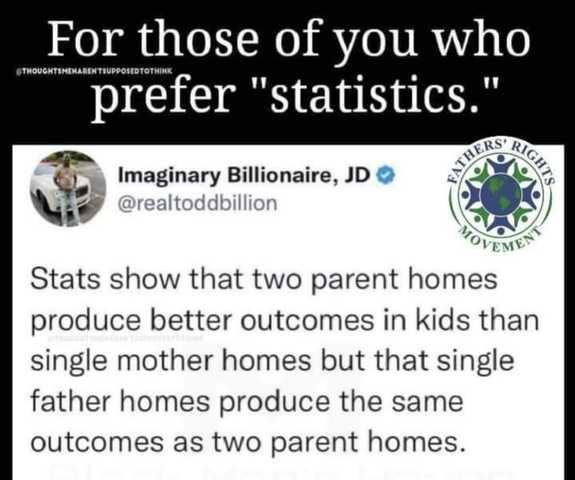
Someone posted this image in a debate group:


"For those of you who prefer "statistics."
Imaginary Billionaire, JD @realtoddbillion: "Stats show that two parent homes produce better outcomes in kids than single mother homes but that single father homes produce the same outcomes as two parent homes."
(the original tweet has since been deleted)

I said that the literature did not support this claim and he challenged me to "prove it" (ironically, the tweet did not cite any statistics)

Naturally, he kept quiet after I posted some sources, the more extensive of which was:

Single‐Father Families: A Review of the Literature - Coles - 2015 - Journal of Family Theory & Review

"As is often the case, the first studies in the 1970s and 1980s were understandably small (16–80 respondents), qualitative, and exploratory, and they were chiefly descriptive and atheoretical. They also largely focused on White, divorced (occasionally widowed), single fathers, who accounted for the majority of single dads in those years. If they included fathers of color, the analysis still often did not address race (this is still largely true today)...

The few studies of this period that included a comparison group of single mothers similarly concluded that single-father respondents were doing pretty well—in fact, similar to (DeFrain & Eirick, 1981) or better than (Ambert, 1982) many single mothers...

Since then, the field has been increasingly dominated by quantitative studies using national, more representative data sets...

In her 1987 study of 55 single fathers, 73 single mothers, and 155 married couples, Risman measured role priority, household tasks, child self-disclosure, physical affection, and parent-child intimacy. Single mothers and fathers were similar on most measures, but single mothers reported more physical affection and intimacy with their children than did single fathers...

Hawkins et al. (2006) analyzed adolescent reports... single fathers were no more involved overall than nonresident mothers, and unpartnered single mothers rated higher on involvement than single dads on all 10 measures...

Single fathers are less close to and less involved with their children’s friends and school, and monitor and supervise their children less than single mothers do...

Single custodial-father families with a coresident partner had the lowest levels of family routines; adolescents in such families are least likely to participate in regular family activities such as eating dinner together. Single-father households with a partner also exhibited lower levels of closeness and awareness of their children’s friends and activities than all other parent types, which may lower social capital for the child...

Using data from the 1982 NSFG, McLanahan and Bumpass (1988) found no differences in the likelihood of teen marriage, teen birth, premarital birth, or marital disruption between youths in single-mother households and youths in single-father households. Adult children from both single-father and single-mother households had equivalently higher rates of these outcomes than those in two-parent households.

Most more recent studies have concentrated on adolescent respondents and have distinguished between internalizing behaviors (e.g., depression, anxiety, low self-esteem) and externalizing behaviors (e.g., antisocial or violent behavior) and substance use. Current evidence from these studies indicates that for internalizing behaviors (Buchanan et al., 1996; Downey et al., 1998) and academic performance (Downey, 1994; McLanahan & Sandefur, 1997; Mulkey, Crain, & Harrington, 1992), outcomes for children from single-father and single-mother households are similar. Again these conclusions support a microstructural approach.

However, turning the lens to externalizing behavior (e.g., antisocial and violent behavior) and substance use (e.g., cigarette smoking, alcohol, drugs), parental gender effects become more salient, with children of single fathers consistently showing higher levels of both (Buchanan et al., 1996; Cookston, 1999; Demuth & Brown, 2004; Downey & Powell, 1993: Hoffmann & Johnson, 1998) over children of single mothers. (Although this review is of US studies, I note that Breivik and Olweus’s (2006) study of Norwegian single fathers came to the same conclusions.)

For instance, Eitle’s own findings from the 2006 study using data from the Florida Youth Substance Abuse Survey, an annual survey of middle and high school students, found that living with a single father increased the risk of alcohol use among boys and girls, the risk of delinquent behavior among daughters, and the risk of marijuana use among Latino students (the study included Whites and African Americans as well). Parental gender didn’t matter for other illicit drug use. The inconsistent nature of the findings led Eitle (2006) to conclude that both the microstructural and the maternal hypotheses were somewhat supported, but not the paternal hypothesis.

Hoffmann and Johnson (1998) focused on drug use among adolescents ages 12–17, using 3 years of NHSDA data. They compared family structures that included two parents, single parents, and stepparents, and they concluded that the risk of drug use, including problem use, was greatest for adolescents in single-father households (see also Cooksey & Fondell, 1996). Similarly, Cookston (1999) used 1995 NLSAH data (adolescent reports) to measure involvement (parental supervision) and outcomes. He found that alcohol and drug behaviors, as well as delinquency rates, were highest in single-father homes. Using the same data, Demuth and Brown (2004) likewise found that family process scores (measures of closeness, supervision, and monitoring) were consistently higher in single-mother families, and this was reflected in lower delinquency rates among children of single mothers versus those of single fathers. However, once they controlled for family process variables—that is, once they compared single mothers and fathers with similar levels of closeness, attachment, supervision, and monitoring—they concluded that gender was of no importance.

One of the few exceptions was a study conducted by Downey, Ainsworth-Darnell, and Dufur (1998)...

Related to outcomes and within-group variation, Buchanan et al.’s (1996) Stanford Custody Project found that having a cohabiting partner in the household, which as stated earlier is more common among single fathers than single mothers, was associated with higher levels of virtually every problematic outcome they measured: poorer conflict resolution skills, substance use, school deviance, anti-social behavior, and lower grades and effort at school. Not surprisingly, the authors concluded that the association between having an unmarried partner in the household and poor adjustment, especially for boys, was strong and consistent.

Several studies related to outcomes for children have gone one step further than asking whether children are better off with single fathers or single mothers; rather, they have asked whether the consequences for children’s outcomes are a result of an interaction between the gender of the parent and of the child. For the most part, these studies ask whether children will fare better when they are raised by a parent of the same sex. Remember that single fathers tend to raise more sons than daughters, which can be attributed to both a greater propensity of fathers to seek custody of their sons and to mothers’ and courts’ willingness to grant those requests, in part because the parties assume that fathers will be more effective parents for sons than for daughters. Underlying this is Freud’s classic psychoanalytic theory, which emphasizes the importance of a child’s ability to identify with the same-sex parent as a prerequisite for his or her healthy emotional development (Downey & Powell, 1993). Similarly, social learning theory stresses the importance of the child modeling the behavior of the parent more similar to her- or himself, as well as the reinforcement received from others for doing so (Bussey & Bandura, 1984). In addition, others have suggested that parents may better understand the needs of their same-sex children (Thompson, 1983), or researchers have highlighted concerns that custodial heterosexual parents may seek emotional fulfillment from their opposite-sex children in the absence of an adult partner (Weiss, 1979).

Among the first studies to support the same-sex theory was the Texas Custody Research Project (Santrock & Warshak, 1979)...

However, subsequent studies have not reached the same conclusions...

Using a sample of 187 children from 160 divorced families in Southern California, with roughly equal numbers of children in same-sex and opposite-sex custodial arrangements, Clarke-Stewart and Hayward (1996) tested the maternal versus paternal theory, hypothesizing that children would do better in the custody of their same-sex parent. Although they found that children were generally emotionally better off in father custody, none of the interactions by gender matching of child and parent was significant for any measure of psychological well-being (e.g., divorce adjustment, self-esteem, depression, anxiety). (A 1998 study in Israel by Guttman and Lazar came to similar conclusions...

With a few possible exceptions, the children of single fathers do about as well in terms of internalizing behavior and academic performance (sometimes better), which again provides support for microstructural theories. However, the children of single fathers appear to be more likely to participate in externalizing behavior and substance use (do not confuse with “abuse”), perhaps a reflection of the already-mentioned style differences, which indicates that resources play a lesser role than parental processes in these outcomes and provides some support for maternal theories. As of yet, the few studies of young adults (as opposed to adolescents) do not seem to indicate significant long-term differences, as related to marriage, teen birth, and divorce, between those reared in single-father versus single-mother homes (Downey & Powell, 1993; McLanahan & Bumpass, 1988)."

Also:

A Comparison of Children Living in Single-Mother and Single-Father Families: Journal of Divorce: Vol 12, No 2-3 - "The measures employed were The Self-Perception Profile for Children (SPPC; Harter, 1985) and The Child Behaviour Checklist (CBCL; Achenbach & Edelbrock, 1983). One-way MANCOVA and ANCOVA procedures were performed and it was found that the overall scores of children from single-father families (SFFs) did not differ significantly from children in single-mother families (SMFs) on the SPPC and the CBCL"

The School Performance of ChildreFor instance, Eitle’s own findings from the 2006 study using data from the Florida Youth Substance Abuse Survey, an annual survey of middle and high school students, found that liv- ing with a single father increased the risk of alcohol use among boys and girls, the risk of delinquent behavior among daughters, and the risk of marijuana use among Latino students (the study included Whites and African Americans as well). Parental gender didn’t matter for other illicit drug use. The inconsistent nature of the findings led Eitle (2006) to conclude that both the microstructural and the maternal hypotheses were somewhat supported, but not the paternal hypothesis.n From Single-Mother and Single-Father Families:: Economic or Interpersonal Deprivation? - DOUGLAS B. DOWNEY, 1994 - "Children from single-father and single-mother families perform roughly the same in school, but both are outperformed by children from two-parent families"

Reexamining the Effects of Family Structure on Children's Access to Care: The Single-Father Family - PMC - "Children who reside in single-father families exhibit poorer access to health care than children in other family structures"

A National Portrait of Family Structure and Adolescent Drug Use on JSTOR - "Hoffmann and Johnson (1998) focused on drug use among adolescents ages 12-17, using 3 years of NHSDA data. They compared family structures that included two parents, single parents, and stepparents, and they concluded that the risk of drug use, including problem use, was greatest for adolescents in single-father households (see also Cooksey & Fondell, 1996). Similarly, Cookston (1999) used 1995 NLSAH data (adolescent reports) to measure involvement (parental supervision) and outcomes. He found that alcohol and drug behaviors, as well as delinquency rates, were highest in single-father homes. Using the same data, Demuth and Brown (2004) likewise found that family process scores (measures of closeness, supervision, were consistently higher in single-mother families, and this was reflected in lower delinquency rates among children of single mothers versus those of single fathers."

American Single Father Homes: A Growing Public Health Priority - PMC - "Compared with other family heads (e.g., single mothers, married couples, or cohabiting caregivers), single fathers tend to utilize health and behavioral health services for their children at lower rates. Children of single fathers have the lowest percentage (59%) of annual well-child visits to a consistent pediatrician compared with children of other family heads (e.g., 72% for married couples, 71% for single mothers, and 69% for cohabitating families) and are less likely to adhere to medical advice"

Related: Balderdash: Single Fathers vs Single Mothers

Friday, March 08, 2024

Links - 8th March 2024 (1 - Parenting)

Meme - Gay Army: "Leah McDermott, M.Ed I Your Natu... @therealleahmcd: "Your child doesn't owe you anything.
Not good grades.
Not good moods.
Not nights without waking up.
Not eating every bite.
Not loving every activity.
Not "yes."
Your child doesn't owe you anything just because you're an adult.
Sit with this for as long as you need."
Daniel Vincent: "Coming from the demographic that demands everyone accept them, when they can't accept themselves"
Seamus McGilleycutty: "This is the type of thinking you get from a generation raised on participation trophies and friends instead of parents. My children absolutely owe me all of that and more. I will not be raising anything but successful and independent adults. If there is an issue with that, there will be consequences. And after you are 18? You can do whatever you want, you aren't my problem anymore"
Eddie Callow: "No, they don't owe it to me. Correct. They owe it to themselves. And as a parent I'm going to make sure that happens."
Jessica Austin: "Teaching responsibilities, morals, and work ethic is definitely needed. Clearly your parents never taught you that."
Left wing parenting is a great recipe to raise successful and happy children!

Opinion | What’s Ripping American Families Apart? - The New York Times - "At least 27 percent of Americans are estranged from a member of their own family, and research suggests about 40 percent of Americans have experienced estrangement at some point.  The most common form of estrangement is between adult children and one or both parents — a cut usually initiated by the child. A study published in 2010 found that parents in the U.S. are about twice as likely to be in a contentious relationship with their adult children as parents in Israel, Germany, England and Spain. The Cornell sociologist Karl Pillemer, author of “Fault Lines: Fractured Families and How to Mend Them,” writes that the children in these cases often cite harsh parenting, parental favoritism, divorce and poor and increasingly hostile communication often culminating in a volcanic event... The parents in these cases are often completely bewildered by the accusations. They often remember a totally different childhood home and accuse their children of rewriting what happened. As one cutoff couple told the psychologist Joshua Coleman: “Emotional abuse? We gave our child everything. We read every parenting book under the sun, took her on wonderful vacations, went to all of her sporting events.”  Part of the misunderstanding derives from the truth that we all construct our own realities, but part of the problem, as Nick Haslam of the University of Melbourne has suggested, is there seems to be a generational shift in what constitutes abuse. Practices that seemed like normal parenting to one generation are conceptualized as abusive, overbearing and traumatizing to another... “My recent research — and my clinical work over the past four decades — has shown me that you can be a conscientious parent and your kid may still want nothing to do with you when they’re older.” Either way, there’s a lot of agony for all concerned. The children feel they have to live with the legacy of an abusive childhood. The parents feel rejected by the person they love most in the world, their own child, and they are powerless to do anything about it. There’s anger, grief and depression on all sides — painful holidays and birthdays — plus, the next generation often grows up without knowing their grandparents.  No one even thought to measure family estrangement until relatively recently. Coleman, the author of “Rules of Estrangement,” argues that a more individualistic culture has meant that the function of family has changed. Once it was seen as a bond of mutual duty and obligation, and now it is often seen as a launchpad for personal fulfillment. There’s more permission to cut off people who seem toxic in your life... The meritocracy and high-pressure parenting are also implicated here. Parents, especially among the upper-educated set, are investing more time and effort in their kids. A 2012 survey from the Institute for Advanced Studies in Culture found that almost three-quarters of parents of school-age kids said they eventually want to become their children’s best friend.  Some kids seem to think they need to cut off their parents just to have their own life. “My mom is really needy and I just don’t need that in my life,” one Ivy League grad told Coleman. In other cases, children may be blaming their parents for the fact that they are not succeeding as they had hoped — it’s Mom and Dad who screwed me up. I write about this phenomenon here because it feels like a piece of what seems to be the psychological unraveling of America, which has become an emerging theme of this column. Terrible trends are everywhere. Major depression rates among youths aged 12 to 17 rose by almost 63 percent between 2013 and 2016. American suicide rates increased by 33 percent between 1999 and 2019. The percentage of Americans who say they have no close friends has quadrupled since 1990, according to the Survey Center on American Life. Fifty-four percent of Americans report sometimes or always feeling that no one knows them well, according to a 2018 Ipsos survey.  I confess, I don’t understand what’s causing this. But social pain and vulnerability are affecting everything: our families, schools, politics and even our sports. A friend notes that politics has begun to feel like an arena where many people can process and regulate their emotional turmoil indirectly. Anxiety, depression and anger are hard to deal with within the tangled intimacy of family life. But political tribalism becomes a mechanism with which people can shore themselves up, vanquish shame, fight for righteousness and find a sense of belonging. People who feel betrayed will lash out at someone if there is no one there to help them process their underlying hurt. As the Franciscan friar Richard Rohr wisely wrote, if we do not transform our pain, we will most assuredly transmit it."

My 15-year-old daughter wants to have a sleepover with her boyfriend - "A British mother has sparked debate after revealing her concerns about her 15-year-old daughter wanting to sleep at her boyfriend's house... The mother then said that she said no to the sleep over, because she feels that 'they're still too young', leaving her daughter 'very annoyed.'  However after she confessed she was wavering on the decision, other parents were quick to comment, with one suggesting the ban could 'drive a wedge' between them... One parent commented: 'You have to set boundaries for your 15-year-old daughter. Stand firm.   'I don't understand why you're wavering honestly.   'Your daughter is trying to manipulate you, which is normal, but you need to be the parent here, not her mate.'... A third said: 'If they are merely sleeping then why is there a need for her to stay over. It isn't too far to collect her so collect her after the party.   'No you can't stop teens having sex but you can stop facilitating it especially for one under the age of consent, no matter how mature they think they are.'   One user warned: 'I had a sleepover at my boyfriend's (16) when I was 15.   'Separate rooms. He sneaked in when everyone was asleep and yes, we had sex.   'If you agree to this, know that your daughter will almost certainly be having sex.'"

Kids Are Master Manipulators. So Use Game Theory Against Them - "Force Cooperation. For siblings who refuse to work together, Zollman recommends a version of the prisoner’s dilemma...
Make Them Pay... have kids bid with chores or their allowance. If one of them wants to name the cat Macaroni & Cheese, he’ll have to pay for it.
Threaten Them—for Real. Screaming “Don’t make me turn this car around!” never works. That’s what Zollman calls a noncredible threat—kids see through it, because they know it means you’ll suffer too. So pick punishments that benefit you. Like: “Stop punching your sister or we’re going to Grandma’s instead of the movies.”
Make Them Lie. If you suspect your kids haven’t done their homework, nail them with specific questions: Which subject? What did you learn? How long did it take? Hardest part? Even if they manage convincing answers, the act of sustaining an elaborate lie exerts psychological discomfort. Eventually they’ll figure out that being honest is just easier. Don’t Bail Them Out. To make all these lessons stick, you have to buckle down. If your kid’s in a bit of trouble and sobbing pitifully, resist the urge to swoop in and save her by remembering something economists call moral hazard. Corporate bailouts incentivize bad behavior—avoid this fate by establishing clear rules and meting out punishment when necessary."
Clearly if you do any of this, you're a toxic parent who deserves to be ignored by your kid and die in a nursing home

This Person Says if You're a Parent and Your Adult Children Don't Speak to You, It's YOUR Fault - "Dear Parents Whose Adult Children Don’t Talk To Them – It’s Always Your Fault. You were the adult when they were a child. If their first instinct, as soon as they get out from under your thumb, is to completely ignore you forever, you need to own the fact that you messed up as a parent at several, consistent, points along the road throughout your child’s upbringing. They hate you for a good reason, and they’re probably better off without you in their lives. There are a number of forms of abuse that range from over-parenting, to neglect, over-discipline to straight up negative enabling behavior. I have friends who don’t talk to their parents because the strictness was so suffocating, and friends who don’t talk to their parents because they were lazy bums who never took an interest in their child’s life. There are tons of other reasons kids abandon relationships with their folks, but the one thing that stays true through all of these experiences for me is that it’s always the parents fault. This is mostly about relationships that end as soon as the kid leaves the house, not necessarily relationships that break down during adulthood, although the same reasoning could be applied in a lot of these cases too."
"Minorities"aren't the only ones with no agency - adult children are innocent and helpless too. No wonder the birth rate is falling

Meme - Gay Army: "Your child doesn't owe you anything. Not good grades. Not good moods. Not nights without waking up. Not eating every bite. Not loving every activity. Not "yes." Your child doesn't owe you anything just because you're an adult. Sit with this for as long as you need."
Daniel Vincent: "Coming from the demographic that demands everyone accept them, when they can't accept themselves"
Seamus McGilleycutty: "This is the type of thinking you get from a generation raised on participation trophies and friends instead of parents. My children absolutely owe me all of that and more. I will not be raising anything but successful and independent adults. If there is an issue with that, there will be consequences. And after you are 18? You can do whatever you want, you aren't my problem anymore"
Eddie Callow: "No, they don't owe it to me. Correct. They owe it to themselves. And as a parent I'm going to make sure that happens."
Jessica Austin: "Teaching responsibilities, morals, and work ethic is definitely needed. Clearly your parents never taught you that."

Am I a Bad Parent? - The Atlantic - "My 32-year-old daughter has developed the idea that I am responsible for all her failures—not having the job she wanted, not being a sociable person, not being capable to love and to be loved.  She also feels that I should not have continued a relationship with her father, even after a divorce. She believes that he is the one who turned our lives into a mess and that I agreed to it—being too weak to fight this. Her father died a few years ago, but she still hates him and me for all her troubles."

Parents are responsible for everything bad that happens in children's lives, and those who disagree are bad, toxic parents who deserve to die alone

Any humanity left in this city? Elderly man dead on sidewalk and people just walking past. : askTO - "True story, my father in law was attacked while babysitting my kid. My kid threw a temper tantrum when told they had to leave and denied knowing FIL. Some guy took a swing at FIL with a bat.  (Kiddo listened to many a lecture about how bad the situation was, and how they made the park less safe for kids who were actually in trouble. Along with about two months of lectures prompted by "Well I would take you to the park. But last time you lied to some strangers and almost got grandpa hurt so I don't feel like taking you is safe for either of us.")"

Believe children. If you don't, you're a gaslighter and an abuser

A Conduct Disorder Support Group for Parents - The Atlantic - "Parenting a child with conduct disorder is the loneliest thing I know.  Conduct disorder (CD) is a diagnosis given to children who have an ongoing pattern of troubling antisocial behavior. The definitions are all very wordy—but the simple version is that a child who gets this diagnosis might grow up to be a psychopath.  When my son got his diagnosis, I wasn’t surprised. He started physically hurting me when his age was measured in months, rather than years. Consequences did not deter him. For years I told friends, doctors, teachers, my own parents that I thought there was something wrong with him. No one listened. Parents at the park started avoiding us. My son was never invited to parties or included in fun activities. Not that I blame them—he was constantly harming other children. But American culture rarely blames the child who is acting out; it blames the child’s parents. Too often, I heard, “If it was my child I would never let them get away with this.” Eventually I stopped trying to connect with other parents. They say it takes a village to raise a child, but what do you do when the village shuns you?... In order to form a support group, someone would have to put their name on it. And no one wants to come forward as the parent of a psychopath... A lot of research is being done on CD, but there is little in the way of actual help. So, for the time being, we are sisters and brothers in an impossibly miserable parenting situation. Our children are often violent toward us or to their siblings. Most of them lack any meaningful amount of empathy, and regularly try to manipulate us. Pretty much every parenting strategy we try with our children fails. Often, the most we can do is offer each other virtual hugs and an “I’ve been there.” But that’s not nothing. Because the biggest thing we have in common is how alone we were before we found each other."
Damn toxic parent!

Here are 13 Other Explanations For The Adolescent Mental Health Crisis. None of Them Work. - "Alternative #1: “People are now more willing to seek help, so there’s not really an increase in depression”
Alternative #2: “More teens are OK with saying they are not OK”
Alternative #3: “It’s because of the COVID-19 pandemic and lockdowns”
Alternative #4: “It’s the economy, stupid”
Alternative #5: “Social media’s impact is too small to have caused the rise in depression”
Alternative #6: “It’s because children and teens have less independence”
Alternative #7: “It’s because of school shootings”
Alternative #8: “It’s because of climate change” (and its twin “It’s because we live in a postmodern hellscape”)
Alternative #9: “It’s due to increased academic pressure and too much homework”... By U.S. teens’ own reports, they actually spend less time on homework now than teens did in the 1990s
Alternative #10: “Suicide rates were higher in the 1990s when there was no social media, so this is just part of a cycle”
Alternative #11: “It’s because teens don’t have places to hang out anymore”
Alternative #12: “It’s because of the opioid epidemic”
Alternative #13: “Parents are more depressed and troubled”"
Why parents aren't to blame for the rise in teen depression

Jonathan Haidt on X - "Here is a 14th explanation for the teen mental health crisis which does not work: parents are increasingly abusive since 2010 (they are not).   Nobody has yet proposed an explanation for the crisis that works--especially internationally-- other than the rapid teen transition from flip phones to smart phones around 2012. This also explains why academic achievement stopped rising around 2012 and started declining, as shown in both NAEP and PISA scores. Students with smartphones pay less attention to teachers, and to fellow students... Note that teen "satisfaction with life" used to track satisfaction with relationship with parents. Until they moved onto smart phones. Can't we at least get phones out of the school day?"
Musa al-Gharbi on X - "I'll say, this chart also seems to remind me of your argument in Coddling though. As young people seek independence, make their own mistakes, etc. I think there should be natural tensions with parents. That there seems to be so little tension today in polling may not be positive"
If your parents regulate your phone use they are toxic and abusive and you need to disown them

Longitudinal Associations Between Parenting and Child Big Five Personality Traits - "The goal of this research was to explore the relationships between four parenting dimensions (academic involvement, structure, cultural stimulation, and goals) and child personality development. Many theories, such as social learning, attachment theory, and the psychological resources principle assume that parenting practices influence child personality development. Most of past research on the associations between parenting and child Big Five traits specifically has used cross-sectional data. The few longitudinal studies that examined these associations found small relations between parenting and child personality. We extended this research by examining the long-term relations between four underexplored parenting dimensions and child Big Five personality traits using bivariate latent growth models in a large longitudinal dataset (N = 3,880). Results from growth models revealed a preponderance of null relations between these parenting measures and child personality, especially between changes in parenting and changes in child personality. In general, the observed associations between parenting and child Big Five personality were comparable in magnitude to the association between factors such as SES and birth order, and child personality—that is, small. The small associations between environmental factors and personality suggest that personality development in childhood and adolescence may be driven by multiple factors, each of which makes a small contribution."

Clearly, parenting is very important and we can blame parents for screwing up their children through bad upbringing

Parents: Don't focus on happiness, help build resilience instead - "“My kids should be happier than they are,” a mother tells me. “They have everything they could ever need and still, all this small stuff bothers them.” “My daughter worries so much about such big things — homelessness, death, inequity around her . . . and she’s only seven!” a father says in my office. “I always tell her, ‘Stop worrying! Let’s think about all the good things in your life!’ but still, she’s up at night, unable to fall asleep.” “I was a pretty lonely, depressed child,” a mother admits to me. “I want to be a different parent to my kids than my parents were for me. My partner gets annoyed with me, because he says I’m always rescuing our kids and making their lives too easy. Is that so bad? Don’t you want your kids to be happy, Dr. Becky?”... What actually leads to happiness? Does eradicating our kids’ worry and loneliness and ensuring they feel good at all times enable them to cultivate happiness on their own? What do we really mean when we say, “I just want my kids to be happy”? What are we talking about when we say, “Cheer up!” or “You have so much to be happy about!” or “Why can’t you just be happy?” I, for one, don’t think we’re talking about cultivating happiness as much as we’re talking about avoiding fear and distress. Because when we focus on happiness, we ignore all the other emotions that will inevitably come up throughout our kids’ lives, which means we aren’t teaching them how to cope with those emotions. And, again, how we teach our kids—through our interactions with them — to relate to pain or hardship will impact how they think about themselves and their troubles for decades to come. I don’t know a single parent who doesn’t want the best for their kids. Count me in: I want the best for my kids! And yet, I’m not sure that “the best” for them is to “just be happy.” For me, happiness is much less compelling than resilience. After all, cultivating happiness is dependent on regulating distress. We have to feel safe before we can feel happy. Why do we have to learn to regulate the tough stuff first? Why can’t happiness just “win” and “beat” all other emotions? That certainly would be easier! Unfortunately, in parenting, just like in life, the things that matter most take hard work and time; helping your child build resilience certainly isn’t easy, but I promise it’s worth it. Picture your body as a large jar. Floating around are all the different emotions you could possibly feel. For simplicity’s sake, let’s say there are two major categories of emotions: ones that feel upsetting and ones that feel “happier.” In our emotion jar, we have every single feeling under the sun. The size of each emotion — and therefore the space it takes up in the jar at any given moment — is constantly changing. Now, remember: our bodies have an innate alarm system and are constantly scanning for danger before anything else. When we aren’t able to cope with emotions like disappointment, frustration, envy, and sadness — when they take up all the space in the emotion jar — our bodies initiate a stress response. And it’s not just the difficult feelings themselves that prompt our bodies to feel unsafe. We also feel distress over having distress, or experience fear of fear. In other words (assuming there’s no actual physical threat, but simply the “threat” of uncomfortable, overwhelming emotions), as we start thinking, “Ah! I need to make this feeling go away right now,” the distress grows and grows, not as a reaction to the original experience, but because we believe these negative emotions are wrong, bad, scary, or too much. Ultimately, this is how anxiety takes hold within a person. Anxiety is the intolerance of discomfort. It’s the experience of not wanting to be in your body, the idea that you should be feeling differently in that specific moment. And this isn’t a product of “being a downer” or “seeing the glass as half-empty”; it’s a product of evolution. Our bodies will not allow us to “relax” if we believe the feelings inside us are overpowering and frightening. So, where’s the happiness here? Well, it’s crowded out. It cannot surface. Of course, it doesn’t have to be this way. The wider the range of feelings we can regulate—if we can manage the frustration, disappointment, envy, and sadness — the more space we have to cultivate happiness. Regulating our emotions essentially develops a cushion around those feelings, softening them and preventing them from consuming the entire jar. Regulation first, happiness second. And this translates into our parenting: the wider the range of feelings we can name and tolerate in our kids (again, this doesn’t mean behaviors), the wider the range of feelings they will be able to manage safely, affording them an increased ability to feel at home with themselves. Do I want my kids to experience happiness? Without a doubt, yes. I want them to feel happiness as kids and as adults; this is why I’m so focused on building resilience. Resilience, in many ways, is our ability to experience a wide range of emotions and still feel like ourselves. Resilience helps us bounce back from the stress, failure, mistakes, and adversity in our lives. Resilience allows for the emergence of happiness. Developing resilience doesn’t mean we become immune to stress or struggle — these are, of course, unavoidable facts of life — but our resilience determines how we relate to those difficult moments as well as how we experience them. People who are resilient are better able to cope when stressful moments arise. Here’s a helpful (though slightly oversimplified) equation: stress + coping = internal experience. The good news? Resilience is not a static character trait that children possess or lack; it’s a skill that can be cultivated, and one that, hopefully, parents help instill in their kids from a young age. Because we can’t always change the stressors around us, but we can always work on our ability to access resilience. Tags books emotional intelligence mindfulness psychology... For me, happiness is much less compelling than resilience. After all, cultivating happiness is dependent on regulating distress. We have to feel safe before we can feel happy... we believe these negative emotions are wrong, bad, scary, or too much. Ultimately, this is how anxiety takes hold within a person. Anxiety is the intolerance of discomfort"

Related Posts Plugin for WordPress, Blogger...

Latest posts (which you might not see on this page)

powered by Blogger | WordPress by Newwpthemes