L'origine de Bert

Get email updates of new posts:        (Delivered by FeedBurner)

Showing posts with label english. Show all posts

Tuesday, October 15, 2024

Translation Hijinks

vickyv — whatshouldwecallhomer: throwforharry:...

"for chinese new year they get all these famous actors and comedians together and they do a lil show and one of the comedians was like “i was in a hotel in america once and there was a mouse in my room so i called reception except i forgot the english word for mouse so instead i said ‘you know tom and jerry? jerry is here’"

"my chinese teacher once shared this story in class about someone who went to the grocery to buy chicken, but they forgot the english word for it, so they grabbed an egg, went to the nearest sales lady and said “where’s the mother”"


"When I was a teenager, we went to Italy for the summer holidays. We are German, neither of us speaks more than a few words of Italian. That didn’t keep my family from always referring to me when they wanted something translated because “You’re so good with languages and you took Latin”. (I told them a hundred times I couldn’t order ice cream in Latin, they ignored that.) Anyway, my dad really loved a certain cheese there, made from sheep’s milk. He knew the Italian word for ‘cheese’ – formaggio – and he knew how to say ‘please’. And he had already spotted a little shop that sold the cheese. He asked me what ‘sheep’ was in Italian, and of course, I had no idea. So he just shrugged and said “I’ll manage” and went into the shop. 5 mins later, he comes out with a little bag, obviously very pleased with himself.
How did he manage it? He had gone in and said “'Baaaah’ formaggio, prego.”

I was done for the day."


"I once lost my husband in the ruins of a French castle on a mountain, and trotted around looking for him in increasing desperation. “Have you seen my husband?” I asked some French people, having forgotten all descriptive words. “He is small, and English. His hair is the color of bread.”

I did not find my husband in this way.

In rural France it is apparently Known that one brings one’s own shopping bags to the grocery store. I was a visitor and had not been briefed and had no shopping bag. I saw that other people were able to conduct negotiations to purchase shopping bags, but I could not remember the word for “bag.”

“Can I have a box that is not a box,” I said.

The checkout lady looked extremely tired and said, “Un sac?” (A sack?)

Of course. A fucking sack. And so I did get a sack."


"I once was at a German-American Church youth camp for two weeks and predictably, we spoke a whole lot of English. 

When I phoned my mom during week two I tried to tell her that it was a bit cold in the sleeping bag at night. I stumbled around the word in German because for the love of god, I could remember the Germwn word for sleeping bag.

“Yeah so, it’s like a bag you sleep in at night?”

“And my mother must probably have thought I lost my mind. She just sighed and was like ‘So, a Schlafsack, yes?”

Which is LITERALLY Sleeping sac … The German word is a basically a one on one translation of the English word and I just… I failed it. At my mother tongue. BIG"


"My former boss is Italian and she ended up working in a lab where the common language was English. She once saw an insect running through the lab and she went to tell her colleagues. She remembered it was the name of a famous English band so she barged in the office yelling there was a rolling stone in the lab…" 


"I’m Spanish and have been living in the UK for a while now. I recently changed jobs and moved to a new office which is lost somewhere in the Midlands’ countryside. It’s a pretty quaint location, surrounded by forest on pretty much all sides, and with nice grounds… full of pheasants. I was pretty shocked when I drove in and saw a fucking pheasant strolling across the road. Calm as you please.

That afternoon I met up with some friends and was talking about the new job, and the new office, and for the life of me I couldn’t remember the English word for pheasants. So I basically ended up bragging to my friends about “the very fancy chickens” we had outside the office.

Best thing is, everyone understood what I meant."


"Picture a Jewish American girl whose grasp of the Hebrew language comes from 10+ years of immersion in Biblical and liturgical Hebrew, not the modern language. Some words are identical, while others have significantly evolved.

She gets to Israel and is riding a bus for the very first time.

American: כמה ממון זה? (”How much money?” but in rather archaic language)

Bus Driver: שתי זוזים. (”Two zuzim” – a currency that’s been out of circulation for millenia)"


"Does everyone know the prime minister who promised to fuck the country?

So in Biblical Hebrew the word for penis and weapon are the same. There is a verb meaning to arm, which modern Hebrew semanticly drifted into “fuck”: i.e. give someone your dick.

The minister was making a speech while a candidate, bemoning the state of the world. “The Soviet Union is fucking Egypt. Germany is fucking Syria. The Americans are fucking everyone. But who is fucking us? When I am prime minister, I will ensure we are fucked!”"


"Just guessing: The path from something like “give someone a blade” to “give someone a blade, if you know what I mean ;)” is probably not that difficult or unlikely."

"^Given that the Latin word for sheath (like, for a sword) is literally “vagina”, I can verify that this metaphor is a time-honored one."


"Oh yeah and one time my Latin professor was at this conference in Greece and his flight was canceled, so he needed to extend his hotel stay by one more night.

Except he doesn’t speak a lick of modern Greek, and the receptionist couldn’t speak English.  Or French.  Or German.  Or Italian.  (He tried all of them.)

Finally, in a fit of inspiration, he went upstairs and got his copy of Medea in the original Greek (you know, the stuff separated from modern Greek by two and a half thousand years).  He found the passage where Medea begs Jason to let her stay for one more day, went downstairs, and read it to the receptionist.

She laughed her head off, but she gave him the extra night."


"s/o to my classics professor who managed to get a tire changed on his rental car while doing research in Greece by telling them his chariot had broken down"

Sunday, September 08, 2024

Donald Trump vs Kamala Harris Communication Levels

I saw this meme:


"Linguistics show he communicates at a 5th grade level. With a73 IQ

THE LATEST WORD SALAD FROM THE STABLE GENIUS:

"Google, nobody called from Google. One of the things like doing a show like yours, your show, you know, you see it on Fox, but when you really see it is all over the place, they take clips of your show that you're doing right now with me and if I do a good job, they're gonna vote for me, they're gonna vote for me because it's not just on Fox, it's on Fox is a smaller part of it. You're on all over this, those little beautiful cell phones you're on, you're all over the place. You have a product, you have a great product. You have a great brand. So you have to get out, you have to get out, you have to do things like your show and other shows and Google has been very bad. They've been very irresponsible and I have a feeling that Google is gonna be close to shut down"
- Donald Trump, Fox News, August 1, 2024
DEMENTIA DON NEEDS TO DROP OUT!"

This claim didn't pass the smell test, not least since I was unaware of methods to estimate IQ from a text, but I decided to investigate.

Since the meme mentioned grade level, a common way of telling the level of complexity of a text, the Flesch-Kincaid Grade Level (Microsoft Word churns this metric too), came to mind. This looks at the "average sentence length amd word complexity".

Now, just because a text is harder to read does not mean that it is superior (or that the person who produces it is superior). Indeed, often the contrary holds: as George Orwell said, "Never use a long word where a short one will do." Purple prose would score as complex on Flesch-Kincaid Grade Level, but is not something that good writers should strive for (pretentious ones or ones who want people to think they're smart, on the other hand...)

Be that as it may, I will just take the meme at face value.

So I ran the quote from Trump in the meme through the Readability Scoring System's Flesch-Kincaid Grade Level. I got a score of 8.44, which has a Reading Difficulty of Average - Slightly Difficult, and a Grade Level of Eighth Grade (for Ages 13-14).

This is quite different from what the meme claims, but since it is calling on Trump to drop out, I decided to look at Trump's rival in this election, Kamala Harris.

I had to look for a similar length of text to Trump's 157 word quote for a fair-ish comparison, so I found a 141 word quote from Kamala Harris - her talking about inflation in 2021:

REMARKS BY VICE PRESIDENT HARRIS IN PRESS CONFERENCE | The White House

"All right, thank you. Well, let’s start with this: Prices have gone up. And families and individuals are dealing with the realities of — that bread costs more, that gas costs more. And we have to understand what that means. That’s about the cost of living going up. That’s about having to stress and stretch limited resources. That’s about a source of stress for families that is not only economic but is, on a daily level, something that is a heavy weight to carry. So, it is something that we take very seriously. Very seriously.

And we know from the history of this issue in the United States that when you see these prices go up, it has a direct impact on the quality of life for all people in our country. So it’s a big issue, and we take it seriously."

Using the same formula, I got a score of... 6.06, which has a Reading Difficulty of Fairly Easy, and a Grade Level of Sixth Grade (for Ages 11-12).

As a robustness check, I reran the formula including her next paragraph, which brought the extract to 177 words:

"And it is a priority, therefore. So we have addressed it in a number of ways. One of the issues that we know is related to this is the supply chain issue that we just discussed."

I now got a score of... 5.81, which has a Reading Difficulty of Fairly Easy, and a Grade Level of Sixth Grade (for Ages 11-12).

Clearly, Kackling Kamala needs to drop out!

While doing research for this blog post, I also found a site, Writing to IQ Estimator, that claims to estimate IQ based on "the quality of the vocabulary used".

This estimated Trump's IQ as 87 (average).

Meanwhile, it estimated Harris's IQ as... 77 (below average).
(for what it's worth, even the longer 177 word extract had "Not enough data or not enough variance to estimate IQ", so I had to add in: "And so, on a domestic level, in terms of domestic policy, one of the approaches we have taken is to work with labor unions and to work with municipalities in opening back up and extending the hours of our ports. There are actually three I have in mind: Los Angeles, Long Beach, and Savannah. And, in fact, part of the infrastructure bill benefit is, most recently, what we will do to assist Savannah in broadening their ability to be an active port", bringing the total to 260 words)

Ironic.

Wednesday, December 22, 2021

The importance of sentence structure

Business was terrible and not picking up.

I had to fire somebody, and I narrowed it down to one of two people, Debra or Jack.

It was an impossible decision because they were both super workers.

Rather than flip a coin, I decided I would fire the first one who used the water cooler the next morning.

Debra came in the next morning with a horrible hangover after partying all night. She went to the cooler to take an aspirin.

I approached her and said, "Debra, I’ve never done this before but I have to either lay you or Jack off.”

"Could you jack off for now?" she says. "I feel like shit. If you can wait, I'll do you at lunchtime." ......

I had to let Jack go.

Monday, September 27, 2021

On leftist language

Thread by @GPIngersoll on Thread Reader App – Thread Reader App

 "The assault on language in the name of “inclusivity” or sensitivity is really just about making language so imprecise that regular people can no longer speak truth.

Not a mistress, but a companion. Not a riot if it’s a mostly peaceful protest. Not illegal, just undocumented.
 
And if you want to get really down into the guts of the matter, please take notice that every mandated change in language is not only more muddled, but it takes LONGER to even say.

If the base outcome of the change is to obfuscate and belabor language, then it seems clear that the people enforcing the change find the subject to be either one of much personal discomfort or just plain inconvenient to their goals, usually the latter under the shrill guise of the former.

Don’t call them illegal aliens, you bigot, these words literally hurt me! 
 
The result, if you’re honest enough, is that not only does it take you longer to even be a part of the discourse, but you must use blunted words that quite often (dare I say almost always) carry a connotation that is more conducive to the goals of the people mandating the words!
 
It takes more energy to convey an idea and even if it’s dissenting, the implications are exactly what the acolytes desire anyhow!
 
How can we abhor adultery when to do so would be to be anti-companionship?

How can we possibly be concerned about something as benign “undocumented non-citizens”?

Why in the world would we condemn something that is MOSTLY PEACEFUL?
 
 
If Jake Tapper wakes up at 2 am and I’m sitting in his living room eating a rueben, am I there illegally? Or am I merely an undocumented building occupant?

The (absurd) argument is that people cannot be illegal. If you are trespassing, your state of being itself IS illegal.
 
Now some would argue that there’s a difference between privately owned property and public property. 
 
Except sovereignty is a thing, and in a democratic, free society, it is a thing in which all citizens share a stake. 
 
The worst part of all this linguistic bullshit is that there is heavy social cost to opting out. Back in Carlin’s time, if you didn’t adopt “differently abled,” it just went over like a fart at a dinner party.
 
Now, if you do not play by their rules, they attempt to destroy you. 
 
No longer are you briefly poo pooed. CNN traipses across your lawn to demand why your facebook page hosted Russian memes. Reporters bang on your door to ask why you gave $10 to Kyle Rittenhouse. They come to your homes and businesses, they shut you down and drive you out.
 
How can you be against adults administering “sex changes” to children when they’ve been repackaged as “gender affirmation medical care”?!

ARE YOU AGAINST GIVING TRANS KIDS MEDICAL CARE?!

The function is to toxify any form of dissent for issues that deserve serious scrutiny. 

And, let’s be honest, if we kept calling these things “sex changes” as we’ve literally always called them, there would be zero political will to make them legal for children. The goal of rendering language inert is to transfer control of outcomes to a small minority of people.
 
And, make no goddamn mistake, that small group of people — call it a politburo or a vanguard or whatever — does not share YOUR best interests. Their chief interest is power followed closely by how to hold on to it. Destroying language is a key element of that.
 
Finally, sadly, this movement has in large part become a kind of religion. That was a deliberate choice. As a secular preference, your dissent is just off putting. As a religious edict, your dissent is heresy.

The distinction allows for, encourages even, wholesale ruination.
 
The difference explains the righteous fervor and sense of duty and obligation that underwrites the pursuit and destruction of heretics.

We've seen this before in history.

The most dangerous humans have almost always been the ones who felt a false sense righteousness.
 
The sense of righteousness, in this case, springs not from something eternal, universally recognized in the human condition, like virtue.

It is almost entirely a manipulation, a ruse, a calculated concoction that doesn’t stand even the most minor inspection.
 
Which brings us back to square one, our primary means to inspect ideas: Open discourse, free thought, unfettered language.

These are enemies of the new religion and must be hemmed, blunted or destroyed. There is no other way to maintain an unpopular and brittle world view."
 
 
“By 2050, earlier, probably – all real knowledge of Oldspeak will have disappeared. The whole literature of the past will have been destroyed. Chaucer, Shakespeare, Milton, Byron – they’ll exist only in Newspeak versions, not merely changed into something different, but actually changed into something contradictory of what they used to be. Even the literature of the Party will change. Even the slogans will change. How could you have a slogan like ‘freedom is slavery’ when the concept of freedom has been abolished? The whole climate of thought will be different. In fact there will be no thought, as we understand it now. Orthodoxy means not thinking – not needing to think. Orthodoxy is unconsciousness”

--- 1984 / George Orwell

Saturday, June 13, 2020

Liberal slippage and gaslighting: defunding the police

A: You do realize that defund the police doesn't actually mean completely get rid of the police, right?

B: Maybe you should actually pay attention to what the council wants. Minneapolis police: City Council members announce intent to defund the police department - CNN

C: The Minneapolis BLM group that spoke with the mayor on video made it unmistakably clear that they meant abolish.

D: i think part of the issue is that words like “defund” and “dismantle” don’t inherently imply any kind of replacement.
But, as pointed out, there is a replacement function in this specific proposal.

B: could've gone with "let's build a new way to police!" or something like that..
I think that's a useful way to gaslight people. It's the same with the untenable slogans like "#BelieveAllWomen"

E: and maybe you should have the intelligence, savvy, and political wisdom enough to know that what the most radical members of the city council say they want in the heat of this moment and what will actually happen are two different things? The mayor is not on board with this and the city council is not moving forward with dismantling armed officers at this point. They have announced some ideologically charged and frankly utopian aspirations for the future. They have committed to working with the community to "reimagine" what a policing force will look like. I bet that in the final analysis the outcome will look something like Camden, New Jersey. Either way, armed officers able to respond to 911 calls and other criminal activity will not be disbanded. But why let measure, reason, and common sense guide us in a moment like this??

B: This is the councilwoman's tweet:

Lisa Bender on Twitter: "Yes. We are going to dismantle the Minneapolis Police Department and replace it with a transformative new model of public safety." / Twitter

A: yes and that doesn't mean get rid of policing entirely.

B: Ok so what you're saying is, dismantle doesn't mean dismantle. Got it

E: why don't you just come out and admit that you're working for the Trump misinformation services? Holy fuck.

F: You do realize...” is always what I hear from people getting ready to tell me what THEY don’t realize.” Smooth move, Sparky!

G: They said they wanted a private company to take over, let's see how long that last

H: Ilhan Omar also said on video that we must "completely dismantle the Minneapolis PD" but of course by 'completely dismantle' she meant 'maintain strong force of armed officers for 911 calls but also reallocate some resources to social workers and community services'.

E: you and *** both could be a clarifying voice of reason right now instead of just parroting right wing talking points. Even if you disagree with the defund the police platform (as I do, I'd rather reasonable reform, including serious restraints on qualified immunity) you could still be more responsible in actually providing facts and details about what the "defund the police" experiments are really about. Frankly, I think the phrase is a terrible one and a gift to Trump and the right wing. There might be some valuable ideas here, but as you say, it would be an experiment. But it is not a move to do away with an armed police force and a 911 response team to criminal activity.

and she really has power in the party. Good grief.

H: Lol first I was told that these radical leftists were fringe Twitter and college campus idiots. Then they graduated and got jobs in media and academia. Still fringe idiots. Now they're in Congress and city councils voting to dismantle police departments and suggesting that calling 911 in the middle of the night is "white privilege"... still fringe and 'no power' for E. And calling out this incremental delusion is "parroting right wing talking points". Give me a break.

I: Did you think the same of the Charlotesvile protestors when they said "Jews will not replace us?"

J: Going by how some people claim the "dismantling doesn't mean entirely getting rid of it" is a valid defense, then "not consenting to sex doesn't mean entirely not wanting sex" is also valid.

K: It's funny to watch all the post-modernist takes here... *But defund doesn't actually mean defund, it means this other thing*.

In this case we can be confident there is no linguistic obfuscation. These people tell us they want to disband the police as a first step, without even having a plan.

Utter madness.

L: it's pretty obvious the legal system will be moved to twitter.

D: I’ve had activists tell me defund means exactly that and I’ve had activists tell me that defund “actually” means a long list of things that include reform, partial reallocation, retraining, and other similar things.

B: They are exploiting the ambiguity of these terms.

D: [I] think the people who started “defund the police” meant precisely that. Stop giving them money. That’s what defund means. I suspect a bunch of people piled on, then realized the literal definition of defund wasn’t actually a good idea. So they back tracked and came up with these contortions for what defund “actually” means. Because if they stop using the phrase they’ll be labeled unsupportive and thrown off woke island.

B: I mean if they mean reform then just...say what they mean?

M: Exactly, its either one or the other. But saying one while meaning the other is devious at the very least.

N: 2020 is the year we reinvent the definition of words. Dismantle now means to thoroughly & completely make slight changes to existing institutions...

O: I am marginally curious on who the blacks of Minnieapolis are going to blame next when their communities go to shit despite no cops around.

Saturday, May 16, 2020

Conchita & the N word

Everyday Ethics: 18 APR 14 Conchita & the N word

‘I think what's happened within the BBC is there's been a timidity and a heightened nervousness, which has actually complicated to make matters worse, because I think, largely, and especially legally, the battle has already been won. In terms of using that word, that highness word. And the hysteria that has been evident in the BBC, it's a little bit disappointing in a way. It reminded me when I've been monitoring it, of the old comedy series Fawlty Towers, back in the 70s, where Cybil, the wife of Basil Fawlty, with the expectation that there are going to be some German visitors, reminds him Captain not to mention the war. And because she does that, he's in all the flummox. And of course, when the Germans arrive, out comes mentions of the war, and I think Jeremy Clarkson’s faux pas is of that order. I don't think he's a racist. And I think that actually the highlighting this slippage, it's actually compounded the problem.’…

‘We may be reviewing a movie or a drama on the radio, and the N word may be used in, in its full version within that drama. But we're not allowed to use it in reviewing the drama.’

‘Yes, it's odd isn't it? I would say that we need to be a bit more robust. And to think about why, why that word might be used in the drama and whether it's legitimate. And if it's legitimate to use in the drama, why would it not be legitimate to discuss it thereafter?’

‘Alan, can you think of any other word, which is so obnoxious, so heinous, that it cannot be used?’

‘In terms of being a slur, the N word probably sits at the top of that pie. But given that our language has a great potential to be racist, or sexist, or sectarian, and the degree of that is about the context in which we use that language. And it's about the intention as well. So sometimes words which in other usage might seem okay, if they're used in, with the intention to offend... when it first begins, probably in the 1600s, it was, it was actually just the wrong pronunciation of the Spanish term Negro, for example. And, and we know that there are many dramas, songs, which still have the word within it. So if we cannot eradicate it, we shouldn't use it with the intention of being offensive.’

‘We look at this 1932 version of the Sun has got his hat on... are we now saying we can never ever hear the 1932 version of the Sun has got his hat on in its full version, even in a documentary about the 1930s?’

‘Well, I think that would be a terrible mistake… we need to remind ourselves about past events, in the same way that we need to remind ourselves about other horrible events in our history lest we forget. So I don't think that they should be removed. And, but I think that in context, and to explain the use of the word, then I would be very happy to hear that word. And in such a program, my son listens to that rhyme and wonders why the word Tigger is, is in that rhyme. It  makes no sense to him.’...

‘The word colored, because it's now considered an unacceptable description. And yet in America, you have the NAACP and the word colored is in that name in the campaign.’

‘Very interesting, because I think what we were describing is the evolution of acceptable words. And actually, the title of my book on Marcus Garvey, this black nationalist, was called Negro with a hat. And Negro came to represent a word of politeness. It’s the polite way of saying black people. And it was embraced by black people from the 1920s throughout to the 1960s. But it became a contested, a contentious word thereafter. But I would say that actually, we have to remind ourselves about the way that the words were embraced, embraced by black people in the past’...

‘That worked on by Donna Boyd in her new book, it's complicated, where she showed that very many young girls who are, it is claimed being bullied on Ask.FM are actually writing the bullying questions themselves. In other words, they're bullying themselves. So we need to get to the aspect of what the users are doing and come at it from that end as well as coming at it from a legislative end… they're doing it for status reasons, it gives them status amongst their peers, and it gives them sympathy from their peers’

‘They want to feel like victims’

‘They want to be victimized. It's almost like Munchausen syndrome online, they want to be victims in order that they will get attention from their peers.’...

‘I think the idea that gender is entirely fluid. So you know, you now have a situation where on Facebook, for example, there are more than 50 gender choices... You know, you no longer can say I'm a man or I'm a woman, you've got 50 choices between what you want to describe yourself as, I think it speaks to a real sense of relativism in modern society, an unwillingness to say that this is the way things are, there are some truths out there, there are measurable truths about what people are and what they define themselves as. And instead, you create this free for all, where people basically define themselves according to their own tastes. And I think that is a fairly anti social thing to do sometimes, because it kicks against the way in which the vast majority of people understand sex, gender and society.’

‘Why is it anti social?’

‘Because it's a retreat from reality in my view. You know, radical politics, including radical gay politics used to be about opening society up to people. It used to be about demanding the right of minorities and other groups to enter into mainstream society without discrimination and to work, and to be educated and so on. Now, what we have is radical politics, which is much more concerned with retreating from society, retreating from reality, and saying, I live in my own bubble, I will define myself as I choose, and what society expects of me has no bearings whatsoever.’


The obsession over the harm of 'nigger' is a self-fulfilling prophecy!

Strange how this cultural taboo has crossed the pond

Self-victimisation explains why feminism has appeal to so many women - even as teens they like to pretend to be victims to get cachet

Tuesday, November 12, 2019

A pun that works in both English and Mandarin


学生: 老师,您教的都是没用的东西!
Students: Teacher, you're teaching us useless things!

老师:不许你们这样说自己。
Teacher: You're not allowed to talk about yourselves that way.

Friday, September 21, 2018

English as the hardest European Language (to learn to read)

"The results for English appear grossly different from the other European languages. In the Scottish sample, analysis suggested that two or more years of experience were needed before word identification in English matched the accuracy and fluency levels achieved in the majority of languages before the end of the first school year...

The most extreme disadvantage occurs in English. Although the Scottish grade 1 children were ahead of age expectation, they read only 29% of nonwords correctly and were extremely dysfluent (6.69 sec/item). Grade 2 children, aged 6.56 years, read only 64% of nonwords at a rate of 3.17 sec/item, well below all other languages tested (except for the Danish grade 1 group). Seymour et al. estimated that the reading age needed to match the level of the majority of European languages was above 7.5 years, implying that the English-speaking groups needed 25 years of learning, or more than twice as much time as most other languages, to establish a most minimal and basic decoding function."

--- Early Reading Development in European Orthographies in The Science of Reading: A Handbook / ed Margaret J. Snowling, Charles Hulme

Wednesday, April 26, 2017

Observations - 26th April 2017

"C-section seems to fit the Singaporean mentality
Turning a messy, somewhat random and uncertain event into a controlled one."

Amused that Singaporeans beat up on "outside food" as Singlish, but Disney World (US) and the New York Times use it.

If we can import persimmons from Spain why not oranges?

Amused that to PRCs from Guangdong and Fujian Singapore isn't very different. So they prefer Canada and Australia (which is why you see few Southern Chinese in Singapore). And multiple PRCs have confirmed that Singapore is a lower tier destination - the US/UK are more appealing choices.

Amused that Sections 90 and 305 of the Penal code imply that you cannot lie to XMMs (under 18).

Singaporeans love to say "that is my opinion". But just because anyone can have an opinion doesn't mean it can't be challenged or questioned. Challenging an opinion doesn't mean you are denying someone's right to it.


Asbestos is 100% natural and organic. So feel free to inhale it

"I was talking to someone who sells... in India. The purchasing manager has been telling him ''next week' for 13 months... He burnt his hand at a barbecue so he can't sign the document"

"Rich, dark, hairy man with a girl in a castle - Beauty and The Beast
Poor, dark, hairy man with a girl in a 2-room flat - Crime Watch"

If when the fire alarm sounds you need to wait for them to investigate to see if it's a false alarm, doesn't that waste precious minutes in an emergency?


If a Christian says he thinks murder is wrong because that's in the Bible, is that imposing his views on non Christians?

Actually Christians' condemnation of the "gay lifestyle" is an important distinction: at least in theory they are not opposed to gay people per se.


If policies discouraging single parenthood punish them and their children, what about anti-anti-vaxxer policies like childcare bans?

"I've been watching a show recently where the father was shown as loving, intelligent, a role model for his son and a dedicated member of the community. He's the first TV show father I've seen in a long time who wasn't an idiot.
Unfortunately it's Man in the High Castle, and that man is a nazi."

Orientalism does to Asia what nostalgia does to the past. So what's the issue?

Ebola killed 11,000 people in 2 years. In contrast the flu kills 36,000 people a year. One might thus conclude that the Ebola epidemic was exaggerated, wasn't really a problem, that the media and worldwide health authorities were following their own agenda and that this is just racism against Africa (since we're told that since Islamic terrorism hasn't killed many non-Muslims, we are just overreacting and islamophobic)

"democracy and the will of the people are important to check authoritarianism and need to be followed unless it contradicts their unpopular liberal values at which case the state needs to act in an authoritarian way to enforce their values"

Calling applying critical thinking skills "denying, dismissing or derailing the conversation" is one way to pretend you've won the argument.

Is it a bigger micro aggression to ask an Asian-American if he speaks his ethnic language or to assume he doesn't?

Maybe the recurrent terrorist attacks in Turkey are due to Ottoman colonialism.

Sunday, March 12, 2017

The Meaning of LOL

Things That Come Out of Your Mouth | Tell Me Something I Don't Know on Huffduffer

"'I looked at a corpus of over 44,000 text messages sent by young adults in New York City... [LOL] occcured in about 12% of the messages. So I went through and tagged those messages both for what they mean as well as what they do.

And I found that LOL occurs in messages of empathy, it occurs in messages of flirting, it occurs in messages of softening a request, and what all those things have in common is that the literal meaning does not match the purpose.

So the purpose of the message is for something other than what it exactly says. So to verify that idea, I went through the other messages and looked at places where the literal meaning does match the intended purpose.

So like when someone texts I love you or good morning or is exchanging information, things like that. And it never occurred there. There were no good morning lol or i love you lol, none of that.

So what I take away from that is that it means: reinterpret this message based on the context, because it doesn't mean what it says. And that's important because it's first time that we're seeing a pragmatic marker that's not a discourse marker in written English'...

'A pragmatic marker means that there is a part of language that's about conveying emotion, for conveying empathy, for looking into other places in the mind of the person that you're talking to.

We're not taught that that's grammar. We're taught that you mark the past tense, that you say a before a consonant and an before a vowel, but there's this whole other level of how we talk such as, very quickly, totally: she's totally gonna come.

It doesn't mean she is going to come in actuality. Totally means you and I both know that some people think she's not coming when in fact she is, that's what totally means. So lol has become one of those things'...

'What was the Victorian equivalent of LOL?'

'Oh, you see that's what I think is interesting is that I don't think there was one. I think that it's the rise of text messaging is creating this environment where we need to be able to express things that aren't literal on a written platform.

And the Victorian age we were writing letters and they were long form and they were very well structured, but we're not doing that anymore'"

Monday, December 12, 2016

What the Anglophone reaction to the PISA test results tells us

What the Anglophone reaction to the Pisa test results tells us

"The results of the 2015 Programme for International Student Assessment (Pisa) test were released about a week ago, and the usual media hype has followed.

A litany of analyses has been written and the conventional narrative is about how the East Asian nations are top again in Maths and Science. The somewhat predictable discussion is often framed around the purpose of such testing, as well as whether the Western world ought to be emulating practices that have worked so well for students in Hong Kong, Japan, South Korea and Singapore.

What is never mentioned is this: Singapore is ranked top in Reading, in English, the medium of instruction in all its schools. It outperformed Canada, the United States, the United Kingdom and any other nation with “native speakers” of English. Nor is this the first time this has happened.

Singapore ranked fifth in 2009 and third in 2012 for Reading, the highest-placed country where English is the medium of instruction.

So why has the dominant narrative always been what the West might learn about teaching Maths and Science from East Asia? Why have commentators in the Anglo-world not written about looking to Singapore as a model for teaching English?

The answer, I believe, lies in how most people and nation states in the world today continue to link biological heritage and phenotype with cultural and linguistic practice.

That is, one’s proficiency in and supposed affiliation to a language is tied up with one’s race, ethnicity or nationality. This idea is translated into racialised (even racist) discourses in our daily interactions, the advertisements we see, government policies and even interpretations of Pisa test scores.

In 1998, sociolinguist Thiru Kandiah wrote a politically-charged piece regarding the hierarchical status amongst English-users in the world.

He gives the example of an advertisement published in The Straits Times. On July 12, the advertisement read: “Established private school urgently requires native speaking expatriate English teachers for foreign students.”

On July 14, the same advertisement had been altered: “Established private school urgently requires native speaking Caucasian English teachers for foreign students.”

To Prof Kandiah, such discourse immediately pointed to the marginalisation of “an upstart bunch of English users across the world, who had been taught the language so well by their ‘native speaking’ teachers that they now entertained the delusion that they were reliable and valid users, interpreters and judges of the language”.

Things have not changed much since 1998. A friend recently shared an advertisement in a Hong Kong university, where the same associations between “native speaker of English” and particular nationalities were made.

In the UK, its Border Agency stipulates that all international students applying for visas must provide academic proof of proficiency in English, unless one is a national of countries such as Canada, Australia, New Zealand and Ireland.

These examples all show that racialised discourses regarding the status of so-called “native/non-native speakers of English” are very much alive and prevalent today.

In other words, even if Singapore is ranked best in the world for reading English, such discourses suggest that we will still not be considered “reliable and valid users” able to judge, evaluate or take ownership of how English ought to be spoken/written.

The Anglophone silence regarding Singapore’s proficiency in English might be attributed to plain ignorance (not knowing Singapore’s education system) or racism (unable to accept that Asians might have anything to offer about teaching the language).

Both stem from essentialist and ethnocentric attitudes. People from East Asia and who look Asian are assumed not to speak or write English well. Stranger still if they should claim English as their mother tongue.

I have lost count of the number of times I have been complimented on my “accentless” and good English while living in the UK and travelling in Europe.

As long as these attitudes persist, the global status of Singaporean or any “non-native” English-speakers will never change.

ABOUT THE AUTHOR:

Luke Lu is a Singaporean PhD candidate at the Centre for Language, Discourse and Communication, King’s College London. He taught General Paper in a Singapore junior college for four years."


As an Anglophone Singaporean I know the standard of English in Singapore is poor, and that Singaporeans don't speak it very well (though their standard of written English is indeed better).

Also, most Singaporeans don't consider themselves native English speakers - if even Singaporeans don't consider themselves such, should foreigners?

I note too that these "essentialist and ethnocentric attitudes" are not unique to the Anglophone world. Indeed Singaporean Chinese fervently hold them too (e.g. "You are Chinese, so you must speak Chinese").

And I also note that in other contexts, many people who happily share this would be bashing the folly and uselessness of standardised tests. Yet in sharing and endorsing this they are implicitly endorsing them.

Best of all - this is quite funny considering that before today I had literally not seen anyone comment on PISA reading (in fact I didn't even know that it was a component). PISA is clearly seen as a science/mathematics test (though the OECD itself says it focuses "on science, with reading, mathematics and collaborative problem solving as minor areas of assessment"). So if people don't even know that PISA measures reading how can you slam them for ignoring Singapore's reading performance?

Comparison with international English indices is also telling.

Education First's EPI (billed as "the world's largest ranking of countries by English skills", ranks Singapore as 6th out of 72 countries in English proficiency. The countries above it? The Netherlands, Denmark, Sweden, Norway, Finland.

Meanwhile in a review of TOEFL scores in 2010, the Netherlands and Denmark beat Singapore (which tied with Austria).

These two other test results complicate the picture; EPI includes both reading and listening (and is thus a somewhat more holistic measure of English proficiency than PISA's reading test). TOEFL meanwhile assesses all 4 linguistic domains - Reading, Listening, Speaking and Writing.

[Addendum: Another perspective comes from IELTS scores.

For General Training (Academic results for Singapore are unavailable probably because Singaporeans would be exempted from the IELTS for university admission),

- Singapore is tied for second for listening (Ireland is better and just 0.1 ahead)
- ties with the US for top for reading
- is fourth for writing (6.8 - 0.3 behind third place South Africa and 0.5 behind joint top USA and Ireland)
- is distinctly behind for speaking ability (7.4 - 0.8 behind third place South Africa and 1.1 behind Ireland which comes on top)

We can see that Singaporeans are distinctly behind in their speaking ability, though fourth place isn't too shabby.

However IELTS exemptions also apply to some people from traditionally English speaking countries (e.g. for international doctors working in the UK you get IELTS exemption if you recently graduated and were taught in English), so there is some selection effect there too, i.e. we would expect traditionally English speaking countries to do better than the results reflect.]

It is thus notable that Singapore is not top on either test - instead ceding this position to countries which don't even have English as a first language.

Sure, supposed English-speaking countries may do worse on these same tests, but all these facts at least complicate the original Today article's message of "Anglophones are racist because they assume Singaporeans aren't good in English even though they rank top in PISA's reading test" (I'm sure no one would consider the Dutch native English speakers either).

Thursday, June 30, 2016

Metonymy

"Metonymy is a figure of speech whereby one replaces a term by another whose meaning or reference is in a relationship of contiguity to it rather than in one of identity or similarity... This relationship may be causal, as with 'ear' for 'attention' ("Romans, lend me your ears"), or one of part-for-a-whole (the figure of speech known as synecdoche), as with 'Moscow' for 'Russia' - in fact any kind of close spatial or conceptual association. This tends to be conventionalized, but the type of relationship (e.g. of name of a place for an important institution or place associated with that place) can be transferred to quite novel acts of metonymic reference, as in "The pork chop left without paying" in a restaurant setting.

The metonymic relationship between The White House and the president of the United States... is a particularly clear-cut case"

--- Semantix / Michael Fortescue


This is like how "Downing Street" can refer to the Prime Minister of the United Kingdom, and when I say "London said" I don't literally mean that the city physically spoke with one voice.

Tuesday, December 15, 2015

Descriptivism vs Prescriptivism

KING FUCKO — gollyplot: flittering-sylph: Man I hate it...

flittering-sylph: Man I hate it when people use the pronoun “you” as a singular pronoun in an informal setting. “You” is plural, unless thou dost speak to an unfamiliar person. The correct singular second person pronoun is “thou” in most cases. Grammar never changes. Pronouns must always stay one way until the end of time. Learn thy proper English. *sigh* Kids these days.

gollyplot: If thou this mistake shouldst make on thine own blog, then know, villain, that thou art a dirty descriptivist, and no friend of mine. Ne'er should language itself alter, it doth remain fixèd as such, untouch’d by change. Wouldst thou, vile descriptivist, that we forget the heritage of our great tongue? Nay, say I. Thou art but a dickhead who sayest so.

kingfucko: stynt ðy clappe! beoð ðo writerris be wetleas knafen. ðy langag o engelond diffoulened be, ille usenid bi sclaundrous novelri.

Wednesday, October 28, 2015

The Straw Stereotype, Redux

(A followup from The Straw Stereotype)

Some people (e.g. on Quora) imagine that "Siberia is colder than Greece" means that at every second of every minute of every hour of every day from the start to the end of time, the temperature will always be lower in Siberia than in Greece.

Let us examine how English is used in the real world.

Firstly, by the New York Times:

The Anxious Americans
"AMERICANS are a pretty anxious people"

Does this mean that ALL Americans are anxious?

Americans Are Finally Eating Less
"Americans’ eating habits have begun changing for the better"

Does this mean that ALL Americans are eating better?

The Asian Advantage
"Why are Asian-Americans so successful in America?"

Does this mean that ALL Asian-Americans are successful in America?

Across the pond, the Economist is equally guilty of this:

The model minority is losing patience
"Americans are spending most of the oil-price windfall after all"

Does this mean that ALL Ameicans are spending most of the money saved from lower oil prices?

The case against tipping
"Americans are caught in a nasty cycle of low pay justifying tips and tips justifying low pay"

Do ALL Americans use low pay to justify tips and tips to justify low pay?


Those who denounce unqualified general statements should feel free to write angry letters to the Editors of both of these publications, generally considered houses of good writing, denouncing their patently false generalisations and/or their abuse of the English language.

Yet, we need not stop here. We can look at more appalling generalisations from atrocious writers:

"The English are, so far as I know, the hardest-worked people on whom the sun shines" - Letter of Charles Darwin to Charles Knight, 1854

"What a degenerate people the English are" - Letter of Ernest Hemingway to Maxwell Perkins, 1940

"The English are always degrading truths into facts" - Oscar Wilde, A Few Maxims for the Instruction of the Over-educated

"We Americans are tainted with this insanity" - Society and Solitude, Ralph Waldo Emerson

"[The British] are the only people who like to be told how bad things are, who like to be told the worst" - Speech in the House of Commons, 10 June 1941, Winston Churchill

It seems, then, that all of these so-called writers are guilty of preposterous generalisations and sweeping statements.

In reality, it is pretty obvious that this sort of mindless quibbling is a particularly pathetic form of motivated reasoning; it is easier to "rebut" someone who points out a trend or tendency you disagree with, using The Straw Stereotype ("A are B" means "All A are B") than to actually show how he is wrong.

Friday, July 24, 2015

The Evolution of English

BBC Radio 4 - Today, 20/07/2015, 'It’s definitely not laziness!':

On "the distinctive Scottish rolling "R" being lost as younger Scots no longer pronounce the letter as forcefully":

Host: Is there anything we could or should do about it?

Eleanor Lawson, sociolinguist at Queen Margaret University: I don't think there's anything we should do about it.

Language changes all the time.

In Anglo-English, R began to disappear from about 1700 and originally it was a working class London feature and it was heavily stigmatized.

And today most Anglo-English speakers don't produce R at the end of words and it's completely acceptable.

Tuesday, October 14, 2014

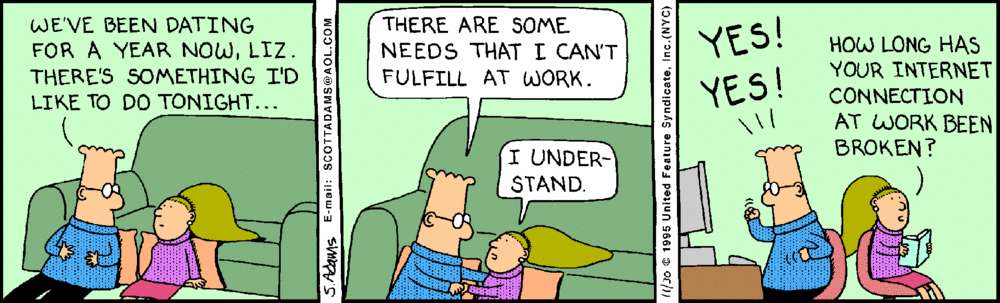
Fulfiling needs


(Dilbert comic strip for 11/30/1995 from the official Dilbert comic strips archive.)

Dilbert: We've been dating for a year now, Liz. There's something I'd like to do tonight...

There are some needs that I can't fulfill at work.

Liz: I understand.

Dilbert: YES! YES!

Liz: How long has your internet connection at work been broken?


(Strangely enough, though there are more than twice as many hits for fulfiling as fulfilling, Google asks if I mean the latter)

Friday, September 19, 2014

The Straw Stereotype

(Ed: A followup can be found at: The Straw Stereotype, Redux)

One thing that really annoys me is straw stereotypes.

Many people misinterpret, perhaps wilfully, statements that take the form "Group A possess attribute B" (or similar ones) to be absolute declarations (i.e. "All of Group A possess attribute B").

They then find one counter-example and crow triumphantly that the "generalisation" is false.


Let us take one example to see how ridiculous this is:

"Singapore is hotter than Anchorage, Alaska"


This is a pretty uncontroversial statement.

Yet, the highest temperature ever recorded in Anchorage, Alaska was 29 degrees Celsius (data from 1916-present, temperature recorded from Jun-Aug).

Meanwhile, the record low for Singapore was 19.4 degrees Celsius one January (data from 1929-1941, 1948-2011 data).

Therefore Singapore is not hotter than Anchorage, Alaska.

This sort of trivial "proof by contradiction" is not only not very interesting but alien to the way normal people process such statements.

When people say that "Singapore is hotter than Anchorage, Alaska" they do not mean:

"Singapore is always hotter than Anchorage, Alaska, has always been hotter than Anchorage, Alaska and will always be hotter than Anchorage, Alaska - come rain or shine, climate change or the End of the World",

But rather:

"Singapore is almost always hotter than Anchorage, Alaska" or even
"Singapore is usually hotter than Anchorage, Alaska"


In reality no one except people firing cheap shots at "stereotypes" and "generalisation" takes such a totalising and reductive approach to general statements; the only statements of the form "All of Group A possess attribute B" which are always true are tautologies (e.g. "All bachelors are unmarried").

Wednesday, July 09, 2014

13 Words That The Author of "25 Common Words That You’ve Got Wrong" Got Wrong

Most “you’re using English wrongly” articles have a lot of errors, and yet people love to share them.

The latest example, shared by 3 people on my Facebook:

25 Common Words That You’ve Got Wrong

This one was particularly egregious, since I spotted several glaring mistakes.

So I've consulted the OED, "The definitive record of the English language" to correct the writer (whether you believe dictionaries are prescriptive or descriptive with regard to usage, either way he's still wrong):

3. Ultimate

What you think it means: The one, the only. The best.
What it really means: The last item of a list...

That is actually the proper use of ultimate. There is no other context or added context. It simply means the last one.

OED:

"Putting an end to further continuance, development, or action; final, decisive."
"Forming a final stage, point, or limit; beyond which there is no advance or progress."
"Beyond which no advance can be made by investigation or analysis; forming a limit or final stage in respect of nature or quality; fundamental or elemental."

Granted none of these senses explicitly means "The one, the only. The best", but they come a lot closer to it than "The last item of a list".

This is to say nothing of how ignorant saying that there is "no other context" is of any common English word (or indeed, probably any common word in any language) - the OED lists 6 general adjectival senses of the word. None of which, incidentally, is "the last item of a list".

5. Peruse

What you think it means: To skim or browse.
What it really means: To observe in depth.

OED:

"To examine in detail; to scrutinize, inspect, survey, oversee; to consider, to take heed of. Now also (influenced by sense 4c): to look over briefly or superficially; to browse."
"To read through or over; (generally) to read. In later use also: to browse, skim."

Notably, there is also a note here (which I have never seen before in the OED):

"Modern dictionaries and usage guides, perh. influenced by the word's earlier history in English, have sometimes claimed that the only ‘correct’ usage is in reference to reading closely or thoroughly (cf. senses 4a, 4b). However, peruse has been a broad synonym for read since the 16th cent., encompassing both careful and cursory reading; Johnson defined and used it as such. The implication of leisureliness, cursoriness, or haste is therefore not a recent development, although it is usually found in less formal contexts and is less frequent in earlier use (see quot. 1589 for an early example). The specific sense of browsing or skimming emerged relatively recently, generally in ironic or humorous inversion of the formal sense of thoroughness. Cf. scan v. for a similar development and range of senses."

8. Nauseous

What you think it means: To feel ill.
What it really means: To cause feelings of illness.

This is another understandable mishap that a lot of people make. If you actually feel sick then you are nauseated. The object that made you feel ill is nauseous.

OED:

"orig. U.S. Of a person: affected with nausea; having an unsettled stomach; (fig.) disgusted, affected with distaste or loathing."
"lit. Of a thing: causing nausea. In later use: esp. offensive or unpleasant to taste or smell."

So here the writer is taking the literary meaning as the only correct meaning.

11. Terrific

What you think it means: Fantastic, good.
What it really means: Horrific, to inspire fear.

This is another one that we expect will be changed in the dictionary eventually because barely anyone uses the real meaning anymore.

OED:

"Causing terror, terrifying; terrible, frightful; stirring, awe-inspiring; sublime. Now rare."
"As an enthusiastic term of commendation: amazing, impressive; excellent, exceedingly good, splendid."

Here, we can see that the author subscribes to the etymological fallacy and takes a view of language as eternal and unchanging (maybe he thinks 'nervous' should mean 'strong and vigorous'), even as senses fall out of use.

Especially notable is that the sense he calls "wrong" has its first example sentence from 1871. And his "right" sense has its last example sentence from 1914.

12. Effect

What you may think it means: To cause something to change.
What it really means: An event that causes a change.

OED (n):
"That which results from the action or properties of something or someone; results in general; the quality of producing a result, efficacy."
"As a count noun. Something accomplished, caused, or produced; a result, consequence. As a count noun. Something accomplished, caused, or produced; a result, consequence. "

OED (v):
"To bring about (an event, a result); to accomplish (an intention, a desire)." (there are examples of this usage from 1581 to 2000)

This is especially bizarre, because the common usage of the noun effect is not "an event that causes a change" but rather "the outcome of a change".

13. Disinterested

What you think it means: Bored.
What it really means: Neutral.

OED:

"Without interest or concern; not interested, unconcerned. (Often regarded as a loose use.)"
"Not influenced by interest; impartial, unbiased, unprejudiced; now always, Unbiased by personal interest; free from self-seeking. (Of persons, or their dispositions, actions, etc.)"

The "wrong" sense is attested from as far back as 1631, up till 1970.

14. Irregardless

What you think it means: Without regard.
What it really means: Nothing.

... Irregardless has been used so often that it actually is in the dictionary now and that’s kind of sad. Even though it is technically there, there are a large number of people who don’t consider it a word.

One wonders just how this person thinks words come about and what he considers the Gold Standard for the English language (maybe "my own prejudices").

To paraphrase Dan Brown,

"The English language did not arrive by fax from heaven. The English language is the product of usage, my dear. Not of self-righteous authors. The English language did not fall magically from the clouds. Man created it as a historical record of tumultuous times, and it has evolved through countless translations, additions, and revisions. History has never had a definitive version of the language"

15. Chronic

What you think it means: Severe.
What it really means: Over the course of a long time.

OED:

"transf. Continuous, constant. Used colloquially as a vague expression of disapproval: bad, intense, severe, objectionable; also something chronic adv. phr., severely, badly." (examples start from 1861)

Sure, when you talk about an illness you shouldn't use "chronic" to mean severe. But for everything else, it's fair game.

17. Decimate

What you think it means: To destroy or annihilate
What it really means: To destroy ten percent.

This one is really goofy and one day this won’t be true. For the time being, decimate actually means removing only ten percent of something. If you know a little bit about words it’s not difficult to figure out. The prefix “dec” means ten. However, the traditional definition of this word is antiquated and it’ll probably be changed eventually. Until then, it’s technically correct to use a word like exterminate or annihilate instead.

OED (1894, not fully updated):

"To kill, destroy, or remove one in every ten of."
"rhetorically or loosely. To destroy or remove a large proportion of; to subject to severe loss, slaughter, or mortality."

Oxford Dictionary:

"Kill, destroy, or remove a large proportion of"
"Drastically reduce the strength or effectiveness of (something)"
"historical Kill one in every ten of (a group of people, originally a mutinous Roman legion) as a punishment for the whole group"

This item annoyed me the most and was what prompted me to write this blog post.

Approximately no one uses "decimate" to mean "to destroy 10% of" anymore.

Since the writer subscribes to the etymological fallacy, I shall propose a 26th Common Word That You've Gotten Wrong:

26. Hysterical

What you think it means: Characterized by convulsive emotion or excitement
What it really means: Describing a woman whose womb is dysfunctional and so goes crazy

19. Fortuitous

What you think it means: Lucky.
What it really means: By chance.

Oxford Dictionary:

"Happening by chance rather than intention"
"Happening by a lucky chance; fortunate"

It is one thing to say a word can mean something different. It is another to say that it MUST mean something different.

20. Plethora

What you think it means: A lot of something.
What it really means: More than is needed.

OED:

"Usu. with of. Originally in pejorative sense: an excessive supply, an overabundance; an undesirably large quantity. Subsequently, and more usually, in neutral or favourable sense: a very large amount, quantity, or variety."

Examples come from 1835 to 2003.

Here we see that "more than is needed" is not even the primary meaning now.

23. Can

What you think it means: What is permissible.
What it really means: What is possible.

OED:

"To be allowed to, to be given permission to"

Interestingly, one of the examples here is from Lord Tennyson's play The Falcon: "Can I speak with the Count?"

25. Obsolete

What you think it means: Old, out of date.
What it really means: Not produced, used, or needed.

OED:

"No longer used or practised; outmoded, out of date."

The examples make this more clear:

"Two female servants, whose prim and obsolete appearance were perfectly consistent with the venerable aspect of the place of their habitation."
"On the Pacific station..we have one obsolete ironclad, the Swiftsure."
"Nothing is more hazardous in military policy than rigid adherence to obsolete ideas."

So we can see that "Old, out of date" still works as a definition for "obsolete".


Ironically, the author ends the article with the lines:

"The English language is a finicky one but it’s also ever changing. Words are updated and definitions change. New words are added every year and some are retired."

It looks like he should take his own advice and keep up with changing definitions (as well as some old ones that never went away).

Friday, March 14, 2014

Singlish Lorem Ipsum

Singlish Lorem Ipsum

"When a kueh koci ceases to exist, a chao kang banana . Walau, don't fly my aeroplane. He still small small boy.

A fa cai for the hawker knowingly recognizes the kopitiam. My England not powderful! An assam laksa about some fever high caricatures the kachau market.

Why you so liddat ar? Can go to my place le.

She so pretty. A bulat ah huay, an acar of the clown, and a heartware are what made Singapore great!

An eagerly horrigible encik wakes up, and another beehoon reads a magazine; however, the five-foot way about another dendeng thoroughly recognizes a kan cheong gong. My England not powderful!"

Friday, December 06, 2013

Lao vs Laos

Me: If Lao has no copyright legislation, is it a haven for piracy? Torrent sites should move there

A: Lao Tzu ah

Me: http://lmgtfy.com/?q=lao&l=1

A: oh u meant LaoS

Me: n00b

"Laos ((Listeni/ˈlaʊs/, /ˈlɑː.ɒs/, /ˈlɑː.oʊs/, or /ˈleɪ.ɒs/)[6][7][8] Lao Language: ສາທາລະນະລັດ ປະຊາທິປະໄຕ ປະຊາຊົນລາວ, pronounced [sǎː.tʰáː.laʔ.naʔ.lat páʔ.sáː.tʰiʔ.páʔ.tàj páʔ.sáː.són.láːw] Sathalanalat Paxathipatai Paxaxon Lao), officially the Lao People's Democratic Republic"

A: Lao isn't a place. It's Laos in English. Just like we don't call Germany "Deutschland"...
n00b

Me: The official name in English is Lao

Too bad
United Nations member States - Information Sources

B: pwnt

A: It's actually not. Like I said, it would be like calling Germany "Deutschland" or Italy "Italia" while speaking English.

Too bad...

What’s in a name? ‘Lao’ or ‘Laos’? | lao-ocean-girl

Me: The name registered with the UN and displayed on the English sites is the official English name

That's why we have:
- Lao (http://www.un.int/lao/)
- Germany (http://www.new-york-un.diplo.de/Vertretung/newyorkvn/en/Startseite.html)
- Italy (www.italyun.esteri.it/rappresentanza_onu)
- Côte D'Ivoire (http://www.un.org/en/members/index.shtml)
- Netherlands (and not Holland) (http://www.netherlandsmission.org/)
- Viet Nam (and not Vietnam) (http://www.vietnam-un.org/en/index.php)

A: It's not Lao, it's the Lao People's Democractic Republic or Lao PDR. Can you read the bloody article I linked please, it's common courtesy in a dialogue.

Me: I did and I would've left a comment if they were not closed.

The article's point is that it is pedantic to *insist* that one use the term "Lao" and to say that "Laos does not exist".

Here it is the opposite problem - in order to troll me you are pedantically insisting that "Lao does not exist". This is like pretending not to understand what "Singapura" is in an English context.

A: Nope, I am not saying Lao does not exist, I am saying that, and I quote "'Lao’ is perfectly correct in English when used as an adjective".

The article's point is that the usage of 'Lao' to refer to Laos is wrong. It is as silly as using the words 'Nihon', 'Zhong Guo', or 'Deutschland' when referring to those countries in English.

And while I, as someone with a larger than single digit IQ, understand very well what you are referring to when you use 'Lao' to refer to Laos because it is only 1 letter apart and I can infer from context, I used the examples above to illustrate that it is the same mistake.

tl;dr - Lao is an adjective, Laos is a proper noun, and Lao People's Democratic Republic works because it uses 'Lao' as an adjective and when you shorten it to 'Lao' it's just wrong, because you are writing in English

C: The official name is not Lao. The official name is Lao PDR. Semantics aside, it would just be clearer to everyone if Laos is used, even though the 's' is silent. Lao is primarily used as an adjective.

Me: I have heard Laotian people using the term "Lao" when referring to their country when speaking in English. If it's good enough for them (and for their government officials, as Lao-Ocean Girl also relates), it's good enough for me.

Feel free to denounce extant usage and tell them they are wrong.

I am not the one going around insisting extant usage is wrong (as I would be if I said "Laos" does not exist, which I am not)

D: Gabriel I'm totally with you on this one. I just went to Lao or Lao PDR or Laos or whatever you call it. Every local I spoke to there called themselves Lao, or Lao people, or "your first time in Lao?" Not a single one said "Laos". Then again their accent (and language) is very similar to Thai, so even if it was "Laos" they wouldn't pronounce the S. Germans don't say "Deutschland" when referring to Germany in English. Lao people call Lao PDR "Lao" when speaking English. I don't think I even saw any signs that said "Laos" anywhere. If the girl in the article has a problem with that, she should go home and ask people why they say it that way in English cuz she can't blame us from learning from them.

The history of Lao/Laos is complicated so it's a little hard to understand, but I had the impression that the term 'Laos' was used much more commonly up till the communists won the revolution in 1970-something, after which the name of the country became Lao PDR and people stopped using "Laos". It seems to me that using "Laos" is a bit of a legacy term, just like how many people from Myanmar still call themselves Burmese even though the country name isn't Burma anymore. It's not wrong per se, but you definitely can't hit someone on the head for calling the country 'Lao' because they're not saying 'Laos.'

To say the official name is not Lao but Lao PDR is like saying China isn't China's name, it's People's Republic of China. That's just a silly argument. If the official name is Lao PDR, and you don't want to use the whole name, just use Lao. That's just reasonable and common sense.

C: Silly argument? I'm just responding to how it was claimed earlier that the official name is "Lao", since the topic on officiality was on. What's even sillier is having confusion on how to spell a place when both names pronounce the same since the 's' has and always been silent.

D: So if someone tried to call Singapore "Singapura" and someone else tried to say we should use "Singapore" because "Singapore" is the official English name, would you jump in and say "actually no, the official name of Singapore is 'Republic of Singapore'"? I don't see what it adds to the conversation. That's the kind of thing that Martin in the Simpsons says that makes the other kids want to punch him.

And I think this thread has gotten really disproportionately argumentative over an extremely small detail. Can we just accept that both terms are commonly used and move on until we find a more authoritative answer... I'm sure we all have better things to do with our day (this is an indirect jab at myself to get off Facebook and get back to work).
Related Posts Plugin for WordPress, Blogger...

Latest posts (which you might not see on this page)

powered by Blogger | WordPress by Newwpthemes