L'origine de Bert

Get email updates of new posts:        (Delivered by FeedBurner)

Showing posts with label europeans. Show all posts

Tuesday, January 13, 2026

Why the golden age of retirement is over for French workers

Why the golden age of retirement is over for French workers

"A recent study by Natixis IM found that retirement security, or workers’ chances of living well in retirement, has declined. France fell three places to 27th in the asset manager’s retirement index, which ranks 44 countries based on their citizens’ ability to save enough for retirement and lead long, healthy lives. This puts it below Cyprus, Slovakia and the UK, which was ranked 14th.

It blamed the decline on France’s high debt, high unemployment and high tax burden. Together these have piled pressure on its public finances, endangering the retirements of current workers. Currently, on average, over-65s in France have higher incomes than those of working age, according to analysis of OECD and Luxembourg Income Study data by the Financial Times.

The country operates a “pay it forward” model where younger workers pay in real-time for the pensions of retirees. In return they hope they will be recompensed by a comfortable and relatively long retirement when they eventually stop working.

But an ageing population has put this model under threat. Today, one in five people in France are over 65. Taxpayer contributions are insufficient to cover the cost, pushing the retirement system into the red. Pensions now account for one quarter of government spending, compared to a fifth in the UK.

It is hard to deny that French retirees have had it good. Many pensioners retired at age 60. Today the minimum age at which a French worker can take their state pension is 62, compared to 66 in the UK. French people are so protective of this low retirement age, there have been widespread protests over plans to increase it to 64 by 2030.

In the UK the maximum state pension you can receive is £230.25 per week, or close to £12,000 a year. This rises annually by the highest of inflation, average wage growth or 2.5pc, under the triple lock.

In France, the state pension averages around €1,500 (£1,265) a month but it can allow workers to take a maximum of 50pc of their wages based on their highest-earning years, up to a limit of €1,962.50 (£1,695) a month, or €23,550 (£20,345) a year. Pensions are also automatically increased with inflation.

On top of this, French workers pay into occupational pension schemes managed by industry groups, such as Agirc-Arrco for private workers. Employees and employers contribute to these schemes on a pay-as-you-go basis, with retirement income calculated based on points accrued during their career.

Contribution rates vary depending on income but can be up to 21.6pc of earnings, with 60pc of this covered by the employer. In the UK, the minimum contribution rate is 8pc, with the employer paying in at least 3pc.

As a result, the average French worker can expect to receive 72pc of their earnings in retirement compared to just 54pc in Britain, according to the OECD. This measurement is called the “replacement rate” – a person’s retirement income as a percentage of their previous earnings.

France pays €400bn to pensioners a year – 14pc of gross domestic product. This compares to about 5pc in the UK, where the state pension costs about £138bn.

Economists have said Britain’s state pension is unsustainable, particularly the triple lock guarantee which is forecast to cost £15.5bn by 2030. But the situation is much worse in France, because retirees access their pension years earlier and also receive a higher proportion of their retirement income from the state.

Today’s pensioners in France paid social security contributions when there was a higher proportion of workers to retirees. As a result, many paid in far less than they now receive. As the demographics have shifted, contributions have increased, squeezing workers’ incomes...

“The pensions that were given to a generation for the past couple of decades were not sustainable in terms of public finances; they were never sustainable to begin with and we are now waking up to that.”

On the current trajectory, France’s deficit is expected to hit 6pc of GDP, double the 3pc allowed under EU fiscal rules. Meanwhile debt sits at around 113pc of GDP.

The former prime minister Mr Bayrou was toppled over unpopular plans to push through €44bn (£38bn) budget cuts which he said were vital to get the deficit down.

Frédérique Carrier, of RBC Wealth Management, said if no action is taken, the situation will worsen because of the ageing population, generous social and healthcare programmes and weak economic growth.

But raising taxes is not a likely solution, he added. “The French are already highly taxed with total tax revenues reaching 45pc to 46pc of GDP last year, compared to some 35pc of GDP for the OECD average, so that increasing taxes is unlikely to be the chosen solution to fund growing pension needs.”

Reining in pension spending is an obvious way forward. Mr Barincou said one option would be to reduce the retirement income of wealthy pensioners by a certain percentage, in a form of means-testing. “That would generate huge savings. I don’t think you can reduce expenditure in France without touching pensions at all because it’s such a large part of spending.”

But any reform is highly politically sensitive. In 2024 former prime minister Michel Barnier proposed freezing the state pension for six months to save billions of euros. It was one of the main reasons why the far-Right voted against him, leading to the collapse of the government.

Mr Barincou said it was “extremely difficult” for a party with a majority to reform the pension system and find meaningful savings. “Without a majority, it’s nearly impossible.”"


Left wingers claim the way to get change is to protest on the streets like the French. The collapse of the welfare system due to unsustainable spending can be averted by "taxing the 'rich'", of course. 

Thursday, December 19, 2024

Links - 19th December 2024 (1 - US vs Europe Economy)

Germans most worried about cost of living and migration, study finds - "Rising prices are the number one German angst, with 57% of respondents saying they are worried about the cost of living surging further."
Time to double down on green energy and reduce nuclear even more, and blame capitalism for ever higher costs

Germany’s rude economic awakening - "After years of turning a blind eye to what the rest of the world could plainly see, Germans are slowly coming to terms with the reality that they are in deep trouble as the four horsemen of their economic apocalypse come into view: an exodus of major industry; a rapidly worsening demographic picture; crumbling infrastructure; and a dearth of innovation... The latest economic indicators certainly won’t help Scholz’s chances. Germany is already the weakest economy in the G7. Just 15 years ago, as much of the West was still reeling from the financial crisis, Germany looked as if it had cracked the code to enduring prosperity. It managed to compensate for weakness in the U.S. and Europe by ramping up exports to China, where demand for its capital goods remained strong. No more. With an industrial base rooted in 19th-century technologies such as chemicals and machinery and a massive digital deficit, Germany is increasingly finding it difficult to compete. Once home to some of the premier global companies, from BMW to Adidas, the country is increasingly an also-ran. Of the 100 most valuable companies in the world, for example, just one — software developer SAP — is German... Tesla, a company German car executives once scoffed at, is now worth more than four times the German auto industry combined. In addition, Chinese consumer spending is struggling. The latest salvo of German doom landed late Monday with the announcement by U.S. chip giant Intel that it was placing its planned €30 billion German expansion on ice... Though German energy prices have stabilized following the shock triggered by Russia’s full-scale invasion of Ukraine in 2022, which cut off German industry’s access to cheap Russian gas, companies continue to cite high energy costs as a competitive disadvantage, a situation compounded by increasingly strict environmental norms for Germany’s traditional industries. In Duisburg, home to Europe’s largest steel-making plants, workers are bracing for substantial cuts. ThyssenKrupp, the erstwhile national steel champion, is struggling to remain competitive despite the promise of about €2 billion in government subsidies to ease its “transformation” away from CO2-emitting production. The government’s goal is to turn Duisburg into a center for “green” steel, replacing coal-fired steel furnaces with new ones powered by hydrogen. Whether that’s a realistic goal is a matter of dispute, given that creating “green hydrogen,” or hydrogen produced with renewable energy, requires copious amounts of both wind and electricity, which is both expensive and logistically difficult... Merz is running on a platform to bring back the good old days of the Germany economy, including by saving the combustion engine and by boosting productivity. “We want to and must remain an industrial country”"
More regulation will surely improve innovation, and more renewable energy will definitely make energy cheaper!

Meme - "The US during one weekend: *rocket launch, self-driving cars, robots*
Meanwhile in Europe: *bottle cap attached to bottle*"
What innovation looks like on both sides of the pond

Thread by @itsolelehmann on Thread Reader App – Thread Reader App - "I'm German.  16 years ago, the EU and US economies were neck and neck.  Today, the US economy is 50% larger than the entire EU combined.  Here's the devastating truth behind Europe's ongoing economic suicide 🧵:
First, let's look at the numbers:
• US GDP: $25.5 trillion
• EU GDP: $16.6 trillion
But in 2008, they were nearly equal. What the hell happened over the past 16 years?  It's simple: Europe chose security over growth. America chose innovation over regulation.  The results?  America has produced 9 trillion-dollar companies (9/10 of the most valuable companies in the world).  Europe? ZERO. Nowhere to be found:
But it goes deeper than numbers...  European talent is fleeing en masse.  I see most European entrepreneurs choosing between two paths:
• The US for higher salaries ($350k+ tech jobs)
• Southeast Asia for lower cost of living to build startups
Why? Because Europe made it impossible to win at home.  Take Berlin's startup scene (where I used to live):  Founders are often viewed with suspicion. "Entrepreneur" = exploiter  I witnessed tech founders being called "capitalist parasites" at local meetups.
Meanwhile in places like Silicon Valley and NYC:  Founders are celebrated. Risk-taking is rewarded. Failure is seen as education, not embarrassment.  To make matters even worse...
Europeans are drowning in red tape:
• Employment laws making hiring/firing impossible
• Tax rates crushing small businesses
• Compliance costs killing innovation
To start a company in France takes 84 days. In America? 4 days. Even French president Emmanuel Macron admits it.  When comparing Europe to the American and Chinese markets, he said:
'The EU could die, we are on a verge of a very important moment.   'Our former model is over – we are over-regulating and under-investing. In the two to three years to come, if we follow our classical agenda we will be out of the market'.
The anti-innovation mindset is killing Europe.  For example, when Elon Musk built Giga Berlin, Germans protested:  "No techno-colonialism"  Tesla almost cancelled the project due to regulatory hurdles and community opposition.  This happens daily with smaller companies too.
Europe's regulatory culture created an economic spiral of doom:
• Talent leaves
• Companies avoid investing
• Innovation dies
• Economy stagnates
• More regulation follows
This is why memes like "Europoors" exist.
The numbers are brutal:
• 90% of EU tech talent would move to US for right offer
• European tech salaries: 50% lower than US
• Startup funding: 5x higher in US
And Europe's few tech successes? Most of them move to America:
• Spotify (now NYC-based)
• Klarna (major US operations)
• ARM (being acquired by NVIDIA)
The theme here is obvious:  While Europe debates the ethics of AI... America builds it.  While Europe regulates cryptocurrencies... America innovates them.  While Europe protects old industries... America creates new ones. The solution? In my eyes, Europe must:
1. Slash regulations
2. Embrace risk-taking
3. Support entrepreneurs
4. Lower taxes on innovation
But will they? As a European, I unfortunately doubt it.  The regulation addiction is too deep. The anti-business culture too ingrained.  As one French friend/entrepreneur told me:  "I love Europe, but I can't build my future here. The system won't let me." This is why America keeps winning.  Not because Americans are smarter.  But because their system benefits those who build.
Europe has become a museum:
• Great at preserving the past
• Terrible at building the future
Unless Europe slashes regulations and embraces risk-taking, the gap will only widen. As a German, this pains me deeply. I love Europe... The rich culture and history. The incredible cuisine. The best techno scene on Earth.  The fact a 2-hour flight takes you to new worlds with new language, new culture, new country.  I'm rooted here.  But beneath this beautiful diversity lies a common problem:  Every European country shares the same anti-entrepreneurship mindset.  It doesn't matter if you're in Berlin, Paris, or Stockholm...  The system is designed to hold builders back.   This is forcing a generation of Europeans to make an impossible choice:  Stay in a culture we love but can't build in?  Or leave everything behind to chase opportunity? The question isn't if Europe will fall behind. It already has.  It's on its way to irrelevancy. And its a reason why I'm currently looking to move out of the continent.  The real question is....  Will they change course before its too late?"
Clearly, they need more regulation

Meme - Mohammed Soliman @ThisIsSoliman: "The only way for Europe to survive this century is to embrace the American model—manufacture and innovate. Being a regulatory superpower won’t save Europe."
Noah Smith 🐇🇺🇸🇺🇦🇹🇼 @Noahpinion: "Europe's elites have spent 25 years saying "Durr hurr, Europe is a GARDEN" and telling themselves that Americans are a bunch of fat gun-toting freaks with no health care and therefore their civilization doesn't have to do anything except regulate America's inventions.  Oops."
Murray Bauman @MurrayBauman3: "It's insane how many leftist Americans want to embrace the EU model and implement it in the US while Europeans elites start to realize that their statist policies lead to nowhere. Ironic?"

Europe Regulates Its Way to Last Place - WSJ - "These are humbling times for Europe. The continent barely escaped recession late last year as the U.S. boomed. It is losing out to the U.S. on artificial intelligence, and to China on electric vehicles.   There is one field where the European Union still leads the world: regulation. Having set the standard on regulating mergers, carbon emissions, data privacy, and e-commerce competition, the EU now seeks to do the same on AI. In December it unveiled a sweeping draft law that bans certain types of AI, tightly regulates others, and imposes huge fines for violators. Its executive arm, the European Commission, might investigate Microsoft’s tie-up with OpenAI as potentially anticompetitive. Never before has “America innovates, China replicates, Europe regulates” so aptly captured each region’s comparative advantage... to preserve competition, European regulators have resisted mergers that leave just a handful of mobile phone carriers per market. As a result Europe now has 43 groups running 102 mobile operators serving a population of 474 million, while the U.S. has three major networks serving a population of 335 million, according to telecommunications consultant John Strand. China and India are even more concentrated. European mobile customers as a result pay only about a third of what Americans do. But that’s why European carriers invest only half as much per customer and their networks are commensurately worse, Strand said: “Getting a 5G signal in Germany is like finding a Biden supporter at a Trump rally.” Putting European networks on a par with the U.S. would cost about $300 billion, he estimated. This has knock-on effects on Europe’s tech sector. Swedish telecommunications equipment manufacturer Ericsson’s sales in Europe suffer in part because many carriers are too small and unprofitable to update to the latest 5G networks. “Europe has prioritized shorter-term low consumer prices at the expense of quality infrastructure,” chief executive Börje Ekholm told me in Davos earlier this month. “I’m very concerned about Europe. We need to invest much more in infrastructure, in being digital.” Of course, Europe’s economy underperforms for lots of reasons, from demographics to energy costs, not just regulation. And U.S. regulators aren’t exactly hands-off. Still, they tend to act on evidence of harm, whereas Europe’s will act on the mere possibility. This precautionary principle can throttle innovation in its cradle.   Starting in 2018, Europe’s General Data Protection Regulation, or GDPR, imposed strict requirements on websites’ collection and use of personal data with fines of up to 4% of global sales. A study by University of Maryland economist Ginger Jin and two co-authors found this depressed European venture-capital investment relative to the U.S. over the next two years. Investors might have shunned business models that weren’t in compliance with, or less valuable because of, GDPR, they said.   History might be about to repeat with AI... European regulation has a protectionist element, often crafted to hit American tech giants while sparing indigenous startups. Despite that, European startups rarely become giants, and even established companies are smaller than their U.S. counterparts.  “I don’t think that the lack of winners in recent decades can be attributed to a single monocausal factor,” one European-born founder of a U.S. tech company told me. But Europe’s regulatory culture, including prosaic tax and labor laws, is near the top, he said. “Simply granting stock options, for example, is pretty difficult in most European countries. It’s famously difficult to part ways with hires that turn out to be misfits.” In a recent study, the McKinsey Global Institute noted Europe’s internal market is larger than China’s and almost as big as the U.S.’s. But when it compared companies with more than $1 billion in revenue, the U.S. firms spent 80% more on research and development, boasted 30% higher return on capital, and 1.3-percentage points faster revenue growth. As the U.S. and China put more muscle into their technological contest, Europe risks falling even further behind. China spends 2% to 5% of GDP on industrial policy—support of sectors deemed strategic—compared with Europe’s 1%... Brussels approved up to $1.3 billion of aid over eight years for cloud computing-related R&D, but that’s just 4% of what Amazon’s cloud division invests in a year... If Europe is going to compete with the U.S. and China, it will need to rethink its balance between regulation and innovation. As German economy minister Robert Habeck observed last fall: “If Europe has the best regulation but no European companies, we haven’t won much.”"

Meme - Michael A. Arouet @MichaelAArouet: "Eye-opening chart. Many Americans still follow principles of innovation, hard work and entrepreneurship, Europeans follow left narratives and believe that they can build prosperity by redistribution of someone else’s work and wealth. One cannot multiple wealth by dividing it."
"America's economy is nearly twice the size of the eurozone's. They were similar in 2008."

Richard Hanania on X - "Spain has a GDP per capita of $30K a year. It has been an economic basket case, with rock bottom fertility and poor growth. Now leftist activists are targeting one of the only industries it has, which is tourism. Europe is so committed to decline it's almost admirable."

Meme - saila @sailaunderscore: "No one hates to see a European succeed as much as European regulators."
"France to ban users' access to Polymarket: report
France's gambling regulator is reportedly preparing to ban Polymarket in the country. The crypto-based platform came to the regulator's attention after a report that a Frenchman used it to place massive bets on the US presidential election."
Matt Bateman on X - "The French Polymarket whale commissioned polls with a specific alternate methodology, the “neighbor method”
1. What a baller
2. What a killer example of how betting markets can surface contrarian, high quality signals"

Norway's 'trillion dollar man' says Americans work harder than Europeans | Fortune Europe - "Norway’s “trillion-dollar man” believes America’s attitude toward failure is helping propel the nation ahead of its European counterparts—where workers may have a better work-life balance but aren’t as ambitious.  Nicolai Tangen leads Nordic behemoth Norges Bank Investment Management, which governs the revenue earned by Norway’s oil and gas resources, with the aim of ensuring its benefits are distributed fairly between current and future Norwegian generations.  Under Tangen’s leadership since 2020, and over the past decade, the $1.6 trillion fund has invested more and more heavily in the U.S. instead of its closer neighbors in Europe—and it’s no coincidence.   America’s performance, particularly in innovation, is “worrisome” in contrast to Europe, Tangen told the Financial Times.  Part of it comes down to mindset, Tangen added, and how accepting each continent is of mistakes and risk: “You go bust in America, you get another chance. In Europe, you’re dead,” he said.  But it goes deeper than that; there’s a difference in the “general level of ambition,” he added. “We are not very ambitious. I should be careful about talking about work-life balance, but the Americans just work harder,” Tangen continued... countries like the U.K. have a statutory requirement entitling staff to 28 paid days of leave a year if you’re a full-time employee. In the U.S. it is not a legal requirement for staff to be given any paid time off. However, according to the Bureau of Labor Statistics, the average employee who is in their first year of service takes eight PTO days...   Investments in the U.S. now represent 46.9% of Norges Bank’s portfolio, whereas a decade ago the U.S. represented just under 30%. Going back a further 10 years, in 2003 the organization’s investment in America made up just 26.3% of all investments...   “I’m not saying it’s good, but in America you have a lot of AI and no regulation; in Europe you have no AI and a lot of regulation. It’s interesting,” Tangen added."

Europeans ‘less hard-working’ than Americans, says Norway oil fund boss - "His views are significant as the oil fund is one of the largest single investors in the world, owning on average 1.5 per cent of every listed company globally and 2.5 per cent of every European equity."

Tuesday, April 16, 2024

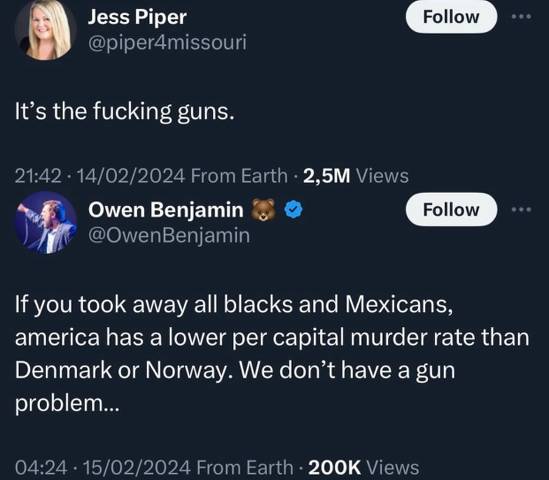
Is the US non-Black and non-Mexican murder rate really lower than Denmark and Norway?

I saw this meme which didn't pass the sniff test:


Jess Piper @piper4missouri: "It's the fucking guns."
Owen Benjamin @OwenBenjamin: "If you took away all blacks and Mexicans, america has a lower per capital murder rate than Denmark or Norway. We don't have a gun problem ..."

So I decided to look into it:

According to Macrotrends, in 2021 the US murder rate was 6.81 per 100,000 population (the CDC says it was 7.8 but let's use one data source for simplicity and data comparability [the data ultimately comes from the World Bank but the web UI rounds to the nearest whole number, which is imprecise]; note that this is being generous to the original claim).

Meanwhile, in Denmark it was 0.80 and in Norway it was 0.54.

The FBI's 2019 Crime in the United States (the 2021 version does not report Latino offender numbers) Expanded Homicide Data Table 6 reports murders by race and ethnicity of offender. Unfortunately, while whether the offender is Black or African American is reported, whether he is Mexican is not. So I will use "Hispanic or Latino" as a proxy for "Mexican" (which is again arguably generous to the original claim, depending on whether you think Mexicans are more or less murderous than the average Latino).

In 2019, out of 6,391 murders where the race of the offender was known, 3,218 offenders (50.4%) were black.

In 2019, out of 4,448 murders where the ethnicity of the offender was known, 874 (19.6%) were Hispanic or Latino.

For simplicity, let us assume that there're no black Hispanic or Latino people, and that the proportion of murderers in the population matches that in the subset for which race and ethnicity is known.

Therefore, with this simplified calculation, 70% of murders in the US in 2019 were committed by Blacks and "Mexicans".

To get a non-Black and non-"Mexican" murder rate, we need to transform the original homicide number and correct it for population.

According to the CDC, in 2021 there were 26,031 homicides in the US. Removing Black and "Mexican" murderers, we get 7,809 homicides. According to the US Census Bureau, 13.6% of the population is Black or African American alone and 19.1% is Hispanic or Latino (only 3.0% are of two or more races), and the midpoint of the April 1, 2020 and July 1, 2022 population estimates is 332,368,179.5.

Removing the Black and "Mexican" populations, we get a population of 223,683,785.

So the non-Black and non-"Mexican" murder rate is 7,809 / 223,683,785, which works out to 3.49 per 100,000 population.

Note that this is much higher than Denmark and Norway. Macrotrends does not seem to list countries by homicide rate, but according to Wikipedia's list (which makes the UNODC data sortable), that would put the US at about the 93rd highest homicide rate in the world, tied with the Cook Islands.

The only European OECD member with a higher homicide rate than the non-Black, non-"Mexican" US is Latvia (3.6, 90th).

Note that the "Mexican" proportion of known offenders is only slightly higher than their share of the population, so restricting the analysis to the non-Black population is not going to change the results much.

Related:

US Murders, Guns and Outlier Cities

Saturday, March 23, 2024

Germany: so much for the ‘grown-up country’

Germany: so much for the ‘grown-up country’

"Germany has long occupied a special place in the liberal-elite imagination. Over the past few decades, and especially since the world was upended by the votes for Brexit and Trump, Germany has been held up by the great and good as a model nation. As the rest of the West lost their minds, or so the story goes, Germany remained a paragon of economic efficiency, political maturity and environmental stewardship. The last bulwark of the liberal order in an age of rising populism.

This elite Germanophilia is best embodied in John Kampfner’s Why the Germans Do it Better: Notes From a Grown-Up Country. First published in August 2020, it became an unlikely bestseller in the UK. It received rave reviews and was declared ‘book of the year’ by the Guardian, the New Statesman and The Economist. Its central claim is that Germany has forged ‘a new paradigm in stability’ that the rest of the world ought to follow. It is hard to think of any book that has aged quite so badly, quite so quickly.

Indeed, the news coming out of Germany lately paints a wholly different picture: one of economic collapse and interminable political strife.

Even though 2024 is just a few weeks old, Germany has already been rocked by huge farmers’ protests, with thousands of tractors blocking cities and motorway junctions this past week alone. It has been crippled by transport workers’ and doctors’ strikes. Factories in its much-vaunted manufacturing sector are shutting down and shipping production elsewhere. The federal government is struggling to reckon with a budget crisis and is ushering in a new age of austerity. Data released this week showed that Germany had the worst economic performance last year of any major economy. In the year ahead, it is predicted to have the slowest growth in the G20, apart from Argentina...

Germany’s problems have far deeper roots than just one unpopular government and its hapless leader. They are structural. In fact, so much of the current crisis can be traced back to precisely the aspects of Germany that are so often admired by liberal-elite observers like Kampfner – most of all, its embrace of green ideology and its democracy-dodging elites.

Germany’s green movement is one of the oldest and most influential in the world. Its Green Party was the first in the West to be in government – initially between 1998 and 2001, and now since 2021. Other mainstream parties were also early adopters of green ideology. Angela Merkel, one of the longest-serving chancellors of the postwar era, wanted the world to know her as the Klimakanzlerin, the ‘climate chancellor’.

It has taken the global energy crisis, prompted by Russia’s invasion of Ukraine in 2022, to truly kill off Germany’s industrial strength. But the death sentence was surely handed down in 2010, when Merkel’s government initiated the Energiewende – the ‘energy transition’ to renewables.

The Energiewende amounted to the world’s largest single investment in wind and solar power. The trouble with this plan was that, unlike fossil fuels, which can be tapped on demand, renewable-energy sources are ‘intermittent’ – they cannot produce electricity when the wind doesn’t blow and the Sun doesn’t shine. And so they need a constant supply of back-up sources, usually fossil fuels like coal or gas, to keep the grid running. This is why, despite Germany’s green reputation, the energy transition has had little effect on CO2 emissions. It is also part of the reason why Germany developed its now infamous dependence on imports of Russian gas.

Madder still was the Atomausstieg, the plan to rid Germany of all its nuclear plants. Despite nuclear power providing plentiful, reliable, cheap and even carbon-neutral electricity, every major political party in Germany is opposed to it, following decades of hysterical, fact-free campaigns by environmentalists. In 2000, the SDP-Green government announced a nuclear phaseout, with the first plants due to be dismantled in 2007. Then, in 2011, following the Fukushima disaster in Japan, Merkel doubled down on the policy. In April last year, the Ampel closed Germany’s last three nuclear plants. It did so even in the grip of the energy crisis, as the government struggled to source alternative energy supplies to Russian gas, such is its devotion to green ideology.

The results of the Energiewende have been stark. Electricity prices rose by 50 per cent between 2006 and 2017, giving Germany the most expensive electricity in Europe. The energy shock of the war in Ukraine then sent prices into the stratosphere. In 2022, the government was forced to spend some €440 billion – or €1.5 billion per day – bailing out energy firms, sourcing new energy supplies and subsidising bills. And still cutbacks had to be made to energy use, as supplies dwindled. Town councils dimmed or turned off street lights and even traffic lights. Large landlords and housing associations turned down the heating on their residents and rationed their hot water. 

In one of his rare complaints about Germany in Why the Germans Do it Better, Kampfner laments Germany’s failure to live up to its lofty environmental ambitions. Ordinary Germans are as fixated on their petrol cars as Americans are on their guns, he complains. This is one reason why emissions from transport are at the same level they were in the 1990s. They are also too hung up on preserving ‘real jobs for real men’, in coal mines and other polluting industries, apparently. Perhaps Kampfner will be pleased to learn that since his book was published in 2020, Germany’s CO2 emissions have fallen to their lowest levels since the 1950s. But, as even Green Party economy minister Robert Habeck was forced to concede earlier this month, this has had little to do with gains in energy efficiency. It was overwhelmingly due to a sharp slowdown in industrial activity, caused by exorbitant energy costs. Major firms like BASF – a chemical giant that is older than the German state itself – are now closing their factories and offshoring production. Even ‘green’ industries cannot cope. This week, Germany’s largest solar-panel producer, Meyer Burger, threatened to shut down its factory in Saxony and relocate to the US.

It’s not as if Germany’s energy woes were unforeseeable. After all, electricity prices were already rising to unsustainable levels before the Ukraine crisis. But the German political class and the system that sustains it are remarkably impervious to criticism and dissent.

Kampfner poses this in positive terms. Germany is a ‘grown-up country’ because its political process is consensual, he argues. The two major parties, the centre-right CDU and centre-left SPD, regularly form ‘grand coalitions’ to govern from the centre. Politicians, he writes, care ‘passionately about process. About getting it right. Not playing fast and loose.’ He contrasts the ability of ostensible opponents to get along with the increasingly ‘adversarial’ politics of the UK and the US. Britain in the post-Brexit era, he says, is ‘infantile’ and ‘improvised’. Where Britain’s leaders are cast as demagogues, rapt by ‘pseudo-Churchillian self-delusion’, Germany’s are supposedly competent technocrats, quietly getting on with the job. They reach consensus through considered deliberation and skilled negotiation, Kampfner says.

But ‘consensus’ in parliament, among the mainstream political parties or even in the media, is not the same as consensus among the public at large. This illusion of consensus ought to have been shattered after the federal elections in 2017, when the AfD became the largest opposition party in the Bundestag. It has been clear for some time now that the way Germany is run is alienating a growing segment of the population. Some have been so angry with the status quo that they have been willing to put their trust in the AfD, a party that is routinely labelled as extremist by the mainstream.

Back in 2017, when the AfD made its first big mark on politics, it was the only party in the Bundestag to question Merkel’s immigration policy. Back in 2015, she decided to open Germany’s borders to around a million Syrian refugees – without consulting parliament or allowing for any political debate. Today, the AfD is playing a similar role in questioning green ideology and the abandonment of nuclear power (although the CDU is belatedly calling for the revival of nuclear, too).

It would have been possible for the political class to denounce the AfD’s more hardline elements while acknowledging the public’s anger and addressing some of their concerns. But instead of trying to win back the voters they have been shedding, the mainstream parties have tried to draw up a cordon sanitaire between themselves and the populist upstarts. Mainstream parties refuse to work with the AfD, even at the local level. Worse still, they have engaged in legal shenanigans to try to delegitimise and undermine it. In 2021, the AfD was placed under surveillance by the German secret service. This was a blatant act of anti-democratic authoritarianism. But Kampfner lauds it as a stirring example of ‘the liberal-democratic state fighting back’. Now, there is even growing clamour from the liberal mainstream to outlaw the AfD outright. It seems if you can’t beat them, ban them.

The result of this suppression of dissent, this aversion to democracy and this enforcement of groupthink is that problems go unaddressed and are allowed to fester and grow.

This has allowed Germany’s elites to become complacent. Merkel, in particular, presided over a notable decline in the public realm, from infrastructure to public services. Today, Germany is no longer a country where the trains run on time... Germany’s internet, where its broadband speed has been among the slowest in the Western world, and its 4G coverage the worst in Europe. Curiously, some 80 per cent of German businesses still use fax machines for office tasks, as do a fifth of doctors’ surgeries. Fax machines are due to be phased out in the offices of the Bundestag by June 2024 ‘at the latest’. German efficiency, at least where tech is concerned, is a myth.

Physical infrastructure is often slow to build and over budget, too. Most notoriously, Berlin’s newest airport, Berlin Brandenburg, took nine years longer to build than planned, and missed seven of its slated opening dates. Clearly, those in charge cannot be trusted to govern smoothly. The technocrats are not as competent as they claim.

The space for political debate in Germany is also limited by the extraordinary power of the Bundesverfassungsgericht, the constitutional court in Karlsruhe, which interprets Germany’s basic law. Kampfner marvels at this set-up – not least at the way it insulates elite decision-making from the influence of the demos. ‘The judges are figures of considerable respect’, Kampfner swoons. ‘They are not pressurised or denounced as “enemies of the people” as their equivalents have been in the UK.’...

The court decided that some of the government’s green-energy investments must be paid for out of day-to-day spending, rather than from a separate ‘climate transformation fund’, lest the 2024 budget exceed the debt brake.

In response to this missive from the constitutional judges, the elected government has been forced to hastily draw up a new budget. Naturally, for a government so wedded to green ideology, it has been reticent to simply scrap its expensive climate measures. Instead, much of the shortfall will be made up by unexpected spending cuts and tax rises. A new round of austerity is now in the offing. 

Most controversial has been the threat to abolish tax breaks on agricultural diesel and to introduce new taxes on farm vehicles – a move that would cost already struggling farmers roughly €4,000 per year. This has been one of the key drivers of Europe’s latest populist revolt. It has brought farmers and their tractors out on to the streets in their thousands. Indeed, this was the final straw for a sector that had already endured a decade of green-inspired rules, regulations and cutbacks.

In this sense, the farmers’ uprising last week strikes at the heart of modern Germany’s malaise. It challenges the elites’ devotion to greenism at all costs. It is confronting a political system that tries to insulate itself from democratic pressure – that tries to hide from the devastating consequences its agenda is having on voters and on the economy. For far too long, German elites were given free rein to undermine their nation’s prosperity – to impose their fantasy of a carbon-free society on industries and people that they do not understand, and do not care to. Previously, anyone who challenged this was ignored or demonised. But as the current winter of discontent shows, the political class will not get away with this for much longer.

Rather than being valorised as a model nation, perhaps Germany ought to be seen as a cautionary tale – of how a cosy elite consensus, untroubled by democracy, can take even a powerful, successful country to the brink."


Clearly, the problem is that Germans didn't embrace renewable energy fast or completely enough

Sunday, August 15, 2021

How To Irritate Europeans In Just One Sentence

(via How To Irritate Europeans In Just One Sentence – Brilliant Maps)

Someone asked for an explanation so since I typed it all out:

Ireland - "Southern Ireland". This is in contrast to Northern Ireland, which is part of the UK. But the Irish just want to be called Ireland.

Scotland - "Where in England is that?". The Scots hate being called English. They see themselves as a different country.

England - "Los Malvinas son Argentinas". "The Falkland Islands are Argentinian" (in Spanish). They fought a war in the 80s over them when the Argentines invaded.

Portugal - "Do you speak Brazillian right?". Brazil speaks Portuguese. Brazil used to be a colony of Portugal. Now Brazil is the more prominent Portuguese speaking country.

Spain - "So you're latino?". Latino is an American term generally referring to people with Latin American heritage. But Spain was the mother country that colonised most of Latin America.

France - "American wines are better." The French are very proud of their wines and think they're the best in the world.

Netherlands - "'Sinterklaas' is racist". The Dutch Santa Claus (Sinterklaas) has a black sidekick called Zwarte Piet. Those who insist on imposing the American cultural context on the rest of the world ignoring local history, traditions and context through Cultural Imperialism claim this is racist.

Switzerland - "Belgian chocolate is the best!" Switzerland and Belgium are the 2 countries in Europe most famous for their chocolate and there is a rivalry among them.

Germany - "This video is not available in your country". Due to German licensing laws many videos were not available in Germany for a long time.

Austria - "Are you Germans?" Austria uses German and is culturally similar to Germany but they are their own country.

Italy - "I like pasta with ketchup". Italians are famous food snobs and pasta with ketchup is very far from pasta with tomato sauce.

Hungary - "Are you hungry hahaha". Hungary the country name is almost a homonym for hungry. It's a bad pun.

Czechia (Czech Republic)/Slovakia - "Are you Eastern Europeans?" They like to be considered Central Europe (the new name for the area after the Iron Curtain fell)

Norway - "Are you the western part of Sweden?" Norway is not part of Sweden. The 2 countries were actually most recently in a personal union (same King) for 9 decades after a war and the Norwegians were unhappy but there's some more complicated history too.

Sweden - "Rape capital of the world". Sweden has the highest recorded rape rate in the world, partly due to its methodology of counting rapes but also due to immigration. This is a contentious issue and even mentioning it often gets you called racist in Sweden.

Poland - "Polish death camps." The Poles like to blame the Nazis for the World War II death camps and gloss over Polish collaboration. There is even a 2018 law under which it's illegal to use such language.

Slovenia - "Alpine Serbs"
Croatia - "Catholic Serbs"
Bosnia - "Muslim Serbs"
North Macedonia - "Southern Serbs"
Serbia was the dominant part of the former Yugoslavia. The other countries which were part of Yugoslavia don't like to be reminded of that. And most of the people in those countries aren't ethnic Serbs either.

Serbia - "Tesla is a Croat". Nikola Tesla the famous inventor was ethnically Serb, but born in modern day Croatia.

Bulgaria - "Still use the Russian alphabet?" Bulgarian and Russian both use the Cyrillic script, with minor variations. Bulgarians like to think their script is unique and not Russian script, even though most people think of Cyrillic as Russian.

Romania - "Beautiful country, I love Budapest". Budapest is in Hungary. Historically Transylvania (a large part of Romania) was part of Hungary.

Baltic countries - "Baltics? You're Russians right?" The 3 Baltic states used to be part of the USSR and were not happy to be part of it. They were the first bits of the USSR to break free.

Greece - "Macedonia for Macedonians". Greece is very sensitive about Macedonia. So much so that they used to force North Macedonia to be referred to as the former Yugoslav Republic of Macedonia and blockaded North Macedonia for a while. Historically Macedonia used to cover much of modern Greece and many Greeks identify as Macedonian.

Turkey - "Can you translate this Arabic sentence?" Turks are not Arabs. The language and even the script are different, though both are Middle Eastern and predominantly Muslim.

Tuesday, June 15, 2021

The fiscal impact of immigration in the Netherlands

GRENZELOZE VERZORGINGSSTAAT: DE GEVOLGEN VAN IMMIGRATIEVOOR DE OVERHEIDSFINANCIËN (translated by Google from Dutch as "BORDERLESS STATE OF SERVICE: THE EFFECTS OF IMMIGRATION ON PUBLIC FINANCES") has a very convenient English summary:

"The report“Borderless welfare state”deals with the consequences of immigration for Dutchpublic finances. It answers the following questions:

•What are the fiscal costs and benefits of immigration by migration motive (labour, study, asylum and family migration) and by region of origin?
•To what extent can immigration provide a solution to the ageing population in the Netherlands?

The current report is an update of the Public Sector chapter of the report Immigration and the Dutch Economy(2003) by the Netherlands Bureau for Economic Policy Analysis. Both reports deploy the method of generational accounting to calculate the net contribution–revenues minus expenses–of immigrantsto public finances, measured from the moment of their immigration to the time of repatriation or death. This net contribution is the key concept of the current study.

The study uses microdatafrom 2016 provided by Statistics Netherlands. These are very detailed, anonymized data of all 17 million Dutch residents, including about two million people with a first-generation migration background and almost two million people with a second-generation migration background.

Total costs of immigration

The rapid pace of immigration into the Netherlands has greatly increased the Dutch population, but not the sustainability of the Dutch welfare state. Of the 17 million Dutch inhabitants at the end of 2019, 13% were born abroad (first generation) and 11% were children of immigrants (second generation). Currently, per capita expenditures on immigrants are significantly higher than on indigenous people in areas such as education, social security and benefits. Moreover, immigrants pay fewer taxes and social security premiums, which further lowers their net fiscal contribution...

The total net costsfor the Dutch public sector of immigration in the period 1995-2019 averaged €17billion per year, with a peak of €32 billion in 2016 due to the2015 ‘refugee crisis’.By comparison, the Dutch government also spent roughly €30 billion on education in 2016. As for totals, the total costs of immigration over the period 1995-2019 amounted to €400 billion. To put that into perspective: these government expenditures have the same order of magnitude as the total Dutch natural gas revenues at €400 billion from the start of extraction until 2019...

As regards the net contribution of immigrants to public finances, there are substantial differences between groups with different migration motives as registered by the Dutch Immigration and Naturalisation Service (IND). Only labour migration generates a positive net contribution of, on average, €125,000 per immigrant. Study migration shows, on average, a negative net contribution of €75,000. Family migration shows, on average, a negative net contribution of about €275,000 per immigrant. Asylum migration shows a negative figure as well, amounting to an average of €475,000 per immigrant.

There are also considerable differences by region of origin. On average, Western immigrants make a positive contribution of €25,000, while non-western immigrants cost nearly €275,000. Within the categories Western and non-Western there is, however, much variation.

Immigration from most Western regions has a positive fiscal impact.Immigrants from Japan, North America, Oceania, the British Isles, Scandinavia, and Switzerland, in particular, make a significant positive contribution of roughly €200,000 per immigrant. Immigration from Central and Eastern EU-member costs about €50,000. Immigration from former Yugoslavia and the former Soviet Union mainly concerns asylum seekers, who make a much larger negative contribution of €150,000.

Immigration from non-Western regions is usually unfavourable for public finances. This applies especially to the areas of origin Caribbean, West-Asia, Turkey and North, Central and West Africa with net costsaround ranging from €200,000 to €400,000 per immigrant, and Morocco, the Horn of Africa and Sudan with net cost of €550,000to €600.000 per immigrant... By way of comparison: an average Dutch native is roughly ‘budget-neutral over’ his or her life.

For all migration motives, Western immigrants seem to ‘perform better’ than non-Western immigrants. The difference is approximately €125,000 for labour and study migrants, and €250,000 for asylum and family migrants.

In isolation, only two categories seem favourable for Dutch public finances; labour migration from western countries (except Central and Eastern European countries), Asia (except the Middle-East) and Latin America, as well as study migration from the EU. All other forms of immigration are at best budget-neutral or have a considerable negative fiscal impact. The highest net costs apply to asylum migration from Africa. It should be noted that study and labour immigration usually comes with family migration, which may have a considerable negative impact on the combined net contribution...

For Dutch residents without a migration background (native Dutch), the costs and benefits are roughly in balance. In other words: they are approximate ‘budget-neutral’. The effect on public finances of persons with a second-generation background who are well-integrated – i.e. with a level of education and labour market performance very similar to natives – is therefore also about budget-neutral.

Migrant groups of which the first generation yields substantial net benefits usually do not show the same outcome for the second-generation. That generation – although well-integrated – is usually roughly budget-neutral.

Migrant groups of which the first generation has a considerable negative net contribution, usually continue into a second generation that also has a negative or, at best, approximately budget-neutral contribution.For those groups, the net present value of the net contribution of future generations will not offset the costs for the first generation. The quite common idea that ‘things will change for the better in future generations’ therefore, does not apply when it comes to the costs and benefits of immigrants.

There is a substantial correlation between net lifetime contribution and educational attainment, ranging from –€400,000 for immigrants with at most primary education to +€ 300,000 for immigrants with a master degree. Furthermore, a robust correlation exists between net contribution and scores on the so-called ‘Cito test’, a 50-point student assessmentscale for primary education. For natives, lifetime net contributions range from roughly –€400,000 for the lowest Cito score to +€300,000 for the highest Cito score. For people with a second generation migration background, a similar correlation exists, though at a considerably lower level.

There are considerable differences in Cito scores between regions of origin and also between migration motives...

Like many Western nations, The Netherlands has an ageing population...

In line with the literature, this study found that solving dejuvenation by immigration resembles a pyramid or Ponzi scheme. A simulation shows that ever-increasing numbers of immigrants are needed to keep the Dutch grey pressure at the 2020 level. This results in significant population growth: 35 million inhabitants by the year 2060, 75 million at the end of this century, and half a billion by the year 2200.

Immigration does not provide a stable solution to population ageing because the underlying problems of low fertility and dejuvenation are not resolved. On average, fertility of immigrants is below the replacement level as well, partly because women from high fertility groups adjust their fertility downwards over time, and partly because immigrants from most countries in the Americas, Europe and Eastern Asia already have low fertility rates...

A simulation shows that closing a permanent financial gap in public finances of 2.5% of gross domestic product, by admitting labour migrants with high economic potential, would lead to additional population growth of 7.2 million inhabitants in the period 2020-2080. In addition, mass recruitment of high-potential migrants may prove difficult in practice, as most high net contributors currently come from countries that are themselves grappling with a rapidly aging population and/or trying to attract highly skilled immigrants...

A less negative, or a positive fiscal impact of immigration can be attained, but requires a fundamental policy change. The present study calculates a restrictive scenario, in which labour migration mainly originates from Western countries (except Central andEastern Europe), Latin America and Asia (except the Middle East), in which there is also a 50% reduction in family migration and a 90% reduction in asylum migration.This scenario is highly selective compared to the current situation and requires changes in international treaties, such as the UN Refugee Convention. Nevertheless,even then, immigration is only about budget-neutral.

Policy implications

The net costs of immigration to the government are considerable, and projections show they will consume a steadily increasing portion of the annual government budget. These costs are mainly due to redistribution through the welfare state. Continuation of the current level of immigration and current arrangements of the welfare state increases pressure on public finances. Downsizing the welfare state and/or curtailment of immigration will then be inevitable...

Nowadays, the consequences for public finances hardly play a role in policy decisions on immigration...

The Dutch government has not published data on net contribu-tions to public finances of migrants since 2003.We can only guess the reasons for this...

Perspective

Immigrants that make on average a significantly negative contribution to Dutch public finances are mainly those who exercise the right to asylum, especially if they come from Africa and the Middle East. The latest UN population forecast shows that the total population in these areas will increase from 1.6 billion to 4.7 billion by the end of this century. It is not implausible that the migration potential will at least keep pace.Migration pressure, in particular on the welfare states in North-Western Europe, will therefore increase to an unprecedented degree. This raises the question of whether maintaining the open-ended arrangement enshrined in the existing legal framework is a realistic option under these circumstances.

The current cabinet recently indicated to the House of Representatives how it views the existing legal framework. This was inresponse to a report on an “investigation into the question of whether, and if so how, the 1951 Refugee Convention can be updated to provide a sustainable legal framework for the international asylum policy of the future”. This response shows thatthe Dutch cabinet wants tomaintainthe existing legal framework for asylum migration – despite the large-scale abuse identified by the cabinet. The calculations in this report leave no doubt about what thismeans in the long term: increasing pressure on public finances and ultimately the end of the welfare state as we know it today. A choice for the current legal framework is, therefore, implicitly a choice against the welfare state."

No doubt the authors will be slammed (at least by Anglos) as far-right white supremacists: the photo of ostriches with one flipping the bird suggests that the authors know their findings will piss people off. This even though Eastern European (i.e. white) migration is also found to have a negative fiscal impact. Of course, Japanese having a positive discal impact doesn't count since Asians are white-adjacent.

Perhaps the best indicator of late capitalism is really harmful virtue signalling.

Monday, July 20, 2020

Ai Weiwei in Berlin

BBC Radio 4 - From Our Own Correspondent Podcast, Lockdown in China

"‘The Chinese artist and dissident Ai Weiwei has just moved from Germany to the UK. I met him years ago when he was living on the dusty edges of Beijing, where he'd been relocated by the authorities. Then later he was under house arrest. He was released in 2015 and arrived to much fanfare in Berlin. And Ai Weiwei said he loved Germany. Berliners were thrilled to give refuge to a global star. But since then the mutual admiration has faded. He said he was leaving, in part because Germans are rude, racist and authoritarian. It sparked outrage and some soul searching. And Damien McGinnis wonders if the Germans really are impolite or simply misunderstood.’

‘There's some graffiti I saw recently that sums up Berlin humor. If you can't make it here, you can't make it anywhere. None of the encouraging optimism of Frank Sinatra's New York. No Berlin is a city of proud slackers not impressed by wealth, career or fame. Here you can embrace failure and relish your flaws. And just in case you forget those flaws, there's always someone ready to remind you of them. Berlin is not a city for the faint hearted. As the Chinese artist Ai Weiwei has discovered. He's just moved from Berlin to Cambridge, saying it's partly because Germans are ill mannered. In Britain they are polite, he said in one interview last week, but in Germany, they don't have this politeness. They would say in Germany, you have to speak German. They have been very rude he says. Commentators in Germany have pointed out that interactions can be easier if you speak the language of a country. But the outbursts have also sparked a bit of a debate here about whether Germans really are rude and unwelcoming...

[Ai Weiwei] citing Berlin taxi drivers as evidence that the whole of Germany is ill mannered is clearly problematic. Each region or city in Germany has its own behavior stereotypes. In Hamburg people are often reserved and polite. In Cologne, they tend to be more jolly and gregarious, but Berliners have a reputation for certain kinds of particularly blunt gruffness. After all, this is a city with a history of war, division and destruction. That's not something you survived with niceties. It's called the Berliner Schnauzer or the Berlin snouts. It's sometimes funny and nearly always insulting and being able to cope with it is a badge of pride for people who live here. A breathtaking level of rudeness is also a speciality for anyone involved in Berlin transport. In Germany this is well known. German tourists from elsewhere will chuckle as bus drivers argue with passengers, as if it's a local color organized by the Berlin Tourist Board. The city's public transport system even plays on this famed indifference to customer service in its ad campaigns. One hilarious film shows how technicians work day and night on making train announcements completely incomprehensible, and how bus drivers are specially trained to know exactly the right moment to slam the doors in the face of someone who's just run for the bus. Given all that it's possibly a bit naive to judge this country's manners by the taxi drivers of its toughest city.

Ai Weiwei also says Germans are authoritarian and even brings up the inevitable reference to the Nazi era. That's something I often hear as an explanation for why people here obey rules such as waiting for the lights to change before crossing the roads. It's basically how Hitler happens, says one American friend. In fact, this respect for rules is more about respect for others. German society generally works well, precisely because rules are kept. The bus won't necessarily wait for you as you're running up the street, because that means the whole schedule gets messed up for everyone. Bus drivers might be a bit nicer in the UK. But then buses there don't always run on time.

In one sense, though, [he] is right. In Germany, there isn't the same sort of veneer of surface politeness that you find elsewhere. It's simply a different sorts of etiquette. And I've often seen outsiders struggling with this. Germany is a country where traditionally workers rights are just as important as the demands of the customer. That's why much to the bafflement of tourists, most shops still close on Sundays and for days at a time during some public holidays... In Germany, the customer is not always King. Rather, an interaction with someone working in a cafe or a taxi or a shop is between two equals...

One final tip for [Ai] now living in England. Don't be fooled by those polite words. I suspect after a bit of time in the UK, You will soon learn that in British English an icy thank you, or excuse me, can also be pretty aggressive."

Saturday, June 27, 2020

Europe’s Virtues Will Be Its Undoing

Europe’s Virtues Will Be Its Undoing

"We often forget that contemporary Europe was not born, as the United States was, in the euphoria of new beginnings, but in a sinking sense of its own abjection. The crimes of the Nazis affected the entire Old World, like a cancer that had long been growing inside it. Thus, the European victors over the Third Reich were contaminated by the enemy they had helped defeat, in contrast to the Americans and Soviets, who emerged from the conflict crowned in glory. Ever since, all of Europe—the East as well as the West—has carried the burden of Nazi guilt, as others would have us bear the guilt of North American slavery and Jim Crow. It has left us sullied to the very depths of our culture. Isn’t this what the Martinique poet Aimé Césaire contends when he de-Germanizes Hitler and makes him the very metaphor of the white man in general?...

The amazing thing is not that such masochistic theories should flourish, but that they are applauded by so many elites. For a few decades, the Cold War delayed the West’s self-examination, but since 1989 and the inclusion of ex-Soviet bloc countries into a widening European Union, the crisis of conscience has only deepened, and has partially, if not completely, guided political thought. Having scaled unprecedented peaks of barbarity, the Europe of Brussels has decided to redeem itself by privileging moral values over realpolitik... Western Europeans dislike themselves. They are unable to overcome their self-disgust and feel the pride in their heritage and the self-respect that is so strikingly evident in the United States. Modern Europe is instead mired in shame shrouded in moralizing discourse. It has convinced itself that, since all the evils of the twentieth century arose from its feverish bellicosity, it’s about time it redeemed itself and sought something like a reawakened sense of the sacred in its guilty conscience.

What better example of this proclivity exists than Angela Merkel’s embrace of about a million refugees fleeing war-torn Syria in 2015?... Already pre-eminent in Europe, Berlin would call the shots, whether exercising toughness or kindness. Merciless with the Greeks in July, when the Chancellery wanted to eject them from the eurozone, but beneficent with the Syrians in September, it could demonstrate severity or an ever so imperial charity...

Europe sees itself as a sacrificial offering, through which the entire world can expiate its sins. It offers to assume the shame for every misfortune that befalls the planet: famine in Africa, drowning in the Mediterranean, terrorism, natural disasters, they are all directly or indirectly our handiwork. And when we are attacked—by terrorists, for example—it’s still our fault; we had it coming and are undeserving of compassion... Two areas in particular reveal this delusion of sanctity—immigration and ecology.

When it comes to mass migrations, no one seems surprised that “migrants”—a vague all-purpose term—choose to journey exclusively to Western Europe rather than to the Maghreb, the Mashriq, the Gulf States, or Russia. That is because, like everyone else, they know that only in Europe will they find a sense of exacerbated culpability; it’s pretty much assured that they will be able to arrive on its shores, preferably under the gaze of the media, confident of being taken in, or at least listened to...

At a practical level, hospitality cannot be granted as a simple offering to the detriment of national sovereignty. The fear, not of the foreigner, but of the stranger in one’s home, of not being protected by the state, the fear of cultural insecurity and expropriation—these are not reactionary fantasies. How can the welfare state, already overstretched, cope with the costs of retirement benefits and medical care if it must also cater to the needs of new arrivals? In former times, such an influx would have been called an invasion, an occupation, colonization. Today, such pejoratives are forbidden. From now on, it is simply a matter of love and listening and radiant outwardness instead of ugly inwardness. But we are forgetting a simple truism: were it a matter of just a few thousand people, one’s duty to help would be clear. But when we talk about tens or hundreds of thousands, even millions, priorities necessarily shift—where there are overwhelming numbers, morale collapses...

Nobel laureate Jean Marie le Clézio denounced the French Republic’s president’s “unbearable lack of human decency” for wanting to distinguish between economic migrants and political refugees. When we know that a majority of those seeking asylum come from Georgia and Albania, however, this is hardly a trivial distinction... Immigration, he writes, strengthens us and enriches us. But this trope of enrichment is peculiar. It suggests that, if left to our own devices, we would be poor indeed, lacking the necessary ingredients for prosperity.

Let us remember that, since 2015, Europe has rescued 730,000 migrants from the Mediterranean. But this fact meets the immediate objection that thousands of others drowned there. In this way, our generosity is turned against us. For having accepted the challenge of migration we have become accountable for every individual who has died at sea. In a strange twist, those who rescue people from the waves have become the executioners...

Today, the migrant has replaced the proletarian and the guerrilla warrior as the new hero of contemporary victimology. He is both the epitome of oppression and the source of our salvation. Every other consideration must fall before him. One isn’t allowed to have one’s own thoughts or entertain any doubts about him, because his wretched condition demands only charity. In the same way that a “racialized” person can never be a racist, the idea that someone wanting to leave his own country to come to Europe could be duplicitous, or lie about his identity or intentions, amounts to a thought crime. Deprecating the European goes hand in hand with idealizing the foreigner, who embodies all virtue. He is at once the persecuted and the redeemer who’s come to shock us out of our comfort and complacency.

Our only duty toward the refugee is to play the solicitous host, the zealous concierge, so that he may save us from ourselves and our shrinking demographics. Without him we’d be vegetating in a retirement home, or like the paralyzed old man pushed about in his wheelchair by a congenial black man in the 2011 hit movie Les Intouchables. Thus, the great nations of Europe have no other purpose than to serve as welcome centers and public lobbies for the world’s unfortunate. Take a look at the 10, 20, and 50 euro bank notes; they all feature arches, bridges, and empty public spaces waiting to be populated by citizens of the world. As Paul Yonnet pointed out in 2006, we want to make immigration the vector of our regeneration; France must become a collaborator in its own transformation...

This movement, we are told, is irreversible. Migrations cannot be stopped. They are written into humanity’s DNA, as stipulated in the Marrakesh Pact, a worldwide agreement on safe migrations signed by 160 countries on December 10, 2018. This document considers migration to be inevitable and beneficial....

According to Novosellof, walls only exist in our imagination, and the states that want to protect themselves behind them will be left more isolated than the people kept outside. What an odd idea: closing the door to one’s home means incarcerating oneself in it!

This is Otherness taken to an extreme. In this way, newcomers are able to dictate European behavior... The more religious practice recedes, the more we abandon ourselves to a kind of goodwill that is as ardent as it is wrong-headed. Chesterton was right: “This modern world is full of old Christian ideas gone mad.” And here we are, since 2013, having adopted the notion of the migrant as Christ figure. We might call this strange mix of passivity and piety altruistic fatalism. Since we can’t stop the influx of migrants, we must enthusiastically embrace them...

To welcome foreigners must we become foreigners in our own home? According to the novelist Marie Darieussecq, yes, we must...

One’s home no longer exists, my home is your home. Just like during the colonial period, the new global individual belongs on no particular soil. We have to dismantle and rebuild our society as if it were a Lego set. The old white European’s hegemony must give way to the richness of diversity. Migrant and minority identity is always positive, and that of the old nations always regressive. It’s not surprising that the people of Europe are unenthused by the reformers’ plans and fairy tales. They have forgotten the basic fact that an offer creates demand. The porousness of our borders, the constant stream of people traffickers, the haste of some rescuers to become service providers and create, via phone signals bouncing off satellites, an “uber-migration” (Stephen Smith)—all of these factors incentivize migration more than poverty or war...

Pulling on heart strings before the cameras is the celebrity’s favorite pastime. What happens to those saved from the sea receives less attention as they grapple with the substantial challenges of assimilating into strange societies, vulnerable to the predatory attention of smugglers, organized crime, and the exploiters of cheap labour. The zenith of goodness risks being transformed into a nadir of indifference when no thought is given to what will become of the survivors.

Let’s not confuse hospitality with world weariness, even when it is dressed up in cheap lyricism. The immigrant, the refugee, is now merely a stick with which we beat ourselves...

In 2018, for example, the human rights defender Jacques Toubon vituperated in Le Monde against the desire of the government to “control migratory movements.” According to him, we’d do better to “create pathways for migrants,” even though there are already legal procedures in place that grant French citizenship to between 100,000 and 200,000 people a year...

To every problem we encounter, we feel a need to offer the most unyielding solution, and then we torment ourselves when we don’t succeed. Another example of this moral maximalism is what we now call the climate emergency...

Ecology, in the sense of legitimate concern about animal suffering and the waste products of progress, has mutated into a doctrine of the Apocalypse. In concrete terms this means that the generations to come have only two options: either widespread death in the near future or the halting of economic growth through some outbreak of unforeseen frugality. This cataclysmic discourse is, however, based on a paradox: the claim that enterprise is in vain, only helps to discourage it. What good does it do to mobilize, to clean our rivers and oceans and lakes, to plant trees and decarbonize the economy, if we are doomed? This doctrine of despair does less to mobilize our conscience than to thoroughly demoralize us.

Those who speak in the name of the planet seek to oppress... Hans Jonas, the spiritual father of German ecologists, explained in his 1979 book, The Imperative of Responsibility, that for industry the party was now over. He called for a hermeneutics of fear, as the only means of jolting us into an acknowledgement of the dangers involved. His advice has been widely heeded. There isn’t a single green movement leader today who isn’t noisily beating the panic drum. We must doubt everything but the worst; we must sweep away all our immediate concerns and face the abominable future ahead of us.

We know the solutions proposed by these prophets of doom... With a straight face, the former green deputy Yves Cochet even proposed bringing back the horse-drawn coaches & ploughs of yesteryear, reducing travel distances, and putting an immediate stop to procreating so as to reduce humanity’s interference with the natural environment. And it goes without saying that we must abandon all fossil fuels—gas, coal, petrol—as well as nuclear energy in favor of renewables. We must voluntarily become poorer, divide our standard of living by 10, and choose a life-saving asceticism over the comfortable indecency of our present lifestyles. Cleverly, the doomsayers locate the end of the world between 2020 and 2030. It’s close enough to terrify us but still far enough away to escape verification. The high priests of disaster don’t want to save the human race as much as they want to punish it. They are calling for the destruction they pretend to fear: humankind—and the European, in particular—is guilty and must pay.

We must be permanently mobilized in the manner of a totalitarian regime to resist this scourge... For the adherents of this way of doing things, there are no actual material stumbling blocks, only enemies and the malevolence of shadowy lobbyists. This blackmail by countdown is furiously topsy-turvy: no achievement is ever enough, the only important thing is what remains undone because time is running out before the punishment of cataclysm befalls us all. We must change our way of life overnight and tolerate no exceptions.

Colonel Louis Rivet was the head of French military intelligence, who tried in vain to alert the military brass to the Germans’ plan to launch a springtime attack in the Ardennes. In a June 1940 letter to his wife, he wrote: “We weren’t defeated, we commit suicide.”...

The European elites, bunkered down in their visions of utopia, have convinced themselves that we must abandon our history... By choosing conscience over power, the Old World risks losing both. It will not only suffer denunciation, it will also succumb to fragility. It will continue to fall short of its moral ideals, but it will be too weak to achieve its lofty ambitions...

Elites wanted to strip Europe’s nations of their particularity and transform the continent into a merely legal entity. But a nation is more than just a contract that haphazardly brings together interchangeable entities. Peoples have strong memories, solid traditions, and they are rising up against Europe in the name of their flouted sovereignty...

It is an inviolable rule that moralists don’t practice what they preach. Open-handed promises are broken as soon as they are made. Tartuffe reigns supreme in this domain. Chaste believers trample on their faith, the friends of the indigent cry crocodile tears, the court disobeys the law it enforces. History is full of preachers and zealots who are caught redhanded after they’ve sworn to live according to their pure principles. As for the celebrities, those paragons of virtue who call upon the people to tighten their ecological belt—they jet themselves around the globe increasing carbon emissions thousands of times more than the average citizen. But, of course, they make up for this by their posturing of living the simple life, like Prince Harry delivering a climate-change speech barefoot, or Greta Thunberg crossing the Atlantic on a luxury sailboat, a journey that will produce four times the emissions of an ordinary flight.

In the same way, the theatrical confrontation between Matteo Salvini and Emmanuel Macron showed that, except for perhaps a slight difference in tone, there is very little to distinguish between the former’s migration policy and the latter’s, for which Macron was vigorously criticized by the NGOs. When a moral imperative takes precedence over any political solution it is even more difficult for a nation or a continent to deal with than for an individual. Without compromise, virtue quickly becomes a nasty behavioral tick, a self-abnegating exhibitionism. The more a democratic entity shows itself to be open and tolerant, the more its enemies refer to it as fascistic and dictatorial. If Europe refuses to countenance the use of force in any of its forms—the military, a common foreign policy—it renounces its own existence. Unless it wants to sink into insignificance, it must stop extending itself ad infinitum; it must live with clear borders. It must become a credible “sheriff,” that can inspire fear when it needs to.

It should be pointed out that since Europe was rebuilt in 1945, it has been the receptacle of all the chimeras of modernity: the late Roman Catholic priest Raymond Pannikar called upon Europe to do its part, for example, to de-occidentalize the world. George Steiner demanded it rediscover the poverty and austerity from which its culture was created. For Jeremy Rifkin, it must favor being over having, unlike the United States. It must create the reign of the spirit (Gianni Vatimo) and become the world’s hostage (Pope Francis). But this bombast and misty-eyed lyricism, as generalized as it is generous, requires us to sacrifice political practicality. We float in an ether of marvels when we lose a sense of the possible. We prefer to dwell in that paradise instead of admitting that democracy is made up of cacophony and tension, as Raymond Aron observed. Democratic governance is conducted in prose, not in poetry. Europe cannot turn itself into a charity. Unless it wants to disappear once and for all, it cannot, like the Catholic Church, seek political guidance from the gospels (which not even Rome itself can manage to follow). Either it becomes a convincing world player alongside the others (USA, China, India, Russia, Brazil), and forges a new balance between power and human rights, or it will be dismembered by hungry predators waiting to devour it piece by piece...

America may one day succumb to its vices of violence, inequality, and segregation. But it is sustained by religion and patriotism, which bolster it despite its divisions. Unless Europe changes course, it will die of its virtues. Its discourse of guilt has metastasized into one of self-annihilation. When a section of the ruling class abandons its responsibilities, the commonweal itself is attacked, and moral perfectionism becomes another name for abdication. Only mortally wounded civilizations can be destroyed. How can the Old World be resuscitated if it wants to disappear? Perhaps we must await a new generation to emerge to staunch our desire for self-destruction and save us from sleepwalking into oblivion as mystical penitents."

Thursday, September 12, 2019

Germany: Reluctant Giant

BBC World Service - The Documentary, Germany: Reluctant Giant

"The object of NATO as its first Secretary General, Lord Ismay famously put it, was to keep the Russians out, the Americans in and the Germans down, and huge efforts were made to steer postwar Germans away from any kind of militarism. It was a message West Germans seemed keen to absorb. While foreigners fed a culture of war films and comics might still assume Germans were militaristic robots, the reality was becoming very different. Historian James Sheehan.

‘Germany is a classic example of a civilian state, a state which recognizes with some reluctance that it needs a military, but thinks of its military very much the way most states think of their police force, right. It's a job that has to be done. But it is by no means central to the real business of the state. And I think in Germany, these civilian values and this persistent distrust of military institutions continues to be strong and in some ways has gotten stronger.’
Rather than traditional parades, you were more likely to come across Bundeswehr big bands at charity events, turning swords into swing, perhaps. Their modest uniforms were compared by some to bus drivers - a long way from traditional military show. And this conscript army taught its recruits like future newspaper editor Bertold Kohler [sp?], that they were not primarily fighters shaped by parade ground drill and blind obedience, but champions of ethical values and human rights.

‘The idea was not so much you don't want a fighter. But a citizen in uniform’

‘Uniforms themselves were meant to show that weren’t they? Very low key

‘Very low key and completely different from the Wehrmart uniforms of Hitler's army. In Western Germany, we wanted to show the others it was a completely different army, an army which doesn't praise the traditions and the forms of the former Army’

‘And that might be prepared to disobey orders if it's thought those orders were unjust.’

‘Well, actually according to the soldiers’ law, which is still valid, you're obliged to disobey orders if they are not in line with the law. This was one of the first things we were taught, you know, when we were young soldiers, you have to disobey orders. You know, like if you're convinced that they are against the law’…

‘In Germany for a long time, if you were a soldier, you could not really ride a train in your uniform, for example. You'd be approached by passengers calling you murderous… this instinctive German pacifism, which really isn't pacifism, the way that we know it from other countries, but is this knee jerk rejection of anything that has anything to do with the military'...

There is broader agreement among NATO's biggest spenders that a country as rich as Germany should spend at least 2% of GDP, a kind of NATO benchmark which Britain is reaching. Germany's been spending around 1.2%. There's no doubt that relatively low spending has sometimes had embarrassing consequences for the Bundeswehr.

‘There was an exercise. I think it was a NATO exercise, where, because there were no machine guns on the tanks, the German military had to use broomsticks that they painted black’...

Those opposed to increasing German military commitment hope international pressure can be resisted by using those old historical arguments. Are you sure you want Germans to have larger and better equipped Armed Forces again?…

‘You say that other countries wouldn't like Germany to be too strong. But I remember a Polish Foreign Minister coming here to Berlin a few years ago, saying, for the first time perhaps in Polish history, we don't fear a Germany that's too strong, we fear a Germany that's too weak.'...

Can the German model of a citizens’ army survive in an era of rapid reaction forces and smaller professional units?...

‘The kind of military that one needs in this age. That is that you don't need big conscript armies, what you need are relatively small, extremely cohesive units of special forces that can act quickly, can be deployed quickly. And this notion of the citizen in arms, which the Germans worked very hard to create, is, I think, not something that's appropriate for the kind of military that you need now.’


Looks like German experts need more National Education so they know that now you still need a robust, credible armed forces made up of overwhelming numbers of conscript soldiers to respond to terrorism and similar modern threats

Sunday, July 21, 2019

Toilet Philosophy

Knee-Deep
Slavoj Žižek

"In a famous scene from Buñuel’s Phantom of Liberty, the roles of eating and excreting are inverted: people sit at toilets around a table, chatting pleasantly, and when they want to eat, sneak away to a small room. So, as a supplement to Lévi-Strauss, one is tempted to propose that shit can also serve as a matière-à-penser: the three basic types of toilet form an excremental correlative-counterpoint to the Lévi-Straussian triangle of cooking (the raw, the cooked and the rotten). In a traditional German toilet, the hole into which shit disappears after we flush is right at the front, so that shit is first laid out for us to sniff and inspect for traces of illness. In the typical French toilet, on the contrary, the hole is at the back, i.e. shit is supposed to disappear as quickly as possible. Finally, the American (Anglo-Saxon) toilet presents a synthesis, a mediation between these opposites: the toilet basin is full of water, so that the shit floats in it, visible, but not to be inspected. No wonder that in the famous discussion of European toilets at the beginning of her half-forgotten Fear of Flying, Erica Jong mockingly claims that ‘German toilets are really the key to the horrors of the Third Reich. People who can build toilets like this are capable of anything.’ It is clear that none of these versions can be accounted for in purely utilitarian terms: each involves a certain ideological perception of how the subject should relate to excrement.

Hegel was among the first to see in the geographical triad of Germany, France and England an expression of three different existential attitudes: reflective thoroughness (German), revolutionary hastiness (French), utilitarian pragmatism (English). In political terms, this triad can be read as German conservatism, French revolutionary radicalism and English liberalism. In terms of the predominance of one sphere of social life, it is German metaphysics and poetry versus French politics and English economics. The point about toilets is that they enable us not only to discern this triad in the most intimate domain, but also to identify its underlying mechanism in the three different attitudes towards excremental excess: an ambiguous contemplative fascination; a wish to get rid of it as fast as possible; a pragmatic decision to treat it as ordinary and dispose of it in an appropriate way. It is easy for an academic at a round table to claim that we live in a post-ideological universe, but the moment he visits the lavatory after the heated discussion, he is again knee-deep in ideology."

Saturday, July 15, 2017

Swedish Migration Policy

On migration in Sweden:

"My friend's brother
He went to Sweden with a tourist visa

He worked with a lawyer for a migration case.

He told them that I don't want money from you, I don't want anything, I just want to have a residency with my family because I'm an atheist and it's very gangrenous for us to stay in Baghdad as he was receiving threats

I will open a private business when I will be settled with my family " he has two small daughters "

The answer from the Swedish immigration office was

Rejected: as you are able to open a business so you don't need our help to stay here, we focus on the people who are in a real need.

And the guy told her
My daughters life is in danger and you only thought that as I'm in a good economic level, so I'm not" the migrant " that you target ?"


This fits in with what we know about Swedish migration policy. The scrapped permanent residence for all Syrians policy aside:

The Swedish Government’s overall EU priorities 2017 - Government.se:

"In its EU-related work in 2017, the Government is giving priority to... a solidarity-based refugee and migration policy"

sweden-promoting-labour-market-integration-among-migrant-population.pdf

"Between 2003 and 2012, nearly 20% of permanent migrant inflows into Sweden were made up of humanitarian migrants – the largest share of all OECD countries. Such migrants have more difficulties to integrate in all OECD countries."

Sweden - the OECD's highest per capita recipient of asylum seekers

"When the figures are adjusted on a per capita basis then Sweden takes a clear lead. It received 5,700 asylum seekers for every million residents of the country. This is more than twice as many as any other country in the OECD"

Friday, May 05, 2017

Prisons in the Netherlands

BBC World Service - Assignment , Prisons for Rent in the Netherlands

"Many are scratching their heads over the astonishing decline in Holland's prison population. It's a complex jigsaw... Drug addiction is treated more as a health issue than a crime. That cuts reoffending...

'What we try to do in the Dutch prison service is that we look at the individual. If you've got an aggression problem we try to give you an aggression regulation training. If you have a drug problem, we try to help you solve your drug problem. If you have debt we help try try and solve your debt. So if you take away the reasons for committing crime, there's a chance that someone will not need to commit crime. Over the last 10 years, we've improved that way of working more and more. One very important measure in the Netherlands is that you have those criminals that commit smaller crimes again and again and again and at some point we started to give them a choice. You can either change your lifestyle and accept help and we're going to help you change your lifestyle, or we're going to put you in prison for 2 years. And then again we help you change your life and I think that measure has been very effective'

'Fewer than 10% of the detainees on this scheme go back inside after their release. By way of comparison, more than half of the inmates released from prisons in England and Wales and the United States reoffend within 2 years'...

By international standards, prisoners here don't spend much of the day in their cells. They have 4 hours labouring in the fields or workshops and 4 hours to play, go to the library or hang out in the yard.

'So now we're in a big sort of quadrangle with grass and trees in the middle. There're picnic tables, there's a voleyball net, there's a little tennis court. Could look a bit like a college campus. And you walk past these magnificent oak trees'...

The open space aids rehabilitation...

The Netherlands now imprisons 57 people per 100,000 of the population, Europe's lowest incarceration rate bar Finland. But just a decade ago, the Netherlands had the second highest proportion of inmates on the continent. In the more distant past, the country locked up even more of its citizens...

'The groceries are cheaper in the Netherlands than in Norway'...

Today the lingua franca at Norgerhaven is English. Working in a foreign language was tricky at first, says Frank, one of the guards. But that's not all.

'Our toughest problem is now prisoners brewing their own alcohol... they were actually very creative with it and we also learned a lot from it... fruit which are provided here... you let it stay for a while with a certain temperature. There will be a very bad smelling and ugly tasting liquor'...

'Lawyers are making our investigations very difficult when it comes to procedures, when it comes to forms. All kinds of regulation, that we need about 2 times more time for an investigation than in the past... you have the same amount of policemen'...

Ministry of Justice figures showing that 12,000 people who have already been sentenced have yet to go to prison. A special police unit set up to look for those with 4 months or more to serve only managed to track down 1 in 6 of the criminals on its hitlist. A few have fled abroad while others disappeared or rather failed to report to prison when summoned"


Norway sends prisoners to Dutch jail because its own are too full - "At Norgerhaven, inmates serving long sentences can plant vegetables in the garden, raise chickens, cook and enjoy the pastoral surroundings from their cells. “It’s a very cushy prison, a pleasant prison,” Kenneth Vimme, who is serving a 17-year sentence for murder and who volunteered for a transfer, told Norwegian public television NRK. But he complained that inmates transferring would get fewer TV channels... The Netherlands has also rented out prison space to Belgium"

Netherlands doesn't have enough criminals to fill its prisons as crime to drop - Telegraph - "Karl Hillesland, Dutch prisons' director, told the country's broadcaster RTV Drenthe last month that there is even a “small waiting list”, partly due to the success of promotional films shown in Norway. Everything happens in English, and Mr Hillesland added: “I think the basic values and what we mean about how a sentence should be served is about the same”... The drop in prison sentences is attributed to an older population – less likely to commit crime – and steep fall in violent offences that lead to prison sentences. There are shock exceptions such as the decapitation of Nabil Amzieb two weeks ago in suspected gang violence in Amsterdam, but figures from the Dutch statistics office, the CBS, show a dramatic 10-year drop in crime victim rates. Recently there has also been a focus on not prosecuting victimless crime and on rehabilitation: shorter sentences, more electronic tagging, programmes on job skills and re-entering the community. One notorious Dutch prison, Het Arresthuis in Roermond, near the German border, has found a new life as a luxury hotel... Frans Carbo, head of FNV, said there was another story. “The ministry puts everything down to a decrease in crime in the Netherlands, partly related to the ageing population,” he said. “Actually, the ministry of security and justice is already cutting back and reorganising the whole chain. This starts with police, where reorganisation is failing, so they are not as good at detection and a lower percentage of crime is solved than ever before"

Dutch jail popular with Norwegian prisoners: less work, more phone time - "Among the differences with the Norwegian regime: the prisoners get more time outside and work less. They also get more telephone time with their families and can keep contact via Skype... Prison personnel, who are Dutch, are also happy with the behaviour of their charges and describe the Norwegians as being better mannered than their Dutch counterparts"
Related Posts Plugin for WordPress, Blogger...

Latest posts (which you might not see on this page)

powered by Blogger | WordPress by Newwpthemes