L'origine de Bert

Get email updates of new posts:        (Delivered by FeedBurner)

Showing posts with label bolehland. Show all posts

Wednesday, July 12, 2023

Sotong Meme

I got annoyed enough by the Taiwan Term-Malaysia Sotong Meme to look up all the terms:


台湾 - 马来西亚
章鱼 - Sotong
花枝 - Sotong
乌贼 - Cuttlefish
透抽 - Swordtip squid
小卷 - Pencil squid
目斗 - Cuttlefish


Translation:

Taiwan - Malaysia
章鱼 (Octopus) - Sotong
花枝 (Golden Cuttlefish) - Sotong
乌贼 (Cuttlefish) - Sotong
透抽 (Swordtip squid) - Sotong
小卷 (Pencil squid) - Sotong
目斗 (Cuttlefish) - Sotong

Bonus: 鱿鱼 = Squid in Mandarin. No prizes for guessing the term in Malaysia.

Saturday, July 01, 2023

Links - 1st July 2023 (1 [including Malaysia])

Andy Riley on Twitter - "It's taken me ages to realise, but if Frodo had led a chicken along on a bit of string, and made the chicken carry the ring all the way, no risk of Frodo turning evil. Sure the chicken might turn nasty but realistically how much damage to middle earth can one evil chicken cause"

Meme - "Today I gave an iPhone and $500 to ahomeless guy. You will never know the happiness I felt when he put his gun away"

Meme - "*Islamic version of The Happy Merchant*
Malala Yousafzai the Islamic Feminist Queen
> Promotes Abortion in Western Countries
> Wants western women to not get married
> Preaches Dhimmis to not criticize Islam
> Claims her country Pakistan is peaceful country but never wants to live there.
> Wants Hollywood to have more Muslim actors to promote Islamic propaganda
"I still don't understand why people have to get married. If you want to have a person in your life, why do you have to sign marriage papers, why can'tit just be a partnership?" - Malala Yousafzai to Vogue
*Four months later* *Gets married*"

Meme - "H-h-how... *defeated man*"
"You're strong but no match for my power... *licks bloody knife*"
Hospital: "Yeah he's doing better... Yeah he did the blade lick again... Yeah.. the doctor said hepatitis..."

Meme - "name something white people cook better than black people, go on... ill wait"
Bryan Cranston @BryanCranston: "meth"
Hollie Lehmann: "Fathers day dinner"

'Meme - Gay Man 1: "Let's make love"
Gay Man 2: "Not today. It's that time of the month again"
Gay Man 1: "Awww I hate when you have diarrhea"

Meme - "Looks like they finally figured out how to get people to slow down in construction zones! *skimpily dressed woman holding SLOW sign*"

Meme - "1958: GO TO youR ROOM"
2018: "GET OUT OF YOUR ROOM"
"PUNISHMENT: THEN AND Now"

Meme - Felix Rex @navyhato: "If war breaks out and 5 million female Ukrainian refugees show up at the door, I have a feeling Western women will not be lining up at train stations to welcome them. In fact, they will come to the conclusion that their countries are exactly as diverse as they need to be."
*Tania Fox, born in 1993, with visible breasts*
Amy Hoy @amyhoy: "that girl looks underage, jeet. and you just shared it."
Couch Thing @nathantyree: "She's 28, Actress."
Amy Hoy @amyhoy: "doesn't change the fact that she looks like child."
a crown of laurel leaves @bardotravelling: :Nice 12 year old dudez"
Cbucksrules @cbucksrules: ""You hit a nerve with the peados"
Squirrel person @fishpawz: "Paedo energy"
The anti "pedo" virtue signallers are at it again (in this specific case they're all female)

Meme - "Sister asked me to watch her son yesterday... so I took him skydiving! *terrified kid*"

Michelin-star chef shocks fans with plan to add semen-based dish to his menu - "Of all the dishes you might expect to find at a Michelin-star restaurant, one with fish semen in it doesn't spring to mind.  But Spanish chef David Muñoz, who has three Michelin stars, is planning to add such a concoction to the menu of his renowned DiverXO restaurant in Madrid.  Muñoz, 43, was so inspired by his experience tasting Shirako - a white paste made from fish semen - with Japanese chef Hiro Sato that he wants to bring the 'indescribable' taste to diners in Madrid... one user disagreed with the outrage and said: 'I don't understand, so much mental nonsense in the head when roe, female fish eggs, has been eaten for centuries.'"

Meme - "I passed out like 3 times, but our birthday cake is done *Strawberry cake with white cloudy liquid on it*"

Meme - "Seesaw, pIayground toy that consists of a fulcrum-mounted plank designed to remind some children that they don't even have one friend."

Meme - "Just got an emotional support animal.
It's a pig. Not the whole pig.
Okay, it's bacon."

The English Actor by Peter Ackroyd review: Are English actors really superior to all others? - "Perhaps the most famous of all acting anecdotes is the one about Laurence Olivier and Dustin Hoffman on the set of Marathon Man. As the standard version runs, the method-acting American had kept himself awake for three days to match his character’s exhaustion. On confiding this to Olivier, the elder statesman of the English stage replied, with feline alacrity, “My dear boy, why don’t you just try acting?”  It is a marvellous story, particularly if you happen to be invested, as Peter Ackroyd is, in the specialness of “the English actor”. It sums up that rare quality that the 16th-century courtier called sprezzatura and the modern-day Old Etonian calls “effortless excellence”. Where the American strives across days to become the role, the canny old Englishman merely clocks on and pretends... No longer just called on to provide convenient villainy, à la Alan Rickman in Die Hard, they are one of our few remaining reliable exports. It seems to be a rare American television series now that does not have a Rada graduate tucked somewhere into the central cast. And yet it is quite the leap from there to the quasi-mystical adulation that Ackroyd – the novelist and historian best known for his London: The Biography (2000) – reserves for them in his latest book."

Meme - "How to never get your things stolen at the beach again *wrapped in diaper*"
Good luck if someone throws it away

Meme - "Go ahead, zap me! Absorbing lightning's totally my thing"
"You've never Black Lightning had before."
(SCREAMS)

Meme - "King Charles III and Camilla. To all the side Chicks there's Always hope"

Meme - "NEW ITEM ACQUIRED! YOU RECEIVED A GIFT:
ITEM #1 N WORD PASS
Grants access to the use of the N word.
Gift from Demoman
(Not Tradable)"

Meme - "Mixed cheese platter
Angus ribeye steak
Codfish and aspargus rolled with hams
Grilled New Zealand calf corbel
Roasted Iberia pork ribs
意式烤春鸡 Roasted chicken that never had sexual life"
"Italian style roasted spring chicken"

Meme - "Mind if I clear my browser history first? *Grim Reaper*"

Woman who scanned QR code with malware lost $20k to bubble tea survey scam while she was sleeping - "She visited a bubble tea shop and saw a sticker pasted on its glass door, encouraging customers to do an online survey to get a free cup of milk tea.  Enticed by what seemed like a good deal, the 60-year-old scanned the QR code on the sticker and downloaded a third-party app onto her Android phone to complete the “survey”.  That night, as she was sleeping, her mobile phone suddenly lit up.  Thanks to the app she had downloaded, scammers used it to take over her device and moved $20,000 from her bank account.  Worryingly, she is not the only victim of such malware scams... Mr Chua said that when the victim scans the QR code, he is prompted to download an app containing malware and is made to grant access to the phone’s microphone and camera. He is also asked to enable Android Accessibility Service, an app intended to assist users with disabilities, which allows the scammer to view and control the victim’s screen. The scammer waits for the victim to use his mobile banking app and notes his login credentials and password. The scammer can also disable the facial recognition function, so the victim has to physically key in his details to log into his account, allowing the crook to record the information. The scammer then accesses the camera to monitor the victim’s activity, waiting for the right moment to strike. At night, when the victim is sleeping, the scammer takes control of the phone through the malware. He logs into the victim’s mobile banking app and transfers money out of his bank account... Mr Chua said scammers tend to paste these manipulated QR codes near authorised scan-to-pay signs, which trick customers into thinking they are legitimate...  In 2022, scam victims in Singapore lost $660.7 million, up from $632 million in 2021, bringing the total to almost $1.3 billion lost in two years... “Although malware scams are less common in iPhone devices, they are not unheard of and are silently on the rise.”"

Hungry student finds Maurizio Cattelan’s $160,000 banana ripe for the taking at Korea museum - "Italian artist Maurizio Cattelan’s iconic art piece Comedian – a ripe banana duct-taped to a wall and on display at an art museum in Seoul – was eaten by a college student in an act he described as “artwork”.  The student ate the fruit on Thursday. The work is part of Cattelan’s solo exhibition WE currently running at the Leeum Museum of Art... When the museum staff asked why he ate it, the student, who is an art major at Seoul National University, replied that he skipped breakfast and was hungry.  In a phone interview later with a local broadcaster, he confessed that he thought “damaging a work of modern art could also be (interpreted as a kind of) artwork”. He added that he came up with the idea to reattach the banana peel, thinking it was a fun way of looking at it.  Cattelan’s banana is being replaced every two to three days, according to the artist’s instructions provided before the exhibition. The museum has decided not to claim damages against the student. This was not the first time the banana was swiped off the wall and eaten. In 2019, a performance artist named David Datuna took the banana on display at the Perrotin gallery at Art Basel in Miami minutes after it was sold for US$120,000 (S$160,000) and ate it."

Shelves stolen less than a day after Boon Lay resident opens library he spent months setting up - "A man who spent months collecting books and shelves to set up an open library in his Housing Board void deck in Boon Lay had a nasty shock when two bookshelves were stolen less than a day later.  The chairman of the residents’ network for Boon Lay View, who wanted to be known only as Hengster Kor, said he spent three hours on Monday shifting and arranging the books and shelves in the void deck."

Oversized T-shirt and shorts: Malaysian woman fined for wearing 'indecent' attire - "A clothing store owner in Kelantan, Malaysia was fined by local authorities for being dressed inappropriately. Her outfit? A pink oversized T-shirt that was covering her shorts... Under Malaysian law, non-Muslim business owners and their non-Muslim employees must wear "decent clothes", and if they are Muslim, to wear clothes that cover their aurat (parts of the body that must be covered except to a woman's husband or relatives)... Malaysia's Local Government Development Minister Nga Kor Ming asked the MPKB to retract the fine issued to Lee, as it infringed her constitutionally guaranteed freedoms, reported the MalayMail. "This was a non-Muslim trader in her own shop and she was wearing shorts. "These are fundamental rights and freedoms which are guaranteed in the Federal Constitution," he told Malaysian media. He added that the enforcement officer should have corrected the woman and educated her in this case, while respecting that she is a non-Muslim."

SAMENTA: “Extra public holiday an unhealthy practice that must stop” - "THE extra day of public holiday given for Hari Raya Aidilfitri will incur billions of ringgit in losses or late penalties, according to the head of a business group.  Datuk William Ng, chairman of the Small and Medium Enterprises Association (SAMENTA), indicated that while companies usually encouraged their employees to enjoy the festivities, mandatory paid public holidays were deemed “unnecessary”.  Ng pointed out that Malaysia has the highest number of public holidays in the world, and that in private discussions with investors, a common joke was that employers hoped Malaysia would not win football matches since this would probably mean another paid public holiday...   “If certain festivities are important enough to warrant a public holiday, they can be planned months or years ahead, approved by the Cabinet, and communicated to the industry.”  He pointed out that the capacity of businesses to plan ahead of time is critical for the fulfilment of orders, contractual obligations, deliveries, and logistics.  Ng described a hypothetical scenario in which a restaurant ordered perishable items to be delivered on what the owner assumed would be a working day, only to discover that it had been declared a public holiday.  “With delivery services halted, those items could be wasted. Who should bear the costs in such a case? The restaurant owner, the supplier or the government?”...   Prime Minister Datuk Seri Anwar Ibrahim on Wednesday (April 19) announced that if Aidilfitri falls on Friday, Putrajaya would declare an additional public holiday the following Monday (April 24).  If Aidilfitri falls on Saturday, the additional public holiday will be set for Friday, while the Raya public holiday will be set for Monday.  On Tuesday (April 18) Mydin hypermarket managing director Datuk Ameer Ali Mydin said that the extra public holiday would cost his company RM500,000.  According to the Malaysian Employers Federation, every public holiday in Malaysia ends up costing the private sector nearly RM1 bil in lost productivity in 2019"

Malaysians mock British singer Dua Lipa on social media for calling her dad 'babi' - "British singer-songwriter Dua Lipa has been mocked by Malaysians on social media after she used the word "babi" to refer to her father.  However, the word "babi" in Albanian, where her parents are from, actually means "father"."
Parochial Malaysians strike again

Malaysian woman claims McCormick’s Cajun season has pork in it, gets schooled by social media users - "A Malaysian woman’s erroneous claim that McCormick’s Cajun Seasoning is made with pork meat recently went viral on social media.  The woman attempted to warn other Malaysians in the one-minute Tiktok video to carefully read the labels when purchasing spices at any grocery store.  She then takes a bottle of McCormick’s Cajun Seasoning to show that it contains pork and is thus unsafe for Muslims to use.  “If you look at this cajun seasoning, the ingredients contain pork,” said the woman in the video.  The woman, however, didn’t realise that she had misread the labels until the end of the video.  Instead of reading the ingredients on the label, she was reading the ‘use on’ suggestions."

Man who gave away Jho Low's whereabouts dead - "Kee Kok Thiam, a suspect in the 1Malaysia Development Bhd (1MDB) case who informed the authorities of the whereabouts of fugitive financier Low Taek Jho, better known as Jho Low, has been confirmed dead."

Dutch designer apologises after comments on M'sia's culture & the baju kurung goes viral - "Lisette Scheers, Dutch designer and founder of Nala Designs issued a public apology after her comments about Malaysia's local culture and the baju kurung went viral and faced major criticism... She said in the SCMP article that it was "shocking to see" how Malaysia had become commercial so quickly, and "everything was about making a quick buck" without pride nor quality.  When speaking about the materials she uses for her products, she was quoted as saying that she "can't bare[sic] the flammable cheap polyester I see everywhere in Malaysia."  Scheers also shared her vision: to "see the baju kurung return" and wanting "people here to feel proud of their heritage" - something which she said she is "on a crusade" to prevent its disappearance"
You're not allowed to promote another culture

Where did this anti-Singapore food bashing by Malaysians even originate from? As someone in their 40s : SingaporeRaw - "Seeing the MGAG post today (and other posts on Reddit) made me realised that during the late 80s and early 90s I don't remember this trope even being a thing. There wasn't such lame "food wars". I feel like it only came about during the 2010s.  I grew up in Malaysia and this kind of trope didn't even exist back then. Is it correlated with the rise of the internet? Or some political factors? Everywhere I go I see Malaysians bashing Singaporean food, and some of them are straight up malicious and rude. You could have videos on Facebook, TikTok or YouTube of people innocently enjoying food in Singapore (like tourists) and then have comments mock and bully them.  What's even weirder is that I don't even see such anti-Singapore cuisine behaviors from other Asian countries like Thailand or Japan or the wider world like Australia or the UK. It's almost always from Malaysians. What's up with that? Sometimes I feel ashamed by how some of them behave...food is literally subjective. Let people eat and enjoy what they want."
When you are insecure because your country is a failure...

After Canadian ex-minister calls nasi lemak 'most delicious breakfast in S'pore', Malaysian netizens say their version better - "Canada’s former Minister of Environment and Climate Change, Ms Catherine McKenna, seems to have ruffled a few feathers when she dubbed nasi lemak as the “most delicious breakfast in Singapore” online... Malaysian netizens were quick to lay claim over the dish and allude that the Malaysian version is better, in response to her tweet which has received over 2.2 million views as of Tuesday (June 13).   The long-standing debate about the two country’s food was re-ignited, as Malaysian netizens took the chance to throw shade at the nasi lemak dish posted by Ms McKenna.   Some netizens felt that the rice portion was small, the dish looked “bland” and the sambal looked like “Heinz tomato sauce” or “tomato puree”.   Sharing a photo of a plate of nasi lemak served with a roasted chicken thigh and a bigger portion of rice, one netizen tweeted: “This is nasi lemak mate. Not whatever you’re having there.”...   Some netizens, however, felt that the reaction by Malaysian netizens to the tweet was "un-nasi-ssary".  “Mad respect for how Malaysians are so protective and proud of nasi lemak but I've never seen anyone posting a picture of a croissant and having French people coming into their mentions (on Twitter) complaining about how it's not authentic or it sucks,” one sai.d Another added: “Malaysians, I beg you, please relax. Not everything is a hostile matter.”...   Singapore and Malaysia share a history of being involved in food fights, fuelled by both nations' obsession over food. In 2018, a CNN article that listed cendol from Singapore as one of the world’s 50 best desserts led to outcry by Malaysian netizens."
The difference is that Singaporeans only get upset when ignorant Malaysians pretend that certain dishes are Malaysian and not Singaporean

Malaysia to seek Interpol help to investigate controversial comedian - "Malaysia will seek Interpol's assistance in tracking down and investigating a stand-up comic who mocked the country and made jokes about missing Malaysia Airlines Flight MH370, its police chief said... Jocelyn Chia, a New York-based comedian, stirred controversy in Malaysia and Singapore this month after she posted on social media a clip of her live comedy set in which she joked about the plane that went missing nine years ago with 239 people onboard... Malaysia will investigate Chia's comments under its own laws related to provocation, incitement, and publication of offensive online content... Chia said she stood by her jokes despite the controversy, but that the short clips on social media took them out of context.  "Upon reflection I do see that having this as a clip that gets viewed out of a comedy club context was risky," Chia was reported as saying.  Her comedy, which also touched on historical ties between neighbours Malaysia and Singapore, also sparked outrage in Singapore.  Vivian Balakrishnan, Singapore's foreign minister, apologised to Malaysians for her comments and said the comedian did not speak for Singaporeans.  Malaysia's pursuit of Chia come amid what activists say is a crackdown on free speech. Last year, a comedy club was shut down following allegations that it hosted comics who touched on sensitive racial and religious issues."

Meme - "M'sian police to ask Interpol for help in locating Jocelyn Chia in US: M'sian media"
*Jho Low* msia police *No*
*Jocelyn Chia* msia police *Yes*

What is up with Malaysia's disproportional response to some third-rate comedian comments being made thousands of miles away? : SingaporeRaw - "No country in the world will make such a disproportionate response to such off the cuff comments made by some third-rate comedian in a comedy club in New York City no one has even heard of prior to this, including involving government ministers. Now they want to protest outside the embassy. Anyone else find this kinda weird?  Are Malaysians seriously THAT glass-hearted? Do these people not realize they are actually helping her with such a huge response? Streisand effect is a thing. She's an American citizen too, do you think she even cares about MY-SG relations? Why should Singapore collectively have to answer for some schmuck thousands of miles away, whether it's uncouth or not?"
"I don't see them sanction and stop business with Russia after they shot down MH17. But they take offense with a comedian."
"They love bashing Singapore as a past-time because the Singaporean government is non-confrontational with other countries. Vivian B. apologizing for a U.S. citizen is such a joke.  However, when it comes to China or Russia, suddenly Malaysia has its tail between their legs. Where was the protests outside the Russian embassy and sanctions against the country after MH17? Definition of a bully, scared of bigger bullies."
"Aiya their own people can't even tahan when their own Chinese citizens wrap nasi lemak with Chinese newspaper , of course those glass hearts sure angry when people make fun of them lah."
"Inferiority complex"
Malaysia Boleh!

Malaysian police warn consumers of poppy seeds 'high' - "A bagel or a cake spiced up with poppy seeds could now land you in the lockup, Malaysia police have warned. Police are looking into cases of poppy seeds being used in cakes, said Kuala Lumpur's City Narcotics Criminal Investigation Department chief Wan Abdullah Ishak.  Tests done on the poppy seeds found in those cakes detected traces of morphine... He noted that while consumption of poppy seeds is not illegal in Malaysia, the consumer could test positive for drugs and be liable to be charged in court... Health Minister S. Subramaniam dismissed the concern as "not new" and said that his ministry was not banning the import or use of poppy seeds, which are commonly added as a spice in traditional cooking.  He noted that the US Food and Drug Administration classifies poppy seeds as safe for consumption due to their low morphine content, media reports said.  "Many local delicacies use poppy seeds, also known as kas kas. This matter is not new and the morphine level in poppy seeds is very minimal," Dr Subramaniam told reporters when asked to comment on narcotics department's warning.  "If you take a huge content and regularly, then there is a chance of becoming addicted. The amount used in cooking is minimal and if you put too much, it will alter the taste," the minister said. Asked if the police had asked for input from the ministry, Dr Subramaniam said: "We learnt about (the narcotics official's warning) when we read the newspapers today.""
Meanwhile in Singapore they're banned

Is there such a thing as too much pay? | Financial Times - "As the UK entered a cost of living crisis in recent months, private equity headhunter Sita Kolossa had a surreal conversation with a client about his salary. “He told me £1mn was not enough”...   Their highest earners are often the most senior people, the biggest revenue generators and longest serving employees, who have helped foster growth at companies for years. They are demanding even greater pay. Tight labour markets and a rush to secure top talent have helped their cause, as managers calculate that finding new people to replace senior staff with institutional knowledge would only cost more money and take more time.  An endless pot of cash could placate everyone. Reality means making compromises. So what should a manager keep in mind when dealing with their highest earners?... retaining high earners is not always about the money. CEOs can be more imaginative and use other levers available to show a person’s value. Individual recognition can come in many forms — a bigger role, a seat at the decision-making table or a clearer career path forward. A positive company culture and attractive working conditions should be another way to entice colleagues. Uniting behind a shared company vision, more flexible working arrangements and greater ownership over one’s own time are perks that money can’t buy.    But don’t then shoot yourself in the foot by doing stupid things. Outsized payouts at the top when a company has cut jobs elsewhere, made huge losses, or embroiled itself in a scandal — or if there is very little leeway to help those at the lowest end of the pay structure — will mean senior managers automatically become a target of worker ire and negative press.  Finally, pay attention to the differential between the highest and lowest paid. While the pay of chief executives always seems to be in focus, in this environment the top band of earners should all watch out. This is a reflection of corporate culture and it affects the motivation of a significant part of the workforce, says Georg Wernicke, who conducts research on strategy and business policy at HEC Paris business school.  “You want to pay the highest earners a sufficient amount to incentivise them to steer the company through difficult times but also enough that you can retain them as staff. But you’ll also be pressured by unions, the public, and the media to pay them something that’s fair, particularly if you’re cutting the workforce”"

Wednesday, October 19, 2022

Malays as Indigenous to Malaysia

"In October 2019, the Malay Dignity Congress, organized by a coalition of Malay political parties and academics and officiated by Mahathir Mohamad, the prime minister at the time, was held in Kuala Lumpur. It was a controversial event and received heavy criticism from concerned citizens for what was perceived to be a racist agenda. Mahathir responded to his critics via his regular blog and Twitter posts. In it, he defended the meeting as filling a need the Malay community has for discussions on the question of Malay dignity and pointed out that other ethnic communities in Malaysia also regularly had their own gatherings and discussions without protest from the general public. In conclusion, he wrote,

It hurts me to think in their own country the indigenous people[emphasis added] are not supposed to have their own gatherings without being accused of being racist. And now of course I will be labelled a racist for writing this. (Mahathir 2019a)

The last part of his statement sparked a heated discussion among some of my Orang Asli acquaintances on social media. The Orang Asli are the aboriginal people of peninsular Malaysia and thus are Indigenous to the land...

Mahathir’s positioning of the Malays as ‘the indigenous people’ and the Orang Asli’s counter comments above give us a glimpse into the competing claims for the Indigenous slot in Malaysia, particularly in the context of peninsular Malaysia, the geographical focus of this paper...

This is not the first time Mahathir has claimed the Malays are the Indigenous people of Malaysia. In his book, The Malay Dilemma, published in 1970, Mahathir makes the case that the Malays were “the definitive” people of Malaysia because they were the first to establish a polity that is acknowledged internationally.

Also referenced in this conversation is the Parti Bersatu Pribumi Malaysia (Malaysian United Indigenous Party), a Malay-led political party founded by Mahathir in 2016 as part of his then political comeback. Many Orang Asli were unhappy with the use of the term ‘pribumi’ as they contended that the term should refer only to the Orang Asli or Orang Asal and not to the Malays. An Asli friend of mine pointed out that it is not just their position and name that are being taken away, but also their land. In Malaysia, much is at stake regarding claims to indigeneity as they are coupled with rights and privileges...

The terms Malay, Orang Asli, bumiputera, native, pribumi, Orang Asal and aborigine are all local concepts of ‘indigeneity’ that circulate and compete with one another in Malaysia...

Indigeneity in Malaysia and in many parts of Southeast Asia is not as clearly defined as in the Americas, Australia or New Zealand where there is a distinct native-settler dichotomy (Baird 2016, pp. 501–2; Erni 2008)...

The Malays position themselves as ‘natives’ of the land as a result of a colonial construct that made a distinction between Malays and the Chinese and Indians who migrated later, while, at the same time, the Orang Asli are acknowledged as the aboriginal peoples of the Malay Peninsula. ‘Aboriginal Peoples’, and later the Malay translation ‘Orang Asli’, is an administrative category that includes the many different aboriginal groups in peninsular Malaysia. In parallel, there are the terms ‘bumiputera’ (sons of the soil) and ‘pribumi’ (native or first to the land), which include the Malays, Orang Asli and the natives of Sabah and Sarawak, while ‘Orang Asal’ (Indigenous Peoples), a newer organizing category stemming from the Indigenous movement in Malaysia, includes the Orang Asli of peninsular Malaysia and the natives of Sabah and Sarawak, but not the Malays...

The politics of indigeneity continue to be the lynchpin of Malaysian politics and the foundation of state-formation narratives...

In the late 1990s and early 2000s, the term ‘Indigenous’ was the subject of a heated debate within both academic and activist circles. Some scholars questioned the usefulness of such a category (Kuper 2003) and warned of the potential risks of subscribing to an essentialized identity (Conklin 1997; Conklin and Graham 1995; Li 2000)...

At the international level, the concept of ‘Indigenous’ is largely shaped by the experiences of countries in the Americas in the context of European invasion and colonization, also known as the ‘salt-water theory’ (Baird 2016, p. 501). In these countries, there is a defined (and, for some, continued) native-settler framework, with the state tracing its roots to the colonizing power. The situation in Southeast Asia, however, resonates more with that of Africa, where, as Dorothy Hodgson writes, “the contemporary lack of dominant colonial population converges with long histories of conquest, assimilation, migration, and movement to make the criteria for deciding who is ‘indigenous’ far murkier” (2002, p. 1037).

However, while anthropologists try to unpack the nuances and convergences of local politics and international Indigenous discourses, at the ground level, Indigenous and human rights activists have embraced the language of international Indigenous rights that is already ‘out there’ in full force (Hodgson 2002, p. 1037; Karlsson 2003, p. 416). While initially having to struggle to fit within an international discourse and the definition of ‘indigeneity’ as a concept (Hodgson 2002, p. 1038), Indigenous movements in Southeast Asia now play active roles at international meetings, even taking on important leadership roles. Forums and mechanisms, such as the UN and the UNDRIP in particular, have provided international space for Indigenous rights activism otherwise limited to their own countries (Baird 2016, 2019; Niezen 2003). Thus, even while Asian governments continue to deny or debate the definition of ‘Indigenous’, the international discourses of Indigenous rights feature prominently in local Indigenous activism and rights claims (Baird 2016; Nicholas et al. 2010; Subramaniam 2015)...

Tania Li’s concept of positioning, drawing from Stuart Hall, is useful in understanding the dynamics and varied politics of indigeneity in Malaysia. Li (2000) examines the different positioning in claims for what she refers to as the ‘tribal slot’. She writes,

a group’s self-identification as tribal or indigenous is not natural or inevitable, but neither is it simply invented, adopted, or imposed. It is, rather, a positioning which draws upon historically sedimented practices, landscapes, and repertoires of meaning, and emerges through particular patterns of engagement and struggle. (Li 2000, p. 151)

... The politics of indigeneity in Malaysia needs to be understood within the context of the country’s plural society and communal politics. The total Malaysian population for 2019 was estimated at 32.9 million, with a breakdown of 69.3 per cent bumiputera, 22.8 per cent ethnic Chinese, 6.9 per cent ethnic Indians and 1.0 per cent Others (Department of Statistics Malaysia 2019). None of the above categories is homogenous; each is made up of multiple ethnic identities. The bumiputera category can be further divided into Malays, natives of Sabah and Sarawak, and the Orang Asli. The total percentage of the Orang Asal population (natives of Sabah and Sarawak plus Orang Asli) stands at 13.9 per cent (Nicholas 2020). The total number of Orang Asli in peninsular Malaysia comes to about 198,000, making up only 0.7 per cent of the Malaysian population (Nicholas 2020).

The term ‘Orang Asli’, which translates as ‘Original People’, is an administrative category that began to be officially used in the 1960s. It is a category that encompasses eighteenethnic subgroups, which are further categorized into three subgroups—Semang (Negrito), Senoi and Aboriginal Malay. Each group is associated with a specific geographical area or ‘ecological niches’ (Nicholas 2000, p. 60) and has their own distinct language and cultural practices. While heterogeneous and distinct, the different tribes share certain similar experiences and, through administrative and advocacy organization, take on the label ‘Orang Asli’ as a shared identity. The different groups do, however, primarily identify with their tribal identities, such as Temiar, Temuan or Semai. One of the commonalities of the different tribal groups is how their identities are tied to their natural environment (Nicholas 2000, pp. 32–33); another is their history of marginalization...

The Orang Asli are governed under the paternalistic Aboriginal Peoples Act of 1954, which positions them as wards of the state. The act includes a definition of who may be considered ‘aboriginal’ or Orang Asli. The state has control over Orang Asli land and territory; at best, they are defined as tenants-at-will on state land. This means that whenever the government wants the land for ‘development’ projects, the Orang Asli can be evicted, often without proper consultation or compensation for the land.

The Orang Asli score poorly on the socio-economic scale, with more than fifty per cent living below the poverty line (Idrus 2013, p. 269). Other social indicators, such as high school dropout rates, high infant mortality rates and malnutrition, point to the impoverished condition of the community (Idrus 2013, pp. 269–77).

Early post-Independence policy set out a goal for the “ultimate integration [of the Orang Asli] with the Malay section of the community” but outlined that “special measures should be adopted for the protection of the institution, customs, mode of life, persons, property and labour of the aborigine people” (Department of Information 1961, pp. 3, 5). However, in the 1970s and 1980s, there was a strong push for the assimilation of Orang Asli into the Malay communities, largely through an Islamization policy (JHEOA 1983, p. 2). Some analysts suggested that the assimilation of Orang Asli into the Malay community strengthened the Malays’ claim as the Indigenous people of the land (Nah 2003).

As aboriginal people, the Orang Asli often face discrimination and are looked down upon as ‘backward’ by other Malaysians. For example, the term ‘Jakun’—a name for a specific Orang Aslisubgroup—is used colloquially as a derogatory term to denote someone who is ‘primitive’. The lack of land rights and self-determination are constant struggles faced by the Orang Asli in Malaysia, contributing to their poverty. The Orang Asli’s positioning as the aboriginal people and Indigenous does not entitle them to the same privileges as the Malays in their positioning as Indigenous.

The Orang Asli and the Malays have had a long history of connections...

Analysis of census categories and policy documents from the 1950s shows how the Orang Asli were sometimes aggregated with the Malays as ‘sons of the soil’ and at other times positioned as distinct and consequently denied the rights and entitlements the Malays enjoyed (Idrus 2011, pp. 109–10).

In the years leading to independence (1957) and in the early post-independence era, the 1950s and 1960s, Orang Asli claims for recognition as the true ‘sons of the soil’ were conveniently made invisible by Malay leaders, who publicly affirmed Orang Asli rights to be treated with equality, but positioned them as ‘one of the ethnic minorities’ rather than as ‘sons of the soil’. In the later post-independence era, having secured privileges for Malays (affirmed in the Federal Constitution) and with their position not actively challenged, Malay leaders drew sharper distinctions between Orang Asli and Malays (Idrus 2011, pp. 111–13). While identifying the Orang Asli as aboriginal peoples, Malay politicians argued that—as the first group that established an internationally recognized government and constituting the majority of the population—the Malays were the rightful Indigenous people of the land. This is exemplified by Mahathir Mohamad’s statement that was referred to earlier in this article. In his book The Malay Dilemma, Mahathir (1970, pp. 127, 133) wrote,

In Malaya, the Malays without doubt formed the first effective government. The Malay states have been internationally recognised since the beginning of Malayan history.... The aborigines were never accorded any such recognition, nor did they claim such recognition. There was no known aborigine government or aborigine state. Above all, at no time did they outnumber the Malays.... I contend that the Malays are the original or indigenous people of Malaya.

... There is, however, another configuration of indigeneity—bumiputera (‘sons of the soil’)—which places Malays, the Orang Asli and the natives of Sabah and Sarawak in the same slot. The term has been in circulation since before independence, denoting communities that had a long history of residence in Malaysia prior to the British colonial period. It gained currency in the 1950s as the country was preparing for independence from the British and negotiations on citizenship rights were in progress (Mason and Omar 2003, p. 2).

Aside from the Malays, the Orang Asli and the natives of Sabah and Sarawak, the Thai ethnic group in Kelantan and Kedah and the Portuguese Eurasian community are also considered bumiputera. Chinese and Indians are excluded from this category as they are considered later migrants. In reality, though, there are Chinese and Indian families who can trace their ancestry to before the British colonial period, and there are also Malays who migrated to Malaysia post-independence. The Chinese Peranakan, for example, have been in peninsular Malaysia since the fifteenth century. Some of these smaller groupings have lobbied for bumiputera status, although thus far the acknowledgment seems limited to gaining entry to certain government financial schemes such as the Amanah Saham Bumiputera (Bumiputera Unit Trust).

Officially, the term ‘bumiputera’ began to appear in government documents in the 1960s. In peninsular Malaysia, the term was synonymous with being Malay Muslim (Andaya and Andaya 2001, p. 342). The Federal Constitution mentions special privileges for the Malays and the natives of Sabah and Sarawak in Article 153, in the form of “Reservations of quotas in respect of services, permits, etc. for Malays and the natives of any of the States of Sabah and Sarawak”. This includes rights to central leadership positions in the government, as well as privileges such as quotas for business licences and jobs in the civil service.

The Orang Asli were not mentioned in Article 153. One possible reason was that the Orang Aslihad been historically categorized under the larger rubric of ‘Malayan race’ along with the Malays. Therefore, an argument could be made that the ‘Malay’ mentioned here included the Orang Asli(Hirschman 1987, p. 563). Others claim that the Orang Asli were intentionally left out from the list by the Malay-led government and made invisible in order to bolster Malay claims as the natives of peninsular Malaysia (Idrus 2011, pp. 109–10; Nah 2003)...

At times, bumiputera special privileges have worked to the detriment of the Orang Asli (Idrus 2013, p. 282). Many projects instituted during the New Economic Policy (1971–1990) created to uplift the bumiputera focused on land allocation and on converting forest lands into plantations for Malay farmers. As more and more large-scale plantations were developed, they encroached upon Orang Asli lands (Nicholas 2000, p. 114). Some communities retreated further into the forest, while others were resettled into villages closer to urban areas. The focus on smallholders also marginalized those Orang Asli who practised subsistence farming and shifting cultivation.

In the 1990s, the state began to use ‘bumiputera’ as a census category. In the 1991 and 2000 censuses, the Orang Asli were officially placed under the bumiputera category. The category was split into two subcategories of ‘Malays’ and ‘Other Bumiputera’ (‘Bumiputera Lain’), with Orang Asliplaced in the latter category. Administratively, Orang Asli are thus acknowledged as part of the bumiputera population and theoretically have access to the special privileges reserved for the bumiputera. In reality, many do not enjoy the same privileges as their Malay counterparts...

In 2007, the UNDRIP was passed by the UN General Assembly after two decades of negotiations, with Malaysia as one of the signatories. I was excited about this news as I had attended the UN Indigenous Peoples meeting a year earlier and was aware of the drawn-out drafting process and negotiations that had preceded the event. However, a long-time activist acquaintance wryly commented to me that the only reason the Malaysian government had signed the document was because they believed that the UNDRIP was for the Malays.

Several years later, a similar claim was made by the deputy director of Jabatan Kemajuan Orang Asli (Department of Orang Asli Development)—the state agency responsible for Orang Asli welfare—when pressed to explain the department’s lack of commitment to the declaration. He explained that the UNDRIP was not of concern to his department because the Indigenous group covered by the UNDRIP was the Malays. He explained that the Malays are the Indigenous people of Malaysia, while the Orang Asli are not,as they were categorized as ‘aboriginal people’. This statement was puzzling, especially coming from the deputy director who was himself Orang Asli. The widely accepted international definition described Indigenous peoples as those “having a historical continuity with pre-invasion and pre-colonial societies”, “consider themselves distinct from other sectors of the societies” and “form at present non-dominant sectors of society” (Martinez-Cobo 1987, cited in Niezen 2003, p. 20). Given this definition, it is the Orang Asli and not the Malays who would fit in this slot. In addition, the Malays had never made any claims for rights via the UNDRIP and were not involved in any of the earlier meetings and negotiations.

For the Orang Asli, the UNDRIP provided the language to claim their rights by invoking international commitment to the rights of Indigenous peoples. The claim that the UNDRIP was for the Malays has largely been ignored by the Orang Asal rights activists, as Malay groups have never in the past participated in the international Indigenous movement, whereas the Orang Asal (which include the Orang Asli and natives of Sabah and Sarawak) had actively participated in the movement and had lobbied for the UNDRIP. Moreover, while the UN has an open policy of self-identification, a commonly accepted definition for ‘Indigenous Peoples’ in the UNDRIP includes being part of the non-dominant society. The Malays do not fit into this definition...

The UNDRIP affirms Indigenous peoples’ ties to their land, their right to self-determination and the right to free and prior informed consent (FPIC)—rights that are currently limited for the Orang Asli in Malaysia...

The discourse on international Indigenous rights was also used in local court cases to invoke Malaysia’s commitment at the international level. In land claims cases, we see historical claims intersecting with those of newer international Indigenous rights. In a landmark Orang Asliland claims case (known as Sagong Tasi and Ors. v. the State of Selangor and Ors.), the defendants—the state and federal governments—argued that the Orang Asliplaintiffs could not claim customary rights because they were no longer practising a traditional way of life. The defendants’ strategy was to suggest that the Orang Asligroup had assimilated as Malays because they now spoke Malay, wore clothes like the Malays and in some cases had converted to Islam. The Orang Asli then had to prove that they were Indigenous enough to make claims to customary rights.

When Sagong Tasi, village elder and lead plaintiff in this case, was on the witness stand... he imagined saying to the Malay attorney representing the defendants, “You say we are the same, but put a monkey in front of us now and we will see who will eat it.”

Sagong’s comeback is significant. It certainly would have made a good counterpoint in court. It is a stereotype that Orang Asli eat monkeys, a taboo food item for Malays, who are predominantly Muslims. Sagong cleverly used this marker in making the point that the Orang Asli are indeed different from the Malays. Here the distinction between Malays and Orang Asli is important because of the different rights accorded to different categories of indigeneity. The government had claimed that the Orang Asli could not claim customary rights because they had become Malays. Yet, as Orang Asli,they had yet to begiven the right to self-determination and the right to be compensated for their land.

In this same case, the Orang Aslilegal team drew upon international precedent in making an argument for the rights of Orang Asli to customary land. Persuaded by authoritative cases from Australia, Canada, the United States, South Africa and Nigeria, the Malaysian High Court made history by awarding native titles to the community...

K: “Sultan Samad Jugra, he came later, after our people settled here.... He was from the pirate clan.”

M: “Our people did not even know there was a Sultan. We were here long ago, wearing clothes made of bark, before the Malays came wearing their tanjak [head wrap made of cloth]. We were here long before the Bugis people came.”

The reference to “pirate clan” refers to the Bugis origins of the present Selangor royal family. The Bugis originated from the southwest district of Celebes and they traded and settled in the ports of Java, Borneo, Malaya and Sumatra (Gullick 1960, p. 16). Dutch military action in Celebes at the end of the seventeenth century prompted many to migrate to the western coast of the Malay Peninsula (Gullick 1960, p. 16). The early Bugis settlers of Selangor were known as excellent traders and fierce warriors. Some were also known as pirates and slave traders.

Here, the Orang Asli were countering the Malays’ ‘first to the land’ claims by telling their own version of the history of the land. They maintained that they had been there before the sultan and therefore had customary rights to the land. Their claim to customary rights was eventually recognized by the Federal Court, which ruled in favour of the Temuan Orang Asli, making this a landmark decision."

--- Competing for the ‘Indigenous’ Slot / Rusaslina Idrus

This is the brown version of Terra Nullius. Ironically, the same logic could be used to disinherit other "indigenous" peoples.

Of course, the Malay supremacist will have some cope about how Malays are the true indigenous people.

Monday, March 28, 2022

Malaysian Culinary Hijacking

Ironic projection:


Malaysian food being hijacked (2009)

Malaysia will lay claim to its signature dishes such as curry laksa and chicken rice, which it claims are being ''hijacked'' by other countries. Foods in its sights include the fragrant coconut milk rice nasi lemak, spicy soup noodle laksa and pork ribs herbal soup bak kut teh, Tourism Minister Ng Yen Yen said.

''We cannot continue to let other countries hijack our food,'' she was quoted as saying in The Star newspaper. ''Chili crab is Malaysian. Hainanese chicken rice is Malaysian. We have to lay claim to our food.'' Ms Ng said her ministry would announce a strategy on how to brand the dishes as Malaysian. 

(more)


The man who put Teh in bak kut teh | The Star (2016)

 VISIT any well-known bak kut teh outlet in Klang, and it’s likely to be run by a Lee.

This is because a man named Lee Boon Teh brought bak kut teh to Klang from Fujian, China in the 40s.

He had seven sons who had branched out to set up their own businesses, some of which are now being run by third generation Lees.

Lee set up his bak kut teh stall at an intersection between the Klang train station and the Klang South police station in 1945 to serve the early Chinese immigrants, many of whom had also come from Fujian.

The stall was moved into a nearby shop named Kedai Makanan Teck Teh about 50 years ago and is currently operated by one of his grandsons who has stayed true to the original recipe.

“I have not changed anything and have kept to the same spices and methods of cooking used by my grandfather,’’ said the reserved man, who wanted to be known as only Lee.

The shop is dilapidated and run down but it gets a steady flow of regular patrons from early morning until closing time at about 2pm.

Lee, who runs the business alone, said he is not keen on publicity because he worries he would not be able to manage if there were many new customers to his shop.

“My children are all graduates and not involved in the business. They have their own careers,’’ said the 58-year-old.

Although the dish, traditionally comprising various cuts of pork, slowly simmered in fragrant Chinese herbs, has been modified in many ways all over the nation as well as in Singapore over the years, it is only in Klang that you can get the real deal.

At Kedai Makanan Teck Teh, chunks of meat in herbal broth are served in porcelain bowls with a helping of plain white rice just as the founder had served the hardworking Chinese immigrants who came to build new lives in the then Malaya decades ago.

Bak kut teh enthusiast Lee Kew Peng whose family is also in the business, said when the dish was first brought to Klang from China, it was known merely as bak kut (pork bone).

“Since it was brought in by Lee Boon Teh, it was known as bak kut teh, meaning it was his dish.

“Over time, the Teh became part of the dish’s name,” said Kew Peng.

Kedai Makanan Teck Teh is located at Jalan Stesen 1, Klang.


But then, a lot of Malaysian national identity seems to revolve around trashing Singaporean food.

Saturday, November 21, 2020

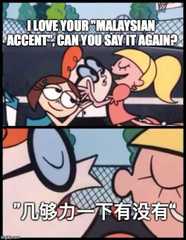
New blog picture - 21st November 2020


"I love your "Malaysian Accent", can you say it again?"
"几够力一下有没有"

Description: Meme from Dexter's Laboratory (original scene - omelette du fromage [sic])

Monday, August 26, 2019

Malaysian Chinese and Integration

An article that is both problematic and interesting at the same time:

Mak Khuin Weng - マク - Posts

"This is a VERY LONG article written by Tai Zee Kin back in 2013. I can't find the original post on his Facebook Page, so I'm just going to do a copy and paste here.

I would say that there is merit to what he wrote considering that other research papers that I have read on the Chinese school subject show that the primary reason we still have it in Malaysia is to ensure the Chinese language continues to thrive and prosper even though it is a language that is not used by Malaysians of other races within their own community.

I think this article provides a very good insight into the psyche of the Chinese educated under the Chinese education system.

........................................................................................
Ethnic Han (chinese)-Malaysian, please wake up from our ancestors' grievance and deparis!

马来西亚汉裔同胞,从我们祖先哀怨和悔恨的沉睡中醒起来吧-

(Preface - This article was originally written by me fully in Mandarin. However i have not gathered enough courage to publish the mandarin version, having anticipated attacks from Chinese Chauvinists in Malaysia. I've seek many advices from wise people before putting my thoughts together in this issue. In the spirit of Malaysia, I shall put forth this to you. I dedicate this to every Malaysian, especially our brothers and sisters from different races and ethnicity.)

- "I was listening to a song by the name of 黄河怨 (Grievance of the Yellow River). The wordings of the song reflected the grievance and mourning by the widows and children of chinese men who went on to fight the japanese. The wordings of the song was painful. they were saddening, and full of regrets."

1) The Great Divide - of Northern and Southern Chinese Immigrants

Being a chinese malaysian/ Han Malaysian, when you know another new Han Malaysian friends by their name, you would then supplement another question that other races wouldn't common asked : "What is your dialect clan"?

are you a hokkien? are you a cantonese, are you a hakka, are you a fuchiew, are you a TiewChew, are you a hainamese, or are you a Kwongxi?

many wouldn't go all the way to ask if you are a kwongxi.

Had it occur to you, that NO ONE ever asked, if you're a : Shanghainese, SiChuanese, BeiJingnese, Nanjingnese, HeBei, ?

During the last Dynasty and the reign of the last Manchurian Emperor Pu-Yi, with the influences and bullying by the 8 foreign-alliances on China (八国联军), as well as persistent civil war lead by Dr Sun-Yat Sen, many Han Chinese, who forms the majority of the Chinese population couldn't bear it any longer. They were living in absolute poverty and were suffering from impoverishment. Deep inside their guts, they couldn't swear absolute loyalty to their king, who were of a different ethnicity from north - the ethnic manchuria, who practices distinct culture from the ethnic han from almost every aspect.

Northern Chinese were commonly known as the 官人 (the rich/upper class). If you trace the english word "MANDARIN", it came from the ancient Sanskrit connotation of "MENTRI/MENTERI", which means "of the upper class". Mandarin, was known as the "dialect of the northern upper class". People who speaks Mandarin dialect, were the beijing officials from north. - I will elaborate further on this later.

Southern Chinese, like the Hokkiens, FUchiew, Hainamese, albeit adhering to the same writing system, spoke it differently. THese are the farmers, petty merchants, or commonly perceived as the "lower class" among the ethnic Hans. They long succumbed to the fate that northerner who speaks the upper class dialect (官语)-which later was known as the "mandarin" dialect are far more superior and richer.

living through poverty under the last ching dynasty, and severe instablity during the Nationalist Party's Reign under Yuan Shi Kai, many Chinese decided to leave the country.

Don't get it wrong here however.

The northern Chinese left China, with the intention of leaving it for good. they are comprised of the the poor, but mostly the rich. These people fearing that their assets would not survive through persistent civil warfare and lateron, the world war two, brought everything along with them to "better places", such as the USA and Europe.

The southern Chinese however, were "less" affected by the political instability, not being located in the crux of the game of thrones as much as the northerner. They, on the other hand, were those who seeked to "Change" the fate of their family. With that in mind, they went down south, as brought and offered by the British, to the Nusantara. (British was one of the 8 country alliances that dictated alot of china's politics).

They were brought in as Miner, labourer, and petty merchants to Nusantara countries, in order to work for the colonial masters' economical favour.

They were clinging on the hope that one day, upon gathering enough wealth, they could bring back their wealth here to China, and change the lifestyle of their Family in China. Some came alone, leaving their wive and children. Many others, bring along their immediate family members.

They suffered through the difficult passages to commute down south through massive ships, squeezing into the cramped little room for 1 month with technically minimal hygene provisions, just to get their way to Malaya.

They, were our ancestors.

__________________________________________________________

2.) Do you know that most of your ancestors do not speak the language you are speaking now?

MY grandgrandmother Chan Seong Lan, who died 3 years ago at the age of 105, was one of the migrants. I had the privileged of hearing 1st hand experience from her regarding her journey. Granny Chan came from TeowChiew.

When i was young, I had terrible communication problem with granny Chan. I spoke mandarin eloquently. but She doesn't. She speaks perfect Hakka and Teow Chiew, but never mandarin. To be honest, I've never heard she uttered a single mandarin phase. (what made me proud was that her MALAY was really good. She always "sembang" with the lady who sell laksa in front of her house, so i was told).

Our ancestors came down to Malaya with their dialect and language. they were very ignorant over the mandarin dialect (common acknowledge as a "language" in modern days). They do not even think that there was a need to learn mandarin. Most of their culutral practices and behavours were defined by their dialects, such as the Hokkiens and Teow Chiews' "Pai Ti Gong" ceremony on the 9th day of Lunar New Year or the Hakka's food like "Son Pan Zi", "Hakka teoh Fu" etc.

They came in with the simple thoughts of gathering Money, and bring it back to China so that it would benefit their relatives and family up in China. If you still have relatives above the age of 85, do ask them if they have siblings in China, and why didn't they go back to reconcile and reunite with them. we shall explore "why" they didn't go back in the next discussion.

_________________________________________________________
3.) Our ancestors who wanted to go back to China, did not go back. Why?

As mentioned above, their main reason of coming down to Malaya/other south east asian country, was not to settle down permanently, unlike the northern Chinese who migrated to Europe or the US.

Our Ancestors taught us a thousand year old virtue, of " Ru Xiang Sui Su 入乡随俗“ ( if you're in another foreign/alien land, you assimilate or integrate into the culture and practices of that society). "Ru Xiang Sui Su" was the guiding principle of the chinese who wanted to permanently migrate into a new society. You see the American Chinese migrant adapting Christian name, going to US schools, reading their news papers (of course you still have chinese circulation or chinese food in China town, which will be discussed later - as in the comparison between the china town of chinese who wanted to settle down in new society permanently, and the china town of Malaysia, former are likened to be a "remembrance" of their root, later is just a facade). The Chinese in Europe too incorporated into the european culture fairly quickly, where they won't be satisfied until their english is rich of British Accent. They did not forget their root nontheless of being ethnic chinese/han, but in terms of lifestyle and routine, they've assimilated and integrated into the society they've migrated to. You see that in places like Japan, Korea, or Thailand too for that matter.

However, this virtue of "Ru Xiang Sui Su" did not apply to southern chinese who've migrated to Malaya. This is simply because they never wanted to stay permanently.

Furthermore, the fact that our ancestors started Chinese school in early 1900, (first being Foon Yew High School in Johor) , started of Chinese Press (Kwong Wah Jit Poh, which is much earlier than Utusan) proved the irrebutable fact that our Ancestors WANTED to ensure that their next generation to be "well equipped" with the Chinese language and culture/customs, so that when they are back in China they would be able to adapt into the norms/culture in China easily. Chinese who migrated with the intention to permanently settled down in a foreign country, never started chinese school or chinese press in the scale that our ancestors did. Back then, Chinese school was not unified. You have Penang's "Fu Jian High School", which conducts it's lesson in Hokkien (currently, renamed "Penang Chinese Girl School/ Bin Hwa High School"). The name of the chinese schools also pretty much reflect on our ancestor's "reminder" of the fact that their presence in Malaya was temporary. you have "中华CHONG HWA". Chong Hua is the abbreviation of the "Chong hua/ tiong hua" race (not ethnic), which then is another rephase of the term 中土大园的华夏民族 (the Hua Xia (deepest root of the chinese) race from the main land ground). Contrary to popular believe, Chong Hua is not derived from China's Full Name "中华人民共和国“'s "Zhong hwa". in fact, both China's name, and CHinese School's name in Malaya derived from the first root of Chinese race (again, not ethnic Han), which is the "Main colossal Land's Hua Xia race 华夏 race).

what was the reason that they then stayed permanently?

If you read my previous blog post of "bumiputra, for non-bumiputra" ----> Link www.facebook.com/taizeekin/posts/10151559295110306 you would have realized that they CAN'T go back to China, against their desire.

soon after they came down, the world war two started. japanese invaded China, and there were civil war in CHina between the Communist fraction and the Nationalist fraction. Fact that Dr Sun Yat Sen started off his revolutionism from Penang, before recapturing China from the last manchurian emperor shows how deep an affinity between the CHinese in Malaya and China (of course he got his later funding from alot of oversea chinese in europe and USA as well, but he started in Penang, Malaysia).

Our Ancestors had NO CHOICE to go back to china and reunite with their siblings, family and loved one. As soon as the war ends, Communist party defeated Nationalist party lead by Chiang Kai Sek, and practiced "Close Door Policy". the Whole china, like North Korea, was sealed. No one was to enter and no one was to leave (technically).

Malaysian ethnic Han/Chinese will have no choice, but to negotiate for a settlement plan. They GRIEVE and MOURNE over the fact that they could no longer go back and reunite with their family in mainland China. But settlement in Malaya, was never meant to be perpetually. That's why they actually agreed to alot of terms that were seemingly compromising meritocracy on their part, but INSIST on venacular education. (read my previous blog above for an understanding about citizenship en mass). Venacular education, is the ONLY way they can ensure that their descendant like you and me, would be able to converse in our native mother tongue used in China, so that we could adapt the China's society when we're back.

The GRIEVANCE and MOURNING were then inscribed in our blood, and as a matter of fact, in the Federal Constitution right to vernacular education was guarenteed as a result of the "great trade off". the native nusantarian had no problem giving citizenship to assimilated Chinese/Indian/Europeans as long as they do not withhold their loyalty to their country of origin. Much to the malay's dismay, the chinese back then had almost all loyalty, in my humble opinion to China. Those who choose to assimilate would then be known as "peranakans", who speaks and behave like native nusantarian. the nusantarian would treat them as part of them. But because of the technical definition of them being "Chinese", they were bound by the faith of the 1st Generation Chinese Migrant unfortunately. The Seranis (eurasians) were not included in the "CHinese/INdian" package deal in the constitution. they assimiliated into the Nusantarian culture and was accepted. Again if you want to attack on this point, do read my previous blog first (Bumiputra, for non-bumiputra ---> www.facebook.com/taizeekin/posts/10151559295110306 )

Therefore It's suffice to say that Our ancestors, who wanted to prepare their next generation to go back in their stead (they couldn't because of the close door policy and world war two), instilled in our blood the "Legacy" of mandarin, the very gateway language to go back to China.

_____________________________________________________________

4.) Chinese School : To protect the 5000 years old culture and knowledge, or its just about the language as our Ancestor's legacy to become a gateway to go back to China?

I used to ask my friends from Chinese school, independent, UEC, or SMJK, on why would they go to Chinese School INstead of an ordinary National School.

i got 3 kinds of answers.

a.) The Chauvinistic answers
- Chauvinist (沙文主义) would tell me that it's our duty to protect the 5000 years old wisdom and culture. thats why we have to send our children to chinese school.

what these chauvinists failed to convince me, is how going to chinese school would ensure that they would protect the 5000 years old history, culture and knowledge?

- I asked them, do you know the "Si Shu Wu Jing (四书五经), the four main literature and 5 great mantras of the chinese. They couldn't even quote me the title of the 9 most important literature work of the chinese literature.

- I asked them, do you know the different school of thoughts between the confusionism 儒家思想, taoism 道家思想,or Mahayanian Buddhism 大乘佛理. they couldn't even distuingshih religion rituals and philosophical ideology behind the Chinese Culture-based religion

- I asked them, of the 4 great dishes in Chinese Culture, 四大名菜,京菜,粤菜,闽菜,and 川菜 (Beijing culinery culture, Cantonese culinery culture, Fu Jian culniery culture, and sichuan culinery culture) , how many dishes can they name? they couldn't even name ONE.

- I asked them, do you know the different between our Ethnic Han's tranditional costume, the HAN FU (汉服) and the Manchurian Bannerman's CHEONG SAM/ KEI PO (长衫, 旗袍,旗服) ? they thought that our traditional costume was Cheong Sam/ Kei fuk / Kei pou ), which was a disgrace to our ancestors. we were ethnic HAN with HAN surname like Tan, Lim, Chong, Teoh, but we called the Manchurian's costumes as our traditional costumes. Manchurians have surname like Yehonala, Nurhachi, Aisinjeoro. Not LIm, Tan, Chong. They didn't even know that.

Having said that, I , who camed from a Malay school, knew more about Chinese Culture, History, Wisdom and knowledge than them.

their defence of chauvinism hence became obsolete, as you DON'T NEED Chinese school to defend the culture/knowledge of the 5000 years old wisdom.

b.) For the language, Economical reason since China is big.

That reason is even worse. Singapore has ZERO Chinese School, but mandated everyone to brush up their mother tongue. Singaporean ethnic chinese ended up speaking better Mandarin than Malaysian ethnic CHinese/Han. THey didn't even need Chinese school for that?

If Mandarin is there for economical and practical reason, they SHOULD acknowledge that and propogate mandarin's learning through the right way. Not the chauvinistic way. I went to Malay school, but took up mandarin all the way to SPM, ended up knowing more about mandarin the language, and Chinese culture than many of the Chinese School graduates.

c.) Don't Know, just follow my parent's wish

That is the most dangerous part. This is exactly the very reason many chinese are living in our ancestors' legacy of Grieving and Mourning over the fact that they COULDn"T go BACK to china, and to make sure that their descendant are at least well equipped with the language so that when they eventually go back to CHINA they would be able to adopt at least in terms of language.

Chinese Education, is different from Chinese Education system. I think it is important for people of every ethnic origin to keep trace of their cultural route including language.

But we MUST not create an Education system purely to accomodate that aspect. Our Ancestors had valid reason to create a separate education system for chinese, for the very reason to prepare themselves and their next generation to Go Back and adapt to CHina. but now that we are permanently settled down in Malaysia, we should defend our mother tongue as a "language to trace our root", but not a SEPARATE SYSTEM altogether that would alienate a racial group from another throughout their growing time.

_________________________________________________________
5.) China Premier Zhou En Lai's visit

in the 70s, when China ended it's close door policy and begin to build foreign ties, Zhou En Lai visited Malaysia. He then made a statement, asking Malaysian Chinese to Swear our loyalty to Malaysia, to our King the Yang Dipertuan Agong.

That puts an END to our grievance and despair of our ancestors, in an abrupt way. No more going back to CHina. CHINA closed it's door to them.

Instead of moving on and , like every other chinese around the world, to assimilate and integrate, our second generation ancestors were very CONFUSED. their affinity to Chinese school system is now changed, from initially being an affinity to mainland china, to purely the school system. It's like , I am an Alumni from Chong Hwa school, and i would NOT let it be replaced/closed. There are 1297 Chinese school in Malaysia, and every each of these schools have alumnis who would, for the sake of their affinity to the school per se, defend and justify their existence.

It soon became and issue of "Quality of Education".

Chinese School was preferred, in the modern context, mostly because of their quality. I have people telling me, Chinese School has better teacher and better quality, thats why we send our kids there.

Therefore it's imperative that we do not hide under the facade and hypocrisy of "Defending 5000 years old culture", and admit that the reason they go to chinese school is because of practical/economical/and quality consideration.

_________________________________________________________

6.) Chinese's ability and willingness to adapt.

The Chinese, in fact, are among those who are most willing to adapt and modify our culture to intergrate with another culture that we look "highly" too. (of course, keeping a trace of our ethnic han route)

How many Chinese couples wear our traditional Han Fu costume during weddings. westernized, no?

Why many Chinese would adopt "Christian" name (NOT western, i am talking about name like Michael, Kelvin, Joseph, which are CHRISTIAN name) despite not being christians, and fact that it's very foreign to Chinese culture? of course they keep their enthic HAN route by keeping the surname/given name.

Why so many Chinese are willing to modify our offerings to the Deities? instead of candle light, many are now replaced with, hmn... red bulbs?

Talk about food, do you know that many of the SO CALLED Chinese food like Hokkien Mee, Bak Kut Teh, Hainam Chicken rice, can NEVER be found in Hokkien, or Hainam China? it's a modification and adaptation to the South East Asian CHINESE taste and preference. If you can modify most of the important cultures, it means you are flexible!

Chinese has a fairly flexible mode to adapt.

fact that the reason Chinese refuse to adapt to the Native nusantarian culture and behaviour, is very worrying. That's the root of Racism, sparked by FAKE chinese chauvinism.

have you seen a Zikri Tan Boon Hook? or Fatimah Ng Siew Lai? ok lets try with malay names instead of Islamic /arabic/persian name. how about Mawar Liew Mei Siew? or Delima Ong Mai Ling? no? you see more Christophers, Kelvins, Michaels (no offence to many of my friends who've adopted christians name) than ever.

Why did we fail to adapt to the native customes and culture is something that we have to ponder upon. i WOULD NOT spell the words out here and risk being labelled a "traitor to the race" like what Emeritus Professor Tan Sri Khoo Kay Kim has been treated rudely by the ignorant chauvinists.

For my Chinese Friends who speaks hokkien.

How do you call a Malay person in Hokkien? HUANNA 蕃仔 ? please use baidu.com to find out what that really means. it's a disgrace and i felt ashamed.

_______________________________________________________________

7.) China Town

Have you been to the China Town in US big sities, and also London's CHina Town? the China town in Western Countries are VERY chinese. It serves as a "remembraces" and "traces" of the Chinese origin for the migrants, as well as , for economical purposes sell off the unique chineseness to the foreigners. Most Chinese migrants in these country, who're well assimilated in their respective native culture, would from time to time, visit China Town to remind themselve about their root, in the form of remembrances more than "embracing" them.

Have you been to the China Twon in Kuala LUmpur, and feel the sorry state of it even being duped as "china town"? There is NO NEED for a China Town in Malaysia. most town in Malaysia is China Town. Chinese bill boards, Chinese advertorials, Chinese signboards etc. Why is there a need for a "CHINATOWN" anymore? any Street in Penang or Certain street in KL/ Serdang/Puchong could well beat London's China town as a more "china" china town.

_____________________________________________________________

8.) Malaysian First, or CHinese First?

Funny enough, If you ask that question, Many Ethnic Han Chinese Malaysian would answer you that they are Malaysian first, and Chinese second, without KNOWING what it means to be Malaysian first.

(Caution, if you are a URBAN BANANA, this does not applies to you. according to cense report, there are only 9% of you existing. rest 91% are Chinese educated ) You wake up every morning and watch TVBS Asia, pheonix channel, CCTV4, or hua hee tai. Shows that 80% of other Malaysians who are not chinese will never watch. Tune in to 988, myFM, aiFM, OneFM, channels that 80% of Malaysians don't understand and will never listen to. You reach your office, open up SinChew, NanYang, GwongMing, KwongWah, China Press, Oriental daily, something that only 80% of Malaysians CANNOT understand. you MIGHT have lunch with your malay/indian colleagues, and chat about life and work. once you go home from work, you talk to your family, children in Mandarin, a language that 80% of Malaysians CANNOT speak or understand. before you sleep, you go to facebook and scroll through. You post among your friends, whom 80% came from your ethnic.

in your daily routine, you are only a MALAYSIAN for 20%, but Chinese 80%. and you call yourself a MALAYSIAN FIRST? hmn... then perhaps, you could tell me how would Chinese first or Malaysian first make a different to you? Lets not quote me example of "WHEN YOU ARE OVERSEA" because you know what, how long are you over sea? so you're only Malaysian first when you are oversea? hmnnn.

The goal of me posting this long post, is to ASK for the ethnic HAN chinese Malaysian, to really reconsider our stand on issues pertaining race. Stop being chauvinistic and start to integrate and assimilate, WITHOUT compromising your ethnic identity. CHinese in UK/ US/ Thailand all did that willingly. why can't we? it's our ancestors' teaching that we SHOULD do that.

WAKE UP from our ancestors grievance and despair of not being able to go back to China. We are done with that. Let the grievance and despair follow our ancestors to their grave. Start rethinking about your stand as Malaysian.

Please INTEGRATE and ASSIMILATE into the native culture, and OF COURSE , keep mandarin as a language that would trace your ethnic origin. NOT THE OTHER WAY round or you are still TRAPPED in our ancestor's grievance.

___________________________________________________________

P/s I will write another post on HOW Mandarin, a dialect of the northerner, KILLS OFF our mother tongue (which is our dialect). Mother tongue for Chinese is different, it's not the language, but the dialect that our ancestors used. Do you know that great poet LI BAI 李白 wrote his poem in HE BEI dialect, which is the current "Hokkien Language", and the HE BEI dialect was the OFFICIAL language used in TANG dynasty royal palace and court? and there you think everyone in the movie speaks mandarin it must be the spoken language back then. MANDARIN is killing off your mother tonger. THe language is called HAN language 汉语。mandarin, (formerly 官语,(language of the aristocrats), now 普通话 putong hua, 华语 huayu) is MERELY a dialect of the northener. Chinese language is HANYU + your DIALECT. NOT Hanyu + MANDARIN.

that i will discuss in another post.

I further dedicate this post to Joan Lai, Wayne Teo, Jeffrey Foh, and every Chinese Malaysian who thinks that we MUST learn how to integrate into the native Malaysian culture.

Regards

TAI ZEE KIN"


My thoughts:

The main issue with this piece is that the author conflates the concept of Malaysian with that of Malay and/or Muslim. To him, to be a Malaysian you need to be (or be like) Malay and/or Muslim (most of the essay isn't about this, but this seems to be what animates his grievances). Certainly that is one model of integration, but nowadays that isn't fashionable anymore. Besides that he has other factual and historical errors.

Why is it wrong to want to preserve your minority culture?

If it was Northern Chinese who left China but went to "better places" like the USA and Europe, why are the older generation of Chinese restaurants (i.e. before the recent wave of PRC migration) all Cantonese, and why do overseas Chinese of that generation all speak Cantonese and not Mandarin?

In view of the above, it is no surprise that the author is also ignorant of the fact that many of the Chinese who went to the US, for example, also wanted to return to China (The History of Chinese Immigration to the U.S.), or of how the Chinese formed ghettos in the US (i.e. they did not integrate). And doesn't consider that the Chinese could create so many of their own schools in Malaysia because they had a critical mass - not that they didn't elsewhere; for example Chinese immigrants in the US set up their own Chinese heritage language schools whose aims sound a lot like that motivating the "chauvinism" he decries in Malaysian Chinese (Chinese Heritage Language Schools in the United States).

Malaysian Chinese speak the "dialects" pretty well - why does the author assume Malaysian Chinese only speak Mandarin? Or ignore the English-speaking Malaysian Chinese (many of whom can't write in Mandarin even).

Do Malays really treat "Peranakans" as "part of them"? Does speaking a Malay creole and having some Malay influence in your food count as adopting Malay customs?

Singapore is a very bad example to use for Mandarin proficiency. I highly suspect Chinese-educated Malaysians have better Mandarin than Singaporean Chinese. Not least since if Mandarin is your medium of instruction you're forced to be better in it.

Why does following your parents' wish for you to go to a Chinese school means they want you to go back to China?

How come when he asks them, no Malaysian Chinese say they go to Chinese schools because the national schools are shit? Or because national schools are effectively Malay schools (a Malaysian Malay describes the discrimination non-Malays face in national schools and how non meritocratic they are at Malaysian Teacher Shares Why Non-Malays Prefer Vernacular Schools Over National Schools - National School Discriminate Non-Malay Students In Schools Every Day - The Coverage) But somehow he parks it under the Zhou Enlai point?

If a separate school system alienates other racial groups, are Madrasahs in Singapore a good idea? How about Tamil schools in Malaysia?

What sort of non-Christian Western names does he have in mind? Kelvin comes from a Scottish river, not Christianity so already one of his examples is rubbish.

Why must Malaysian Chinese convert to Islam, adopt Malay names and customs etc to show that they are Malaysian? Why does he take Malayness and/or Muslimness to be Malaysianess?

Indeed he goes even further and claims that not adopting "Native nusantarian culture and behaviour is "the root of Racism, sparked by FAKE chinese chauvinism". That is a very bizarre claim and besides is ignorant.

The Chinese languages as spoken in Malaysia are influenced by Malay and other languages, Malaysian Chinese food is influenced by Malay food (e.g. sambal kangkong) and Datuk Gong is Uniquely Nusantarian:

"Around the Malaysian countryside some small, yellow-colour or red-colour painted shrines by the roadside or under a tree can be found, and these shrines are usually worshipped by the residents living around the neighbourhood. The shrines are normally of a fusion Chinese-Malay design, with Islamic elements such as the crescent moon decorations. Inside the simple room, a small, decorated statue is venerated, depicting the Datuk. Around the statue offerings are brought, sometimes on a small altar in front of the datuk statue.The Statue of Datok Kong (拿督公 Nadu-Gong) is commonly represented by a Malay man dressed in Traditional Malay Costume,wearing a formal Songkok (hat) on the head, Kris (Malay sword) & other traditional Malay court regalia & ceremonial objects would also be placed on the altar" (TAOIST SORCERY: Datuk Gong - Malay Deity of the Chinese)

Is a Malaysian Tamil who speaks Tamil, consumes Tamil media and mostly has Indian friends Malaysian (consider that more Malaysians don't understand Tamil than don't understand Mandarin)?
Is a Singaporean Malay who speaks Malay, consumes Malay media and mostly has Malay friends Singaporean (consider that there are more Singaporeans who aren't Malay than Malaysians who don't understand Mandarin)?


If you feel my characterisation of his thesis statement is unfair, he explicitly states in the linked post:

"till chinese in malaysia decide to tone down our “chineseness” (*not getting rid, just tone down), we cannot do away withbumiputra policies. it’s too dangerous.

The exit clause of the Federal Constitution Contract is clear.

1.) Either we honour it until time immemorial if we are still carrying our ancestors’ legacy (chinese school, chinese language, chinese chamber of commerce, the word “chinese” trumpts over malaysian in education and economical aspect)

or

2.) We assimilate into the Nusantarians. IE, become a malay.
That’s the exit clause.

But to put the contract to an “END”, we need to find MORE common grounds with the nusantarians."


He claims Malaysian Chinese only need to "tone down" their "chineseness", but his prescription involves getting rid of Chinese schools, the Chinese language(s), the Chinese Chamber of Commerce and Chinese involvement in the economy (or at the very least, presumably toning it down till they are only responsible for 24% of the economy to match their numbers).

That or becoming Malay.

You can't get more clear than that.

Addendum: Malaysian Chinese need to convert to Islam and practise Malay customers to be integrated Malaysians. Minority bashing is good when the minority is Chinese

Friday, June 28, 2019

Halal cert a passport to success

Halal cert a passport to success
(2012)

Getting halal certification from Jakim is good for business but there are some who are wondering if the effort is worth it.

HAKIMAH Mohd Yusoff chuckles when asked about the oddest thing that Jakim has been asked to certify as halal.

“Furniture! One manufacturer wanted to have its furniture certified halal' but we said sorry, we don't have a standard for that'.

“Another asked for knee replacement implants to be halal-certified but these are metal and we can't process that.

“One wanted Jakim to certify his live goats halal' but the goats are still alive. How can we do that? It is only when it is slaughtered that we can certify if it is halal or not.”

Malaysians can be a bit peculiar sometimes, adds Hakimah, director of the Halal Hub Division of Jakim (Malaysia Department of Islamic Development).

One entrepreneur selling dates from Saudi Arabia was stunned at the recent Mihas global halal trade fair in KL when Malaysian buyers wanted to know if the Saudi dates were certified halal.

“I don't know if it's a joke or if they are playing with halal. Dates are fruits. Who gives halal certificates to fruits?” asks Mustafa Iqbal, whose head office is in Jeddah.

He says the dates are not processed or stuffed but merely cleaned and packed yet Malaysians still ask if they are halal.

Concurring, Jakim's Hakimah says dates are fruits so it is fine for Muslims and there is no need for them to be halal-certified. But, she notes, manufacturers see halal certification as a “marketing tool”.

Just take chicken eggs.

These are naturally halal but Hakimah says some local industries selling eggs want Jakim to give them a halal certificate because they believe it will giving them an edge over their competitors.

Jakim's halal certification does not depend purely on whether a product complies with the syariah requirements alone as it also takes into account other aspects such as if the process, hygiene, equipment, storage and safety and standards are quite stringent.

“So some industries feel having a halal logo and label would add value compared to a product that has not been certified halal. And I don't want to dampen their aspiration,” Hakimah says.

Wasli Ibrahim, managing director of Pawada Food Industries Sdn Bhd, received halal certification for the ground pepper his factory produces. Why?

“People are emphasising halal these days. Between a halal and non-halal certified product, buyers would prefer the halal one, so for me it's a marketing strategy,” he admits.

In recent years, there has been a lot of interest in the halal industry not just in Malaysia but also in other parts of the world with a Muslim population. Both local and foreign manufacturers are tapping into this market.

Four categories

In Malaysia, halal certification is divided into four main categories food and non-food products like cosmetics, soaps, shampoo, toothpaste; restaurants and food premises; slaughter houses and logistics.

Most applications for halal certification, of course, are not as frivolous as for black pepper and eggs but are in fact warranted and legitimate.

Jakim is the sole body in the country authorised to issue halal certification. In the past, state reli gious bodies could issue their own halal certification with their own logos but not anymore.

“Last year, the government decided it was not effective to let states issue the certification because when industries want to export their products, they find they can't export them as halal' products because those (importing) countries only recognise Jakim's halal certification. So now, there's only one issuing body (Jakim) and one logo,” says Hakimah.

She adds that the halal logo issued by private entities such as Ifanca International, Halal Food Council S.E.A, and IFRC Bahtera Lagenda is no longer recognised by Jakim.

Like most things, there is a process to get the certification. It starts with filling up an online application (on the Jakim website) listing out every raw material (including water) used to make the product and stating if these are halal.

Next, the manufacturer would need to submit documentation with the halal certification for each of these raw materials.

If Jakim finds everything in order, it will ask for the fee to be paid, after which it will carry out an unannounced audit on the factory.

An inspection will be done on the raw materials to determine if they are indeed from the sources stated, the processes and whether the factory complies with the requirements as well as hygiene and safety standards.

If there are things lacking, Jakim will advise the manufacturer concerned to rectify the problem.

Last year, Jakim received 4,237 applications for halal certification and it certified 1,674.

Mohamed Zulfikar Ibni Mohamed Hazri, manager of DMG Food Industries Sdn Bhd, finds that if a manufacturer has all the necessary documentation, it is easy enough to get the halal certification.

But some say that despite all the proper documentation, they end up waiting for up to six months for their halal certification because Jakim is short-handed.

“The government is doing a good job promoting the halal industry and we are riding on the advantage. Our selling tool is halal and new oil-rich Muslim countries like Kazakhstan, Uzbekistan, and Turkmenistan prefer to buy from us rather than Europe because we are halal.

“But what we want is efficiency. After we have met Jakim's halal requirements, why do we have to wait six months for the halal certification? We are doing business. That's lost opportunity for us.

“Jakim needs to speed things up and get more manpower. Some of our products have up to 50 ingredients. Does Jakim have the manpower and expertise to go through the documentation for the 50 ingredients,” asks the general manager of a huge Malaysian food manufacturer who declined to be named. It took Chung An-Hung's factory in Hong Kong, which produces premium Three Crabs fish sauce, eight months to get its halal certification from Jakim.

This included paying for the flight and hotel stay for two Jakim officers to audit the factory in Hong Kong. The factory also now employs two Muslim workers a Jakim requirement for certification.

The fish sauce sells for RM18 and is relatively new in the Malaysian market but as it has already made a name for itself internationally, Chung can't tell if getting the halal certification has boosted sales.

But he maintains that the effort was worth it.

“Yes, I would do it all over again. I learnt a little bit about the Muslim community because of the halal issue. And if the Malays accept it here, we can use the halal certification to penetrate other Muslim markets,” he says.

A long slog

Hakimah says Jakim has 154 people in the halal hub section involved in the certification process but they cater to three different major jobs processing the application, auditing the factory, and monitoring.

And the same team handles both local and overseas manufacturers seeking halal certification.

“I won't deny there are times when we are short-handed and applications can get stuck for a bit. That is one of the challenges we face. But the delay can also be due to us finding non-conformance during the audit process, so we have to go back to the client and ask them to make the changes,” she says.

DMG's Mohamed Zulfikar says applications for certification can get held up when a supplier cannot produce the halal certification (for the raw materials). He finds it odd too that Jakim demands halal certification for raw ingredients like salt and sugar.

“Our butter cookies use no animal fat and are suitable for vegans. We use 15 raw materials and Jakim wants halal certificates for each of the 15 ingredients including sugar and salt. Sugar and salt should not need to be certified halal but Jakim insists on it,” says Mohamed Zulfikar who studied food science and technology at university and is well versed with how raw ingredients are processed.

“Butter is made from milk. You don't need to slaughter a cow to get the milk. There are no enzymes from pigs or from any animal in butter yet Jakim wants a halal certificate for it. Flour is from wheat and when you put wheat into a grinder it becomes flour, so why does it need to be halal-certified?” he asks.

He also points out that while suppliers are allowed to produce halal certificates from the countries they import the raw materials from, “there are some halal certificates that Jakim recognises and some that it doesn't.”

“If the supplier can't produce a (Jakim-recognised) halal certificate, we would have to change suppliers even though it may cost us more. Some manufacturers cheat.

They submit documentation of the raw material from a halal-certified supplier but later, without Jakim's knowledge, they switch to another supplier because it is cheaper. That is a silent policy going on in the industry,” he says.

Currently, Jakim only recognises 57 halal certification bodies from a total of 31 countries which is a relatively small number. Of this, none are Middle Eastern countries.

Hakimah explains: “When Jakim first started halal certification, it was mainly for meat so the certification was primarily for imports from non-Muslim countries like Australia and New Zealand. With time, the list expanded.”

She says that before Jakim recognised the 57, it checked their systems, standards, capacity, expertise in syariah, technical knowledge, food technology and even went over to witness how they carry out their audit to make sure that it is up to Malaysian standards and procedures.

Suspect ingredients

People in Middle Eastern countries are asking why they need to have their products halal-certified because they feel that as they are Muslim, naturally all their products are halal, Hakimah says.

“But we ask them about their gelatin, additives and emulsifiers. Are they made locally or imported? If they are imported, are they sure these are halal? That has made them think again. Now these countries are aware and are interested in setting up their own halal certification body and have asked for our assistance.”

As for sugar and salt needing to be halal-certified, Hakimah refutes this. She says that while Jakim does ask for the source and supplier of all ingredients, it does not demand halal certification for sugar and salt.

“Sometimes the industry doesn't check with us and just bases things on hearsay. They should ask us,” she says. But when it comes to water, she says, there is a possibility of it being not halal.

“Water from the pipe is not a problem but when it comes to distilling water, some parts of the equipment can be made up of bones and if the animal is not slaughtered then the water is not halal,” she explains.

But what about concerns that listing out ingredients to Jakim is as good as giving away one's trade secrets or recipes? Phyto Herbal Industries' factory manager Yi Chee Hwa does not have a problem with this.

It manufactures a phytonutrient drink formulated with 23 ingredients and gives Jakim a list of all 23 ingredients complete with halal certification for each. Hakimah says all Jakim wants to know is what the ingredients are and not the formulation.

“We just want to know what you use. Otherwise, how can we tell if it's halal or not? We don't ask how much sugar or how much salt you put in. That's your secret. A company will never reveal its formulation and we don't ask for it either,” she says, adding that even huge companies like Pepsi and Coca Cola have no problems listing out their ingredients.

The Pepsi and Coke made in Malaysia have been certified halal.

Jakim charges small industries RM200, middle-sized industries RM800 and multi-national industries RM1,400 for the two-year halal certification. Hakimah describes this as only a “token”.

“Our expenses are more than that especially if they had to correct some things and we have to return to do a re-audit. When we do audits in Malaysia, we pay for the flight, transport and hotel stay ourselves. We are doing it as a government service so we are not profit-based. And I think our fee is probably the lowest in the world. Singapore and Indonesia charge more,” she says.

She stresses that manufacturers are not obliged to apply for halal certification. But Mohamed Zulfikar says that without the halal certification, sales will definitely be affected.

“We don't use animal fat at all but there is a thing called customer stigma. So we have to get halal certification to give customers the confidence.”

The food manufacturer who declined to be named, adds that 70% of his customers are Malays and without the Jakim halal sticker, many would stop buying his products because they would be wary.

As for imported goods, Jakim approved halal certification for 35 products last year. When Iranian Amir Sallehi, who imports Clipper's organic tea and coffee from Britain into Malaysia, applied for halal certification from Jakim, he found the requirements were more than he bargained for.

Jakim wanted to visit the factory in the UK to do an audit for this he would have to bear the cost of the flight and hotel stay and there was the specification that there must be two Muslim staff working in the UK factory.

“It's just tea and coffee and it's organic and imported in places like the UAE. The principal company doesn't need the halal certification because its product is organic, and they told me I have to pay the cost.

“I thought getting halal certification from Jakim would be easy but it's been nine months. It's not worth it, so I think I'll give up. I can put the tea and coffee on the shelves in supermarkets here without the halal sticker.”


Related:

Islam-friendly coconuts: has Malaysia’s halal drive gone too far?

"Coconuts do nut automatically spring to mind when it comes to food fit for consumption by Muslims... Linaco, Malaysia’s largest coconut product company, has been halal certified since 2000.According to executive director Joe Ling, halal certification was not a requirement but being declared halal has improved business...

Malaysia External Trade Development Corporation (Matrade) is one of several government agencies working to expand halal beyond the narrow question of what is permitted or prohibited by Islam to encompass higher standards of quality, safety and health in production processes.

“Halal is beyond food and beverages – halal is a lifestyle,” said Wan Latiff Wan Musa, the agency’s CEO...

Even non-Muslims had come to regard the halal seal as a sign of quality, he said...

The question of whether bottled water or carbonated drinks could be labelled halal ignited a social media debate in the Middle East. As Sirajuddin Bin Suhaimee, the director of the halal hub division of Jakim, noted, some water-purification systems use charcoal made from pig bones in the filtering technology.

In Saudi Arabia, home to Islam’s holiest sites, even if medicine is not halal it can be used to prevent death or illness. In Malaysia, though, the pharmaceutical industry has suggested it is possible to create genuine halal medications free of pork products and alcohol. However, not every medication can be produced this way...

[Indonesia's] President Joko Widodo last month moved to implement a law requiring all food, drinks, pharmaceuticals and cosmetics to be certified halal or carry a stamp making clear they are not...

Electronics giant Sharp released Indonesia’s first halal-certified refrigerator, designed to provide customers “with a sense of security and comfort”, according to the promotional materials. However, some observers suggested this was a bridge too far in the expanded definition of halal.

Also, according to some halal advocates, the Indonesian law places an undue burden on businesses – particularly smaller ones – which make consumer products...

The Indonesian Ulema Council (MUI), which implements halal certification, is led by Indonesian Vice-President Maruf Amin, and Indonesian news site Tirto estimated that MUI could have made US$8.8 million from halal-certification fees in just four years."


When you copy Arab customs thinking they make you more Muslim but still try to out-Muslim the Arabs (by declaring water and salt Halal)
Related Posts Plugin for WordPress, Blogger...

Latest posts (which you might not see on this page)

powered by Blogger | WordPress by Newwpthemes