L'origine de Bert

Get email updates of new posts:        (Delivered by FeedBurner)

Showing posts with label sedition. Show all posts

Sunday, January 14, 2024

Singapore kills a Chicken to Scare the Monkeys

From 2023:

Singapore kills a Chicken to Scare the Monkeys

"On July 23, 2021, an article appeared in the Tokyo-based English-language weekly Nikkei Asia Review, calling attention to the Singapore government's handling of so-called KTV lounges, alleging that decades of institutional failures in dealing with what the article called "organized crime cartels” were running what amounted to illegal brothels, which were responsible for the widespread spread of Covid-19 among the lounges’ patrons. 

The result was astonishing. The story got an unheard-of 1.5 million hits from amid Singapore’s 5 million-odd population virtually from the moment it was uploaded, and far more than Nikkei had ever scored on a Singapore story, by a factor of thousands. As most Singaporeans know, the KTV lounges have been an embarrassment to strait-laced Singapore for decades, widely regarded as an unregulated hotbed not only for the coronavirus but as places where prostitution flourishes openly as authorities have long looked the other way.

The article appears to have generated absolute fury at the very top of the Singapore government, particularly in the office of law minister K Shanmugam. Singapore's answer to the story, which was written by a 28-year-old security analyst named Andy Wong Ming Jun, wasn't long in coming. Indignant articles appeared calling the Nikkei article “full of inaccuracies” and justifying the government’s control over the lounges and pointing out, among other things, that “Singapore has laws against organized crime, money laundering, and trafficking-in-persons” that keep the lounges squeaky clean.

The government apparently didn’t turn to the courts for defamation, as usual when deeply offended although officials in Singapore’s Tokyo embassy relayed a threat to throw Nikkei's entire business operations out of the country, reliable sources say, not just Nikkei Asian Review.

Wong is now in the UK, writing his master’s thesis and counting his scars, and unlikely to ever return to the city of his birth absent a political revolution. In the aftermath of the publication of the article in Nikkei Asia Review, he says, his life has been taken apart in stunning fashion, to the point where his professional and social life in Singapore have been ruined and he's been forced into exile.

According to his account, as well as news reports and court records made available to Asia Sentinel, Singapore mounted an attack on him that can only be described as unprecedented. It extended even to the consulting firm boss he was working for, who will remain unnamed, but who was blackballed from Singapore by his industry and political contacts, who “implied because they questioned his judgment in hiring a Singaporean who turned out to be a political critic.” The owner of the firm was forced by circumstances to close his consultancy and leave Singapore.

Three days after the article appeared, Wong and three others were arrested and charged in court with possessing or transmitting obscene materials through a Telegram chat group in an affair that had occurred 20 months before and seemingly gone dormant. Wong has repeatedly been identified as a ringleader of the group in state media reports and social media chatter as allegedly possessing vast amounts of porn on his iPhone and on his computer although in court documents he was identified as only a member of the chat group, which had 25,000 members.

Never mind that according to the Straits Times, 90 percent of teen boys and 47 percent of teen girls in a survey acknowledged viewing pornography. (Downloading such materials, however, is an offense.)...

“Up till July 2021 I was also gainfully employed in business/political risk advisory in Singapore under a British boss, from which I've since had my ties severed due to significant compromising and blowback from my ongoing political persecution.”

Andy Wong is in company with victims of Singaporean government vindictiveness going back to four decades to the days when opposition leader Joshua B Jeyaretnam was persecuted falsely for irregularities in his party’s financial books. More recently the targets of government wrath have included citizen journalists Terry Xu and Ai Takagi, critic Roy Ngerng, cartoonist Leslie Chew, blogger Alex Au and many opposition politicians who have ended up in court facing charges and crippling fines after they called attention to alleged shortcomings in the Lion Republic.

Human rights lawyer M. Ravi was recently suspended from practice for five years for criticizing government vindictiveness against one of his clients who was on death row. He had previously also represented Alan Shadrake, who was jailed for more than five weeks in 2010 for his criticism of the death penalty in Singapore with his book Once A Jolly Hangman.

This process was described earlier at length in a 2017 Human Rights Watch report titled “Kill the Chicken to Scare the Monkeys: Suppression of Free Expression and Assembly in Singapore...

In November of 2019, he says, police raided his home and those of three others, apparently acting on a police report from an unnamed young woman angered about their alleged organized possession and sale of “illegal nude pictures.” While the other three were administrators of these groups, he says he was just a member along with 25,000 others. His passport and electronic devices were impounded and he was bailed for S$5,000.

Things went very quiet, he says, with no progress, and subsequent devolution of the initial accusations of selling illegal pornography or being a group administrator into simple possession by the time the first interview had ended. As a direct result of his arrest and ongoing investigations, he missed work and was later forced to resign from his position as a corporate secretary.

Then Covid happened. Without a job, unable to leave Singapore because of his impounded passport, he took other jobs such as working in port logistics (for which he was featured as a positive example by Singapore state media) and freelance defense writing. He says he established a strong network with thinktank heads, industry professionals, and people within the local political establishment.

In July 2021, he wrote the offending personal post about the Singapore government's handling of the pandemic on his LinkedIn social media platform, gaining traction among local expatriates. An acquaintance and think tank associate forwarded it to Nikkei Asia Review, whose editor then asked him for permission to modify it for publication.

The article elicited a furious response in local mainstream media and even in Parliament. Nikkei was threatened with the use of Singapore’s “Protection from Online Falsehoods and Manipulation Act,” commonly abbreviated as POFMA and known colloquially as the Fake News Law, and threatened with being kicked out of the country altogether. The publication stuck by the article, as Asia Sentinel has verified.

“So, what do you do when you can’t take down a message online? You destroy the person who said it. You shoot the messenger with any convenient weaponized leverage within reach That's what happened to me,” Wong said. “An immediate campaign of character assassination was initiated against me by Singaporean state media, calling my article full of falsehoods and inaccuracies. Shanmugam even went on record in the news and televised parliamentary sessions denouncing me and calling me out as a fraud with an axe to grind against the government.” 

This was a sitting law minister actively interfering with public comments on an open case, despite also stating in a 2016 Law Bill that “Persons in court cases should not face prejudgment by the media or by the public, in a way which whips up sentiment and creates a real risk of interfering with their trials.”

The wheels of justice spun fast. Barely a weekend after the publication of the offending Nikkei article, the Singapore Police acted on Wong’s dormant porn possession charges. He and the three other unrelated suspects were ordered to Tanglin Division police headquarters on July 26 – three days after publication.

Two days later on July 28 he was in court to officially acknowledge charges and start the court process, more than 20 months after his initial arrest. The case had been in limbo for so long that the police had to assign a new investigating officer because the original one had been reassigned elsewhere.

Wong ended up facing a total of 11 charges relating to possession of pornography, of which the most serious three were officially proceeded on to exact the highest possible punishment, he says. There was no mention of any aggravating factors such as “illegal nudes,” nor of linkages of his private pornography possession with his membership of the Telegram groups.

Although the original charges in the press circular put out by the police didn't contain any names of the four, their names were added in and plastered all over the police news web. Wong says state media character attacks increased as he attended court to acknowledge the possession charges.

“This concerted character assassination campaign resulted in a trial by trial by media and public opinion before a trial by law in a court to defend and address my charges,” he told Asia Sentinel. “This was the ultimate intent of the government in weaponizing my dormant criminal investigation case to discredit and destroy my life, even if it was utterly irrelevant and unlinked to my article.” 

He says that as a direct result, he was subjected to targeted harassment and personal attacks on various local social media forums, he says, with some disclosing his publicly-available court dates in case potential troublemakers wished to turn up and harass him...

In fact, in the end, the attorney general said the office had no intention of adding anything about transmission to possession of porn charges, and they would only be asking for a fine and no prison time. But, he says “this didn’t stop them from attempting to put me behind bars, for after the three other individuals linked to my case were sentenced to jail time, the deputy prosecutor was still communicating to my lawyer stating that his superiors had ordered “one final look” at my case to see if there was any justification to put me in prison.”

When his lawyer tried to raise this point in his defense statement, the deputy public prosecutor sought a hearing against the lawyer to discredit him in the eyes of the judge. His request was ultimately denied

He says the government set out to “weaponize my ‘porn possession’ charges although there were no links to any of the Telegram groups he was a member of, as attested to by the public prosecutor’s own statement of fact. Nonetheless, prosecutors asked for a "double fine" for his two video possession charges, with a maximum fine S$20,000 each. With another S$2,500 charge for possessing porn pictures on his phone for a total of S$42,500.

“I have been effectively publicly and professionally silenced and societally outcasted in Singapore,” he says. “I was robbed of any chance to defend myself in the open and say whatever the media and Shanmugam had reported about me was false and wrong. This was in large part due to obfuscation and stonewalling by the police and attorney general’s chambers towards my lawyer’s protestations as to who was responsible for the erroneous press circular put out about my case. As long as it was not changed, state media could then have their smokescreen to claim objective factual reportage of my case even before final sentencing.”

His lawyer, he says, “strongly advised me not to defend myself in public about my Nikkei article or my case till we have more legal clarity out of concerns about further state aggravation and trial by media over my unrelated article muddying my legal case and we had to somehow play dumb and pretend that my case is going to be tried and handled in a vacuum independent of external circumstances and political interference. Not that it worked in the end.”

Shortly before Wong was convicted and sentenced, Singaporean state media released a documentary indirectly corroborating and confirming his Nikkei Asia Review article on YouTube titled “Sing City: What Drives Singapore's Underground KTV Industry?”"


Tuesday, September 12, 2023

Nobody’s independent: Singapore’s presidential election

Nobody’s independent: Singapore’s presidential election

"Singaporeans elect a new president from the three people the government has deemed fit to run: Ng Kok Song, former GIC chief investment officer (CIO), Tan Kin Lian, former boss of NTUC Income, and Tharman Shanmugaratnam, former senior minister with the ruling People’s Action Party (PAP).

If character, competence and experience were the yardsticks by which voters choose, Tharman, respected across the political spectrum, would be a shoo-in. That he isn’t speaks to several issues with this problematic office, including its troubling origins in Lee Kuan Yew’s paranoia about losing power; the undemocratic and sometimes opaque nature of the qualifying process; the ambiguities about the role; the misalignment in expectations about the role between the establishment and the electorate; and the relentless tinkering by the PAP over the decades with the qualifying criteria, seemingly to install politically aligned presidents.

All this has caused among the electorate deep disillusionment with the elected presidency. Many generally regard it as a frivolous exercise. For some, it’s a chance to cast a protest vote against the PAP. This year, a “spoil vote” movement has emerged. Despite some enthusiasm about overseas Singaporeans being able to vote by post for the first time, Friday’s election is in many ways less a celebration of democracy than an obligatory ritual. It’s important to understand the origins of this apathy before assessing the three candidates.

Before 1991, Parliament appointed Singapore’s president, who served as a ceremonial head of state. The genesis of the elected presidency can be traced to 1981, when JB Jeyaretnam of the Workers’ Party (WP) won a by-election and broke the PAP’s 14-year stranglehold of Parliament. This scared Lee Kuan Yew. In 1984, he worried about a “freak election” delivering to office free-spending charlatans, who might raid and deplete our reserves. That’s when he first mooted the idea of an elected president as a possible check on a rogue government.

Seven years later, the Constitution of the Republic of Singapore (Amendment) Act 1991 revamped the role, duties, and selection mechanism of Singapore’s presidency. Chief among these changes were the president’s new veto powers over the use of Singapore’s reserves and key public service appointments, and the need to elect the president so they have the mandate to do all that. Only those who’d held a senior position in government or led a big corporation would qualify automatically to run. Despite changes since then, those remain the core powers and the guiding philosophy for eligibility.

Given that incumbent Wee Kim Wee had two years left of his term, the first presidential election was held in 1993, pitting Ong Teng Cheong, a former deputy prime minister with the PAP, against Chua Kim Yeow, Singapore’s first auditor-general. The LA Times reported that Richard Hu, finance minister, persuaded Chua to run. So reluctant was Chua that he admitted that he was running out of a sense of “public duty”, and that he considered Ong “a far superior candidate”. The Straits Times (ST) published a letter from an irate citizen: “I am greatly dismayed and disappointed by Chua Kim Yeow’s approach to his candidacy for president.”

Even after endorsing his opponent, Chua still garnered 41.3 percent of the vote. A now-popular adage among establishment folk emerged: even if one puts up a monkey, they’ll still get 40 percent of the vote. 

Further complications would follow for Lee, because the new president Ong—how dare he—actually tried to do his job. He wanted to understand the size of the reserves he was charged with protecting. In 1996, when Ong asked for a valuation of the state’s physical assets, the accountant-general irritated him by responding that it would take 56 man-years to compute. “Oftentimes, senior civil servants found him ‘a pest’ and told him that the scheme only required him to check ‘the bad guys’, not the current government,” wrote academics Cherian George and Kevin Tan in “Why Singapore’s next elected President should be one of its last”.

Ong fell out of favour with his former party colleagues. In declining to seek re-election in 1999, he spoke about a “long list” of problems he had faced as president. The government issued a point-by-point rebuttal. When Ong passed away in 2002, he received only a “state-assisted” funeral, not a full state funeral as other leaders, including his predecessor Wee, had enjoyed.

The treatment that Singapore’s very first elected president received did not bode well for the office. The second elected president, SR Nathan (1999-2011), elected twice in walkovers, downplayed the office’s discretionary powers given that there was, in his view, a good government in charge. In 2011, amid broader political liberalisation, another problem emerged for the establishment. 

Lee had believed that the stringent qualifying criteria would limit the presidency to figures friendly to the PAP, noted George and Tan. But he hadn’t counted on “breakaway establishment figures” vying for the role. The most important of these in 2011 was Tan Cheng Bock, a former PAP member of Parliament, and current chairman of the Progress Singapore Party, who ran against Tony Tan, the PAP’s preferred candidate, in an election featuring four Chinese men surnamed Tan.

Tony Tan won with 35.2 percent of the vote, with Tan Cheng Bock just 0.35 of a percentage point behind, with 34.85 percent. Tan Jee Say, a former civil servant, won 25.04 percent and Tan Kin Lian, a candidate this year too, won 4.91 percent.

With its preferred candidate having come within a whisker of losing in 2011, the PAP was shaken. A slew of constitutional changes followed ahead of the 2017 election. Most contentious was the affirmative action tweak: if a particular racial group had not been represented as president for five terms, or 30 years, then the subsequent presidential election would be open only to them. This effectively reserved the 2017 election for Malays. Critics perceived this move similarly to the creation of the Group Representation Constituency system in 1988—an attempt by the PAP to instrumentalise race for political gain. “Tan Cheng Block,” some cried.

The other important change was that private sector candidates henceforth had to lead companies with at least S$500m in shareholders’ equity to qualify, up from S$100m in paid-up capital. This change meant that both Farid Khan and Mohamed Salleh Marican, who may have easily qualified under 2011’s rules, were unable to do so in 2017. Likewise, for George Goh this year. Critics believe that all these changes make an institution that’s inherently undemocratic even more so. Based on minister Chan Chun Sing’s comments earlier this year, Jom calculated that only 0.044 percent of Singaporean adult citizens can easily qualify to run for president.

While the government accepted the Constitutional Commission’s recommendations in 2016 on tightening the criteria for the private sector, it rejected those for the public sector: minimum six years in a qualifying office. If it had also accepted that recommendation, Halimah wouldn’t have qualified—she’d been speaker for only four years. As it turned out, she was elected in a walkover. 

This was the most questionable Singaporean election in recent memory, and not only because Tan Cheng Bock, Farid and Salleh couldn’t contest. Ugly complications emerged ahead of the election. Citizens learned that Halimah’s official race on her identity card is “Indian”, following her father. Yet, she claimed to be Malay and was accepted by the community as such. Interrogations into the salience of ethnic identities and classifications ensued online.

Many Singaporeans had by then been making genuine attempts to carve out space for granular meaning and identity within those broad yet limiting buckets, “Chinese”, “Malay”, “Indian” and “Others”. But the transactional way the PAP was seen to be treating race meant that public discourse was a reductionist one, about the PAP and Halimah’s perceived opportunism. It was often accompanied by racially charged terms, like makcik (auntie).

To rub salt in the wound, in Parliament in February 2017,  Chan called Halimah, then speaker, “Madam President” twice. Many colleagues laughed along with him. This was months before Halimah had even confirmed she’d be standing for the election in September, and well before Farid and Salleh’s applications were considered. Senior PAP politicians appeared to possess some electoral clairvoyance.

One can trace a clear line of voter bewilderment from the apparent charade of the first election in 1993, and the problems Ong, a party stalwart, subsequently faced as first president, all the way to 2017, and the manner in which Halimah entered office. The elected presidency remains the largest constitutional amendment, having added 30 percent more content to the Constitution itself. Penat lah, tired, is how many Singaporeans feel about the whole show.

Even though Lee Kuan Yew envisioned the elected presidency as a possible check on a non-PAP profligate government, it’s evolved in a way that many citizens now see it as a potential check on PAP hegemony. This is the underlying reason why there is so much democratic dissonance leading up to it...

For liberals, the disillusionment with Tharman stems from the persistent feeling that he’s not as progressive on socio-economic issues as they want him to be. This has its roots in the late 1970s and 1980s, and the hope invested in Tharman, the young student activist and leftist. “The sharpest mind of our generation”, as KC Chew, Tharman’s friend since secondary school, told Jom.

That generation’s desire for socio-political liberalisation would be rudely halted by 1987’s Operation Spectrum, when the government arrested and detained without trial 22 church workers, opposition volunteers, and activists, including Chew, claiming they were “Marxist conspirators” plotting to overthrow the state.

While many remained outside the system, Tharman went on to enjoy a long career in public service. He rose to managing director of the Monetary Authority of Singapore (MAS) before resigning to join the PAP and stand for election in 2001. If this was perceived as him selling out, a month following the election Tharman, in an interview with ST, publicly stood up for his former leftist comrades who’d been arrested in 1987, saying that “...from what I knew of them, most were social activists but were not out to subvert the system.” (He’s done so recently again on the campaign trail.)...

Elections in most democracies are usually opportunities for citizens to revel in the marvel of joint decision-making, of collective choice, of living in a system where citizens are empowered to choose their leaders. But Friday’s presidential election in Singapore will be a reminder mostly of how convoluted the practice of democracy here has become. And how that, itself, is a symptom of a rather depressing aspect of being Singaporean: our leaders simply don’t trust our judgement."

Monday, July 24, 2023

"Affordable" Housing in Singapore

Don Soh: "My son tried 7 times to apply for a BTO but failed each time. The documentation fees is a paltry $10 for each application. I am not bringing this up as a small token of money but the principle behind it. Every time, my Son was filled with anxiety and expectations at each application. As he looked at the numbers of applicants and the availability of flats, he was optimistic. But each time before his date of appointment for selection, the flats were all taken up and he did not even has a chance.
Yesterday I read the news of BTO offered at various locations. The total number of flats available was about 8000 units ( I round off the figure) and the total applications was 18,000. Look at the figure of 10,000 people who will not be successful and multiply it by the miserable $10, it is $100,000. Is HDB being fair to those who did not have a chance to choose a unit ? Is this the cost of administration for this BTO ( 18000 x $10 = $180,000).
To be fair, the unsuccessful applicant who did not even has a chance to select an unit should be spared and that $10 maybe kept for the next BTO exercise when the applicant try again. I am sure HDB is not “hard up” for $10 to make for its administration service.
If the administration costs is higher than maybe they should make the successful applicant pay a higher amount ( but not those who failed).
It is already frustrating that each time you fail (as worse as buying lottery)"

Those who claim housing in Singapore is affordable like to point to the parallel market to argue that for Singaporeans, property is affordable.

For example, take the statistics that "Singapore’s affordability ratio of median property price to median annual income is 13.7 for private property and 4.5 to 4.7 for public housing".

However, even ignoring things like the 99 year lease (which also applies to many or most private property), just looking at the lower sticker price of public housing is misleading. Beyond restrictions like marital status, race and/or age, there is a very important factor of time.

Beyond the example above, I have a friend took over 10 years to get his BTO - 4 years for the balloting stage and 6 for the building stage (and it'd probably have taken even longer if he had not married a minority).

Singaporeans pay for their "affordable" public housing not least with time.

Friday, June 02, 2023

Workers Party

Me: Lol Daniel Goh got expelled from wp

A: yep
WP is going into the shitter for a party that is selling themselves as the good guys

Me: I guess they'll just content themselves with the hardcore anti pap vote

B: i think they're moving further and further left

A: i thought they stopped after RK blew up
when RK was there they were running a steady drumbeat of race/religion issues
using her to spearhead fault lines in these issues
after she left they went quiet on woke
i think Pritam's strategy then was to capture minority vote and swing marginal seats, never mind the damage WP race baiting does to our social fabric
RK was to spearhead this
Daniel wasn't the only one to be expelled, earlier on both of RK's aides who testified at the COP also resigned soon after it ended

people are not stupid, they can read between the lines
those who cause problems for Pritam will go
they didn't lie for the party and cover up for Pritam, so out they had to go

Me: I was arguing with someone once who pretended not to understand that often when people resign they're really fired

A: Pritam did a lot of unwoke things to save his skin after he decided to let her burn
so hard to run on woke ticket

Me: Like putting down "minorities"?

A: like revealing details alleging she had mental illness... etc

actually it's weird, after RK saga some of my zoomer acquaintances became less woke
there will always be the crazies of course, but some of them seem to be asking if this wokeshit is what we really want for sg

B: it was a serious blow to the political woke movement in SG
It took the wind out of their sails

A: the saga has made me suspicious of WP and their grassroots activists
because I know they are not batting for Singapore but the party
if they are ever put in the position where they have to choose between public interest or party interest
they will sell us out so Pritam can retain a position he clearly doesn't deserve.

the right thing to do was for Pritam to resign along with RK, and hand leadership over to the next in command
one can argue if the other 2 needs to be punished for deceiving everyone but Pritam clearly had the full hand in this

they did the two cadre members dirty, and Daniel as well
Daniel did a lot of shit for the party in forming the policy framework that gave them more credibility in the eyes of the public
Loh Peiying served for over a decade and served under Pritam as well
this is how they are repaid

A: you get the sense PAP's interests are more aligned with Singapore's
currently anyway

can't say the same for PE2017
but in general, the broad strokes

WP... under Pritam it seems he is doing whatever is expedient for himself
pick at racial and religious fault lines to capture minority votes
lie repeatedly to the public and even his own party when he fucked up with Rak

he is helping to make a case for PAP supermajority, he has so little integrity I can't trust him not to veto stuff that will help Singaporeans if he stands to benefit from it

C: Did I ever tell u guys the story of how I used to help out at PS' meet the people session? Hahaha

It was 2011. I was an opposition supporter. Went for WP rally, felt strongly for their cause.

When the dust settled and WP won Aljunied, PS reached out to a lawyer friend of mine saying he needed lawyers at his MPS. I thought ok I'll go

So I did.

Very quickly realised it was a shitshow. PS (and I felt WP by extension) was more about optics than actual work.
They didn't bother to research and find out what G schemes are available. Or how to qualify residents under those schemes.

Their appeal letters are just:

My resident X came to see me. He has this [issue].

Please assist.

Wtf might as well don't write?

Then when the appeals invariably fail? The WP folks will say, "Yah see how the G and the civil service all bully us. Just because the letter is on WP letterhead."

It's like the North Koreans saying on the radio that, "The capitalist American devil's are bombing us again" whenever their shit infrastructure fails and they have blackouts.

But they genuinely believe it. They genuinely believe its not a lack of effort on their part.

I cleaned up their system. Tried to help them draft some template letters, with placeholders for info that needs to be obtained from residents. Not sure if they bothered to use it.

I left after about 6 months. Disillusioned

***

Daniel PS Goh:

"My retirement from politics is complete. I am still away on the work trip, and video-calling home, my older boy was excited about a registered mail and asked to open it, and then exclaimed with some amusement, Daddy you are expelled from the Workers’ Party! My first thought, good job understanding the letter! Well he did accompany me a lot on my WP work for a good part of his early childhood and was my bastion of moral support. Then, he took photos and sent them to me.

Since the Central Executive Committee requested nicely that I not disclose the correspondence due to information about the “inner workings” of the party, I won’t. Though ironically that is the very reason given for the expulsion. Such is the closed loop in the lack of accountability. With this closure, I can now focus on serving my country in my responsibilities in NUS. Gotta update my CV to say I was expelled from WP for calling out the leadership. Anyways, my dear friends, thanks for all the support and concern all these years, they were really important for me during this fruitful political journey! "

Yudhishthra Nathan:

"One evening a decade ago, in a void deck in Sengkang, as we were typing away appeal letters at Lee Li Lian’s Meet-the-People Session, Daniel PS Goh turned to me and asked me whether I’d be interested to come on board the Workers’ Party policy team to work on environmental issues. I asked him if he was sure that an 18 year-old who hadn’t set foot into university yet and hadn’t – to use a contemporary term – “adulted” yet could be of much help. He gave me a reassuring nod in a way perhaps a teacher would give a student.

Indeed, without Daniel’s almost academic approach to policy, the WP probably wouldn’t have had a robust manifesto in GE2015, relevant for modern times. Current WP MPs would do well to remember that it was this manifesto which formed the basis of the one they campaigned and got elected on in 2020.

What the public also probably doesn’t know is that Daniel Goh helped modernise much of the WP’s media outreach efforts through his leadership of the party’s media team. It was a team where it didn’t matter if you were a MP or the newest volunteer – anyone in the team could pitch ideas, could criticise the approach. With Daniel’s encouragement, we dared to try new things on social media to set us apart from the PAP. From day-to-day challenges to contentious Parliamentary debates, we were all on alert to respond. We learnt our limits as a team in GE2015, and spent years thereafter learning from our mistakes. By GE2020, although Daniel was out of the picture by then, those of us involved in the media effort knew how to get things up and running for the campaign thanks to our experience under his able leadership in the years before.

Daniel’s expulsion from the WP is but symptomatic of much bigger problems in the country’s largest Opposition party in Parliament today.

But on a more personal note, I look back fondly on our shared experiences since our days together in the Punggol East Constituency Committee all those years ago. Perhaps with sorrow, for the WP we joined - that rational, progressive force built up in many ways by Mr Low Thia Khiang - was not the WP we left."

Earlier:

Daniel Goh says Workers’ Party disciplinary committee formed to investigate his Facebook posts on Raeesah Khan

"In his Facebook post, Assoc Prof Goh also said that he had asked those questions as a “concerned citizen” and as a party member who believes that “public accountability and integrity are non-negotiable values demanded of our political leaders”.

In issues of grave public interest, he said that questions must be asked about the inner workings of any organisation.

“If asking those questions carry a price, I am willing to pay it, and count it inexpensive,” he wrote...

“I spent nearly 10 years working alongside many colleagues, building WP up as a credible political party, with the core values of integrity, service, and public accountability,” he said.

“In the same spirit of public accountability, I would ask that the party leaders make public the grounds of their decision and explain any disciplinary sanctions they would impose on me.”

He also said that he disagreed with seeing the Government or any political party as “political opponents”.

“As opposition politicians working to advance public interest in a field dominated by the ruling party, it is too easy to fall into a cycle of pride and irresponsibility driven by a persecution complex,” he wrote as he concluded his post.

“The Workers’ Party had placed men and women in Parliament because we believed in looking beyond ourselves and the party itself to build a better and more just Singapore. The party must serve Singapore responsibly.”

In April 2020, Assoc Prof Goh stepped down from the WP central executive committee (CEC), citing health reasons."

Sunday, February 26, 2023

Social studies and citizenship for participation in Singapore: how one state seeks to influence its citizens

Social studies and citizenship for participation in Singapore: how one state seeks to influence its citizens

"Lee Kuan Yew (1966), the patriarch of Singapore, once said:

The two factors in the formative influences of a young man or a young woman's life are the home and the school. We cannot do very much about the home, but we can do something about the school. (n.p.)

... In its broadest sense, social studies education aims to prepare students for active participation in society. One of the key traditions in social studies, long argued by many (Barr et al., 1977, Ross, 2001; Ochoa-Becker, 2007) is the preparation of good citizens. In Singapore, social studies seeks to develop in young people confidence and the motivation to ‘adopt a more participative role in shaping Singapore's destiny in the 21st century' (MOE, 2001, p. 3). In what follows, I examine how social studies develops students for their role as citizens. Specifically, I address the nature of social studies, the conception of citizenship, and ask if students are respected as ‘citizens' or are treated as ‘subjects' (Wringe, 1992; Faulks, 2000; Pike, 2007).

Most conceptions of citizenship contain a few key elements, including the notion of participation in public life, the idea that a citizen is one who both governs and is governed, a sense of identity, an acceptance of societal values, and rights and responsibilities. The exact nature of each of these components, however, will vary depending on the political system of which they form part. This gives rise to very different understandings of what citizenship entails. Consequently, beliefs about participation will also differ (Turner, 1993; Faulks, 20005 Heater, 20043 Osler & Starkey, 20055 Halstead & Pike, 2006). For example, Kennedy (2007) argues that what is meant in Singapore by participation is not the same in England. While both governments encourage participation and involvement on the part of citizens, in Singapore this does not run to fully-fledged oppositional politics.

Unlike subjects, Whose status implies hierarchy and domination, citizens formally enjoy legitimate and equal membership of a society (Marshall, 1950; van Gunsteren, 1994; Faulks, 2000). This status acknowledges the individual's contribution to the community, and grants him/her autonomy through the rights he/she possesses, to express his/her agency. To be a citizen in this sense is to be able to take an active part in controlling one's own destiny (Wringe, 1992; Faulks, 2000)...

Discussions about citizenship usually focus on three approaches: the liberal individualist, communitarian and civic republican...

The underlying cause for NE is that the Singaporean nation-building project is at a crossroads. The government recognises that globalisation and the changing economy ‘will strain the loyalties and attachments of young Singaporeans' (Gopinathan, 2007, p. 61). The developmental state model in which the state was a key economic player succeeded brilliantly, and arguably this became the source of the govemment's political legitimacy. With globalisation, the government realises it cannot guarantee sustained prosperity. Simultaneously, local demography has evolved with a growing young, affluent, mobile and educated middle class with diverse needs and aspirations, who want greater freedom and individual choice. Political leaders are concerned that young people might be pulled into allegiances that challenge the hold of the nation-state. They worry that many ‘will pack their bags and take flight when our country runs into a little storm' (Goh, 2001)...

As a conduit of NE, social studies is carefully planned by the MoE, with clearly delineated objectives to culturally reproduce the ruling party's View of the good society. The MOE creates the national curriculum framework, produces the detailed syllabus, and authors the social studies textbooks used by all students. According to the syllabus (MoE, 2001, p. 3), the subject focuses on ‘issues pertaining to the historical, economic and social development of Singapore', and addresses ‘regional and international issues which can or may affect the development of Singapore'...

The desired outcome of social studies is for pupils to be ‘more informed about Singapore's achievements and limitations and have confidence in her future' (MoE, 2001 , p. 3)... In an earlier study conducted (Baildon & Sim, 2009), it was found that the local ideological and political contexts constrain the range of teaching and learning possibilities available to teachers and students...

The social studies curriculum utilises national myths to promote ‘a deep sense of shared destiny and national identity' (MOE, 2008, p. 3). For example, the syllabus highlights certain key traumatic episodes such as the racial riots of the 1950s and 1960s between the Chinese and the Malays. Stories of national achievement, such as the rapid development of the Singapore economy under the PAP government, are constantly given prominence.

These values and beliefs often go unquestioned, as they are portrayed as commonsensical in a nation perceived to be profoundly vulnerable. Citizens are frequently told there is no room for dissent, or it can ‘plunge the country into civil strife' (Bell, 2006, p. 55) and risks oblivion. This narrative is constructed to socialise students into ideological consensus. It fosters allegiance to a specific way of life, and a particular View of good citizenship as a tightly organised and highly disciplined citizenry, all pulling in the same direction with a sense of public spiritedness and self-sacrifice in the national interest, adopting the moral attitude of putting the national community above oneself (Chua, 1995). This raises complex questions that will be discussed in the next section.

Notably, the Singapore government initiated NE and social studies in the absence of any real crisis by which the citizenry is often tested and nations are built. The timing of the launch of NE and social studies coincided with an intense worldwide interest in citizenship in response to globalisation. A critical reading suggests that NE and social studies are attempts by the political leaders to maintain power in contexts in which that power is increasingly challenged by globalisation...

Individual rights are barely mentioned, they form what Eisner (2002) describes as the ‘null curriculum'. This raises the question of whether the intent of social studies is to develop citizens, whose possession of rights implies agency (Faulks, 2000), or to train ‘serviceable subject[s]' (Wringe, 1992, p. 31). Reference to the individual is made only in the context of the nation, evident in the themes (see Table 1) that are nation-centred, and from which citizenship is understood. Citizenship is seen in service to the nation. The discourse emphasises responsibilities and duties, loyalty and patriotism, submission of individual interests to the common good, and contributions citizens can make to the country. The value ‘commitment', for example, is emphasised in four out of the six themes. The committed citizen, it is believed, will not flinch from performing his/her duties nor endanger the unity of the nation.

This view is supported by Hill and Lian (1995) who highlight that since the early years of independence, the government has appealed to the individual's sense of civic duty by referring to the ‘crises' in which Singapore found itself, reminding citizens of the role they should play in ensuring the country's survival. Indeed, the ideas of vulnerability and survival structure the reasoning and rationalisation of social studies, with the themes and guiding questions revolving around challenges and crises. In what follows, I argue that the conception of citizenship is fraught with assumptions and contradictions, and I draw upon the notion of common good to illustrate this...

A feature of the civic republican tradition is an emphasis on the pursuit of the common good (Oldfield, 1990). In social studies, the common good is narrowly defined in terms of national interests...

In ‘Understanding Governance', the British welfare system was used as a contrasting example to reinforce the message that the welfare state is financially burdensome, saps the will to be self-reliant, and threatens the nation's economy, and it is believed, survival of the nation. National interests are not to be questioned.

According to then Prime Minister Goh Chok Tong and then Deputy Prime Minister Lee Hsien Loong, knowledge of our national interests must become ‘part of the cultural DNA which makes us Singaporeans' (Lee, 1997, n.p.), and we ‘must systematically transmit these instincts and attitudes to succeeding cohorts' (Goh, 1996, n.p.). The social studies curriculum is prescriptive, directing students on how to think about national issues. The belief is that education should achieve national goals, with the government defining the role and purposes to ensure the goals and values are maintained.

However, the common good involves values, and values are contested (Williams, 1995). In multiracial Singapore, different people will have different ideas about what constitutes ‘the good life'. This becomes problematic...

The social studies textbook also states, ‘Singapore practices representative democracy. This means that the leaders in the government are chosen by the people in an election' (MOE, 2007, p. 26). Political participation is narrowly understood as voting. As written, ‘the people have the power and responsibility to choose the right leaders for Singapore. How else can the people be involved in decision-making other than choosing the right leaders?' (p. 26). However, electoral participation is arguably problematic. The PAP government has developed a tight system of political control that allows few opportunities for dissent to maintain the social order (Ho, 2000). Power is overwhelmingly in the hands of the PAP, opposition parties are inconsequential, and civil society is weak. Lee Hsien Loong reiterated the irrelevance of opposition, claiming that without opposition distractions, the government can focus on long-term issues and act in time to tackle challenges ahead (Chua, 1995).

The ideal citizen participates by supporting and co-operating with the government. The theme ‘Conflict in Multi-Ethnic Societies' reinforces this with photographs of Singaporeans participating in government-led activities. According to Lee Hsien Loong (1985, pp. 40—41), the people should have faith that ‘the government has the welfare of the people at heart, and can be entrusted with the solution of the most far reaching problems of the people'. He attributes the success of Singapore to the ‘strong ties between the leaders and the led'. Similarly, the social studies textbooks give many examples of how the government takes care of the people, such as organizing activities to enhance interracial understanding, programmes for senior citizens, and providing affordable healthcare.

The Singapore government is concerned about the kinds of participation appropriate for citizens. Political participation by which civic republican thought places the greatest emphasis on is problematic in Singapore. In the 2003 review of the social studies syllabus, the topic on Switzerland was removed. The official reason was to reduce the content of an otherwise heavy curriculum. The real concern, I argue, is that students have been introduced to the idea of direct democracy and its processes such as the referendum, initiative and power sharing. These forms of participation are deemed inappropriate for Singaporeans. Similarly, political leaders also believe there should be limits placed on the kinds of topic that can be discussed, and the manner in which this should be conducted. These have been attributed to the delicate balance in race relations that may be disrupted with insensitive handling of ethnic or religious issues. Such limits are necessary to ensure social and political stability on which economic success and, it is believed, survival, depend. The examples of Sri Lanka and Northern Ireland emphasise this message.

The social studies textbook also explains the ‘need to create communication channels' (MOE, 2007, p. 26). The government is seen to be open to engaging citizens in national issues. Examples show efforts at engaging a range of Singaporeans to discuss issues in the Singapore 21 and Remaking Singapore initiatives in 1997 and 2002. The Feedback Unit was set up in 1985 as part of a more consultative government. Citizens are encouraged to voice their opinions in the national newspaper. While these channels allow citizens to give feedback and suggestions, they are attempts by the government to ‘direct' dissent and dissatisfaction through institutions that either the state controlled or had the potential to depoliticise policy debate (Chua, 1995). For example, the Feedback Unit, headed by PAP members of parliament, was created as a result of the PAP's frustration at winning a smaller share of the popular vote than expected at the 1984 General Election. Consequently, ‘feedback' is designed not so much to replace a top-down mode of rule, but to manage dissenting voices.

Opportunities for participation are limited, and views are frequently expressed from the standpoint of petitioner, rather than a position of agency. Participation is encouraged without allowing it to have policy and political consequences. There is an underlying ambiguity in what is implied by national interests, for this is often subjected to the regime that rules the country. There is no basis to assume that national interests always reflect the interests of the citizenry...

The social studies curriculum tends to regard the government rather than the people as both the apex and the centre. While the themes in the syllabus are nation—centred, the narrative in the textbooks emphasises the achievements of the PAP government. The relationship between the people and the government is one of imposing a decision on the people by a "‘father knows best" leadership, hence it is authoritarian in nature' (Chua, 1995, p. 204). The people are like subjects, whose loyalties are shown in their support of government initiatives, and are reciprocated by protection and provision.

While citizenship is addressed in the curriculum, it is fraught with contradictions. Citizen participation is gestural, circumscribed by the discourse and practices of existing ideological framework (Cornwall, 2005). For the government, participation is the practising of consensual politics, the mobilisation of support for administrative and policy reforms, and in providing feedback so that it can fine-tune policy initiatives (Ho, 2000). This trivialises citizen participation, reinforcing the government's control of its citizens (Wringe, 1992; Faulks, 2000). Hence, social studies is about the attempts by the government to maintain power in increasingly challenged contexts rather than a concern for better educating young people as citizens...

As we saw, this led to a push for uncritical, and often universal acceptance of ideas in social studies. The content selected for the textbooks narrows and limits possible understandings through the promotion Of single, unassailable views, which serves to socialise students into accepting and reproducing the status quo. This is ironic because the syllabus states that the aim of social studies is to develop ‘well-informed, responsible citizens with a sense of national identity and a global perspective', who are able to ‘envisage possible and preferred. futures and evaluate alternatives' (MOE, 2008, pp. 3—4)."

What do you do if some aims of social studies (e.g. "develop thinking and process skills") conflict with others (e.g. 'have confidence in [Singapore's] future')?

Monday, December 13, 2021

Intention and Culpability; Lying and Intentionality

"There are several kinds of case in which an action can be described as being wrong but not culpably wrong. Sometimes people accidentally perform actions that harm others, as when an unlucky driver skids off the road and hits a pedestrian. In cases in which the person who accidentally performs the harmful action does so with culpable negligence, we hold that person morally responsible for inflicting the harm. In cases in which the agent was not being reckless or unduly careless, we do not hold the agent morally responsible for the harm that has been inflicted. Even though we might say that what that unlucky driver did was wrong, in the broader sense that there are decisive moral reasons against hitting pedestrians with your car, we excuse the unlucky driver who accidentally but non-negligently inflicted this harm. Similarly, sometimes people deliberately perform actions that unforeseeably tum out to have bad consequences. For instance, a doctor might vaccinate a child who subsequently is debilitated by the vaccine. In such cases there is sense in which the doctor has chosen incorrectly and has done the wrong thing, although she was not to know this at the time of choosing. Yet we should not hold people morally responsible for unforeseeably tragic mistakes. Nor should we hold people morally responsible for harming others when they inflict those harms only because they are subject to extreme threats or coercion. In such cases we might even say that the agents did not freely choose to do what they did. While their actions were morally wrong in the broader sense that there are decisive moral reasons against harming innocent people, the coerced wrongdoers have a non-justifying excuse for having acted as they did, and hence they are not morally culpable for having performed those actions.

I think the judgement that an action is evil includes the judgement that the action is culpably wrong. If an action is evil then there are decisive moral reasons against performing that action, and the agent can properly be held morally responsible for having performed that action. An action is evil only if it is a moral discredit to the agent, and the agent is blameworthy for having performed that action. If a terribly harmful action is performed by non-negligent accident, then we would say that it was a tragic event, but not that it is an evil action. If someone performed a terribly harmful action but has a good excuse for having done so, then it would be unfair and misleading to say that her action was evil (cf. Calder 2013, 187). This condition is built into many of the recent philosophical accounts of the concept of evil. For instance, Morton believes that harmful actions that result from mere “incompetence or miscalculation” do not count as evil (Morton 2004, 16, 61). Singer claims that through “accident or misadventure one can do something wrong or had, even terrible, but not something evil” (Singer 2004, 190). Kekes agrees, maintaining that, if an action is evil, it must lack an excuse (Kekes 2005, 1; but cf. Kekes 2005, 207)."

--- Evil: A Philosophical Investigation / Luke Russell

The Definition of Lying and Deception (Stanford Encyclopedia of Philosophy)

"The most widely accepted definition of lying is the following: “A lie is a statement made by one who does not believe it with the intention that someone else shall be led to believe it” (Isenberg 1973, 248) (cf. “[lying is] making a statement believed to be false, with the intention of getting another to accept it as true” (Primoratz 1984, 54n2)). This definition does not specify the addressee, however. It may be restated as follows:

(L1) To lie =df to make a believed-false statement to another person with the intention that the other person believe that statement to be true.

L1 is the traditional definition of lying. According to L1, there are at least four necessary conditions for lying. First, lying requires that a person make a statement (statement condition). Second, lying requires that the person believe the statement to be false; that is, lying requires that the statement be untruthful (untruthfulness condition). Third, lying requires that the untruthful statement be made to another person (addressee condition). Fourth, lying requires that the person intend that that other person believe the untruthful statement to be true (intention to deceive the addressee condition)."

A diehard Workers Party supporter claimed that Vivian Balakrishnan being inaccurate about TraceTogether was just as wrong as the Workers Party repeatedly and deliberately lying (from other diehard supporters' copes, this is not an isolated sentiment).

Presumably this means that manslaughter is just as bad as murder.

Thursday, August 12, 2021

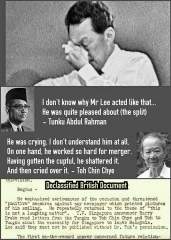
On Lee Kuan Yew's Crocodile Tears (Redux)

Toh Chin Chye:

"He was crying. I don’t understand him at all. On one hand, he worked so hard for merger. Having gotten the cupful, he shattered it. And then cried over it.

He held two successive press conferences, and in which both he cried. On the third morning I went to work, and saw the press boys again. I asked Lee Wei Ching, his press secretary, “Why are they hanging around here?” Another press conference! I told Lee Wei Ching, “You ought to tell the Prime Minister to go to Changi and take a rest. Call the press conference off! Another crying bout, and the people of Singapore will think the government is on its knees."


British declassified document:

""He emphasised seriousness of the occasion and threatened "punitive" measures against any newspaper which printed pictures of him smiling."


Goh Keng Swee:

           Melanie Chew: When did you feel that Malaysia was going to break up? Was it a surprise to                   you?

Dr Goh: Now I am going to let you into what has been a state secret up to now. This is a file, which I call Albatross.

In the early days there were a lot of discussions about changing the terms of Malaysia by the Prime Minister, Rajaratnam, and Toh Chin Chye. It got nowhere. They discussed all types of projects. Was Singapore to be part of Malaysia, but with special powers, or with no connection with Malaysia?

Now on the 20th of July 1965, I met Tun Razak and Dr Ismail. Now this is the 20th July 1965. I persuaded him that the only way out was for Singapore to secede, completely.

(reading) “It should be done quickly, and before we get more involved in the Solidarity Convention.” As you know, Rajaratnam and Toh Chin Chye were involved in the Solidarity Convention. “Malaysia for the Malaysians,” that was the cry, right?

Melanie Chew: This Solidarity Convention, you felt, would be very dangerous?

Dr Goh: No, not dangerous. I said, “You want to get Singapore out, and it must be done very quickly. And very quietly, and presented as a fait accompli.”

It must be kept away from the British. The British had their own policy. They wanted us to be inside Malaysia. And, they would have never agreed to Singapore leaving Malaysia. Now, the details, I won’t discuss with you.

          Melanie Chew: How did Tun Razak and Dr Ismail react?

           Dr Goh: Oh, they themselves were in agreement with the idea [of Dr Goh’s proposal to get                   Singapore out quickly]. In fact, they had themselves come to the conclusion that Singapore must            get out. The question was, how to get Singapore out?...

           Melanie Chew: What was his view? Did he himself want Singapore out?

           Dr Goh: I had better not say.

           Melanie Chew: So the secession of Singapore was well planned by you and Tun Razak! It was                not foisted on Singapore!

            Dr Goh: No, it was not.

            (There followed a long silence during which he slowly leafed through the secret file, Albatross.             Then he shut the file, and resumed his narrative.)

            --- Leaders Of Singapore / Melanie Chew

Addendum: Also, via Secret documents reveal extent of negotiations for Separation: Lee and friends were "excited" about independence, looked at it as "an escape" and called it "most attractive", and looked forward to "political stability with economic expansion, and autonomy in Singapore without interference from KL" - all this a few (?) months before independence. Since Singapore's independence from Malaysia had been discussed for over half a year, it being presented as sudden and a fait accompli just testifies to the success of the PR campaign.

All these add on to Tunku Abdul Rahman's account ("I don't know why Mr Lee acted like that . . . He was quite pleased about it"), which corroborates the claim that the crying was staged.

Addendum: Related - Toh Chin Chye - "He was crying. I don't understand him at all."

Sunday, December 15, 2019

Observations - 15th December 2019

"When I bake bread, I give thousands of yeast organisms false hope by feeding them sugar, before ruthlessly baking them to death in an oven and eating their corpses."

"It must be seriously alarming for cut guys to realize that their dick still stinks if it isn't washed."

The original whataboutism was chiding someone for looking at the speck in his brother's eye, but not the log in his own

It is curious that those who insist we should listen to scientists that climate change is a serious threat don't listen to them on climate change being more serious a problem than plastics. Or indeed, on GMOs, nuclear and fracking.

First they came for our plastic bags
Now they've come for our straws
Next they'll come for our utensils
What will follow that? Eventually we'll be lugging around our whole houses just to save companies money (disguised as environmentalism)


""I had a super liberal kumbaya brotherhood of all men friend that went to South America and came back super LKY style conservative.
he got wacked on the head from behind and then went back to his hotel room to find out that all his stuff was cleaned out. Then he found out his credit cards were all maxed out as well.
The police shrugged and told him it was unwise to be travelling as a lone asian dude in that area."

"Saying people "let" bedbugs bite is a form of victimblaming."

"calling illegal immigrants undocumented is like calling drug dealers unlicensed pharmacists."


"Gahmen keeps close tabs on all opposition related matters
and even Amos Yee
when Amos' asylum was approved, it was labeleld as "negative news"
on the Gahmen intranet
called "media watch"
they also keep track of Triple H, Roy, etc."

Maybe many Singaporeans talk about "denouncing" Singaporean citizenship when they mean renouncing it because it's a Freudian slip


Why don't the people who get upset at having to pay for other people's healthcare get upset at having to pay for other people's security? Many of the same arguments apply: personal responsibility (you can buy a gun and defend yourself), moral hazard (you can choose not to go to or live in a bad neighbourhood), taxation being theft/extortion etc

Telling people to go home if they hate your freedoms doesn't work if they make up a non-negligible part of your population. Not least since they can also move to subvert those freedoms for everyone else

Wednesday, October 02, 2019

The Past in the Present: Memories of the 1964 'Racial Riots' in Singapore

The Past in the Present: Memories of the 1964 'Racial Riots' in Singapore

"The 1964 racial riots are a prominent event in Singapore's history. They are often cited officially but rarely discussed by the Singapore community. This paper examines the riots from the perspective of a sociology of collective memories. A comparison of official and popular memories reveals a number of contrasts in the interpretations placed on these events by different groups. An official interpretation of the memory of the riots is disseminated to the younger generation through the media and education, and used to justify and legitimize the ideology of multiracialism and its social policies. Older people's memories give rise to more varied interpretations...

A nation is a collective group whose members' individual memories are tied up with the rest of the community. However, on this level, the articulation of what is to be remembered belongs to the political leaders and intellectual elites who bring their personal memories and interpretations to bear heavily on the social memories of Singaporeans. Thus within Singapore, the dominant discourse on the riots provides the official or "national" memory (Fentress and Wickham, 1992:127). Memories can therefore be re constructed or manipulated, or used as a tool against internal or external opponents. In Singapore, "national" memory is seldom contested openly by social groups. It is transmitted through educational insdtutions and the media and used to entrench institutional interests and ideology. National memory articulated through dominant discourses is imposed from the rul ing elite down to the general population through private or public means. These conceptions of the past are linear and chronological leading even tually to a legitimate present situation. The dominant memory can become hegemonic and totalizing such that alternative memories are regarded as irrelevant, inaccurate and at times even illegitimate. This subjugation of alternative memories depends on how tolerant the national culture can be and the degree to which it can be challenged. Individuals or social groups can support or challenge public representations of the past because these will either "guarantee their identity or deny its significance" (Tonkin, 1992:10). In Singapore, the dominant memory of the riots serves to define the identity of a multiracial society...

In each of these [official] discourses, the narrative structure of the riots in national memory has remained the same. The selection and ordering of events creates a moral order. Chronology can therefore be seen as a tool used by historians to construct a timeline to connect and compare the sequence of events. This in turn can direct thought, since the narrative structure suggests that events are causally connected. The riots are presented as being a result of political tension because of racial issues raised by politicians, and the racial divisions existing within the population. This then becomes a factor in the Separation from Malaysia. The moral drawn is that we need interracial harmony, or rioting and chaos will be the inevitable end. This moral story is used by the political elite to discipline the population. In the official memory, the narrators lend their authority to the account, and the moral precedent built in to it legitimates the ideology supported by the teller...

Many of my informants did not experience any fighting or rioting at all because they lived in calm areas and carried on their lives as normal. For them the rioting seemed far and removed from their every day life...

Of the 23 informants who lived through this period, 16 were unaffected by the riots because their residences were calm and peaceful. The only fear was that outsiders would enter their kampong and pick a fight with them. Thus, contrary to official discourse, which claimed widespread fighting, the popular discourse showed otherwise. Violent clashes only occurred in areas near the precipitating event

The Malays as a collective ethnic group believed that the riots were not "racial" to begin with. Contrary to the official memory, it began as a "religious" riot because it occurred during "one of the biggest religious festivals" in the Muslim calendar...

Many Malay informants also observed that the Muslim procession was a mix of a majority of Malays and Indians and perhaps some Chinese and thus could not have been racially motivated. Collectively they expressed a sense of loss, since the procession was subsequently banned because of the riots...

Although they believed it was the Chinese who initiated the riots, some thought they were Chinese gangsters, belonging to Secret Societies (SS), taking advantage of the chaotic situation to initiate fights with rival SS members, leading to skirmishes between Chinese and Malay youth gangs in certain parts of the island. Many believed that the local community was not involved...

Informants who read widely or held civil service jobs believed that the riots could be politically motivated due to the internal politics between the two opposing parties, PAP and UMNO, and the on-going Indonesian Confrontation. Mr Buang, a civil servant, believed it was "mainly motivated by political parties", but was unsure which party was the instigator...

Others thought Indonesian agents instigated the riots and shifted the blame onto the Chinese. This was the opinion of Mr Awang, a former police officer, who obtained his information from newspapers he read during and after the riots, and from discussions with his colleagues...

The riots did leave the Malay informants initially angry at the Chinese. In some kampong, this affected their relationships and interactions with one another. However these feelings did not last long when they realized that there could be other causes of the riots:

Sure angry lah, how can the Chinese fellow throw stones, kill these fellow, do these things. But after that nothing lah relationship the same. (Mr Farid)

Mr Awang, who saw himself as part of the collective group of Malays in Singapore, expressed this anger in a collective mode rather than an individual one:

Everybody you know. Majority of Malays all angry, but 1964 was a small misunderstanding between Malay and Chinese. Most of the villages in Singapore were living peacefully together.

... Those informants who read widely or who held government occupations, and were in touch with the political scene of that time, tended to attribute the cause of the riots to the political situation...

Contrary to selective official memory, which views the 1964 racial riots as Singapore's worst riots, the Malay informants remember the Nadra riots as bigger. The Nadra riots were recalled as a significant occasion on which they had stood and fought for their religion. Religion is of greater importance in the Malay construction of identity than is typical for other groups. Islam evokes such deep feelings in the community that all of them felt involved...

As we have seen, the Nadra riots were not emphasized in the official dis course examined thus far, perhaps because, having a religious rather than a racial colouring, they are perceived to be less useful in a narrative devoted to emphasizing the importance of ethnic harmony.

In contrast, all my Chinese informants, especially those who witnessed frightening episodes, believed that the Malays were responsible for starting the riots...

Mr Goh uses the same political discourse as Mr Lim to explain the reason for the instigation of the riots. Their memories replicate the national memory...

The Indian informants, on the other hand, seem marginal to the riots. They had very vague memories and were unable to recollect much...

Within the dominant memory, mutual antagonism, fear and hatred prevailed between ethnic groups. The spectre of the racial riots is used often in the state's discourse to justify and legitimate ideology and policies. In order for it to be effective, memories have to evoke scenes of violence and fighting. However, within popular memory, helpfulness and co-operation is a recurring theme. In ethnically mixed settlements, the riots served to "gel" the two races together to protect their own kampong. My informants recollect many instances of people living in harmony. The fact that this theme runs so consistently throughout the popular discourse testifies that this was a common phenomenon during the riots...

The official memory of the riots portrays a one-sided picture of chaos, violence and fighting between the Malays and the Chinese over the entire island, while popular memory shows otherwise. The fighting and rioting were confined to areas adjoining Geylang Serai. Many of the informants pointed out that sporadic incidents did occur in other parts of the island but were only small skirmishes and many other parts were unaffected. In contrast to official memory, which represents the two races living in fear of one another, many informants relate living harmoniously and helping one another...

Through discursive practices, the 1964 riots have evolved as a dis cursive object. Since their occurrence, they have been discussed by ordinary people, the media and the state. The riots as a discursive object is embedded in a discourse of multiracialism. It is invoked by the government, both to raise racial awareness and to justify social policies. The re presentations of the memories of the riots as racial can be associated with the process of state and nation building, within which "political rhetoric" depends on the past as a "legitimation device" for political action (Fentress and Wickham, 1992:132). Once this rhetorical discourse is in place, it affects present actions, and conditions future activity as well. The past is a "resource to deploy, to support a case or assert a claim" (Tonkin, 1992:1)...

he government has also used the riots to justify social policies. In 1989, the government was concerned that certain minority groups were forming concentrations in certain estates. The Minister for National Development explained that these "enclaves will become seedbeds for communal agitation" (Straits Times, 7 January 1989). The spectre of the riots was used to rationalize the policy of ethnic quo tas for each estate in this discourse on race relations. There is a prevalent belief that spatial segregation would lead to racial conflicts similar to the 1964 riots (Hill and Lian, 1995:116). Framed in such a manner, the riots are decontextualized and over-simplified. The existence of ethnic enclaves need not lead automatically to antagonism and riots...

Although the older generation, having been through the riots, have their personal memories, which at times contradict national memories, this contradiction is confined to the private arena due to the state's hegemonic control over the public sphere. Their statements reflect this dilemma. On the one hand, they emphasized that: "Riots will never happen again" (Mrs Prabalakshmi); "Life is so secure now, who wants to cause trouble and destroy all we have today?" (Mr Cheong); or "Today people more educated, how to happen again?" (Mr Farid). On the other hand, being embedded within the multiracial discourse, they contradictorily state that racial harmony and tolerance is important because: "Racial issues so sensitive, someone want to take advantage can easily spark it off" (Mr Awang); "We must be sensitive" (Mr Cheong); or "We will face riots days again" (Mr Goh)...

When the second generation were asked which events in Singapore's history they considered important, none included the 1964 riots... most of their historical memory is formed through additional information through the latest educational programme (National Education), from books, or through television programmes. Most were also unable to furnish further details of the events that unfolded prior to or after the riots. None could discuss political or economic issues in 1964, or could give a well-defined account of what had happened in the riots...

Although students have gone through these activities, how much is retained in their memory is debatable. One of my informants commented that "it was all very boring. Some of us skip the lectures lah" (Karen). Jamil was not at all interested: "I didn't pay attention, so I can't remember what they said". For Peter, "I forgot already ah, can't remem ber what it is all about." However, the discourse only requires the riots to be remembered factually as race riots and as a natural consequence of interracial disharmony. The images that students have retained, either from the media or their exposure to the NE programme, are suitably lurid:

It's not out of the question that riots will come again. (Norlina)
Anarchy, chaos everywhere, homeless people, burning house. (Melissa)
If a riot occurs, the government will step in with their tanks. (Anita)

These extreme images are a contrast to the older generation's popular memories of the riots being localized and peaceful relations prevailing. Thus the NE programme serves to further disperse statements on the 1964 riots, and make them more effective and powerful tools for justifying and legitimating state initiatives"


In other words, maybe the 'race riots' weren't really race riots, and really, they didn't threaten to destroy Singapore.

Sunday, August 18, 2019

The History of Singapore: Living in a Time of Deception

Episode 23: Living in a Time of Deception

"Poh Soo Kai (PSK) on his memoir's title: The left wing was deceived. Kuan Yew presented himself... pro-forma as an anti-colonialist. When in fact he was fighting the left and working with the British...

PJ Thum (PJ) on the British Archives : When you were going through the material, was there anything which really shocked you or surprised you or just jumped out at you...

PSK: I was very shocked. First I went there to find out what were the real reasons for my arrest. Was it security? I know it wasn't security but I wanted to know what they write, and the archives showed it wasn't security but political. We were arrested on political grounds. In fact Moore the acting high commissioner, PBC Moore wrote that "if it was security we should arrest them straight away"... it's because we were political opponents and he, the British admitted that we were the strongest political force in Singapore at that time. And so we had to be smashed. We had to be crippled...

The greatest shock came when first I found that Lee Kuan Yew was like, you take Clause 30. Where detainees were not allowed to take part in the 1959 Rendel Constitution election... we all thought at that time that it was the British who insisted on that clause. But when I read the archives, I was shocked because it was Kuan Yew who initiated the clause and who persuaded the British to introduce it. And told the British that you introduce it, you bear the blame. But I am going to oppose. I can't believe the deception, the depth of deception. And in the Tanjong Pagar by-election he went to the extent to tell the electorate look if you vote for me I will have that clause which was introduced by him, suggested by him removed...

'When Lim Yew Hock wanted to spill the beans when he felt that Lee Kuan Yew was attacking him unfairly'

'On the Chew Swee Kee case. He said in the assembly: you play dirty, I play dirty'

'And of course, this is all in the government hansard of course. When Lee Kuan Yew realises what is going to come out of Lim Yew Hock's mouth, he jumps up and says "That's a dirty lie".'

'And technically he's correct. Because Lim Yew Hock said he and Lim Yew Hock both saw the colonial secretary together. But it wasn’t so. The colonial secretary was careful to see each of them separately. So it was a lie. Technically a lie'...

[On being detained and getting newspapers] ‘Why black out the economic news?’

‘I don’t know. I mean why don't they allow me to read Barisan newspaper? It's published legally. I asked for it they say no, we can’t let you have it. Unless you apply personally to the director. So I did apply. And he says, no no, he says Dr. Poh, I permit you to read this paper, that issue because you are not a communist. And the letter was sent by his department through the prison to me… I had the letter with me but during my second arrest, it disappeared.’

‘So you had in writing at one point that you weren't a communist. So then did you respond well if I'm not communist why am I here? Why am I locked up?’

‘They said you’re pro-communist’...

‘In British hongs, British firms, if they employ a British officer and he comes down to Singapore, he falls in love with a local girl, he can't get married. He can’t. If he gets married they send him back, sacked.’
‘And what happens to the local girl?’

‘He can only keep her as a mistress. And they all do that’"

Saturday, August 10, 2019

'Communism' and History in Singapore

Episode 25: Questions and Answers II

"‘How real or exaggerated was the communist threat in Singapore in its early years?’

I presume he means in the 50s and 60s.

‘Recent contrary accounts say that the threat has been grossly exaggerated. But I heard recently at the funeral of the ex-Principal of Zhong Zheng High in the 1950s, many old boys turned up and admitted that they were influenced by the communists to cause unrest, although they themselves were never card carrying members’...

The crux of your anecdote is that you assume that these are mutually opposing positions, right? That students could be influenced by the communists, and that the threat could be grossly exaggerated. But these are not mutually opposed positions. You see, the fundamental problem is that we today tend to project backwards what we know today on to the people of the past. We forget that the past is actually in many ways, a very alien place. It had different values, different beliefs. Most of all, we have the benefit of hindsight, and they don't. We have the benefits of, well, historical researchers like myself, who go into the archives, and are able to point out what was going on at the time from all these different angles…

We need to understand this idea of communism, right? In order to understand this anecdote. So really, I think there are three important points I want to make. First of all, when we talk about being influenced by the communists. Well, the thing is, everyone was influenced by the communists back then, right? Socialism was the future of humanity, the future of mankind. See, following the excesses of the 1920s, and particularly the failures of unrestrained capitalism. And then the rise of fascism in the 1930s, leading to war in the 1940s, right? Humanity was absolutely sick and tired of these. And of course, a lot of these forces were caused by colonialism and imperialism.

So after World War Two, a lot of people said, we need to find a new way of living. We need to reshape the way we live our lives. Because the the powers that we possess, have grown so large, that we threaten the entire world, if we go too far. And the most optimistic said, we need to reshape human society, we need to arrange our lives to be better people to take care of each other. And this whole spectrum, this whole idea that we can change our society was basically what we think of the left, right? We need to change our society to be better to avoid all these problems that the right wing, right, the conservative capitalist forces caused. So opposed to that is the left wing. And this was a huge spectrum, ranging from the people who felt that, you know, it was inevitable that we would rearrange, but you need to slowly, cautiously move forward. You know, people like the Fabian socialists, who sought to encourage the reshaping of society through gradual processes, all the way to the extreme left, who sought to use all sorts of extreme methods to reshape society, including violence and terror, right.

So the 1950s then were shaped by two forces, okay. The first, of course, was what I talked about. Socialism, all the way stretching to what you might call violent communism, and it took on all these forms later that we think of Maoism, Stalinism. Okay.

And in its milder forms, we see its impact on Europe. The UK, for example, after the war tries to… create a new state. It tries to create the NHS for example, the welfare state saying that if during the war, we can have full unemployment, you know, why can we do it after the war? Why can't we take care of all of our people and all these are manifestations of socialism. In the US, you know, we have FDR and his new deal followed by Truman, and so on and so forth.

So socialism was on the rise throughout the world, people saw it as inevitable that we had to change the way we lead our lives. And so this was the rise, also, this led to the rise of communism in the USSR, in China, right, in these new ideologies, which, you know, sought to end exploitation.

Now, alongside this was nationalism and self determination, anti colonialism because these go hand in hand, right? Colonialism was fundamentally in many places as much about capitalist exploitation, as it was about territorial occupation, especially for Singapore, for the British Empire. Singapore was fundamentally about exploitation, economic capitalist exploitation. That was what the Empire was, was trying to achieve via Singapore, via Malaya. So these two forces, anti colonialism and socialism go hand in hand. They are in some ways, almost the same thing, they are closely allied with each other.

And so it is because of these that, we see that anti colonial movements were also fundamentally about reshaping society to end capitalist colonialist exploitation. So my point is that, as in the, what I have been discussing throughout this podcast, right, when people have debates about what is the future of Singapore? What is the future of Malaya after independence? A lot of times the answer is, well, it cannot be the same society we've had before. It cannot be this colonial capitalist exploitative system, it's got to be something that's fair, it's got to be something that takes care of people, that recognizes that people are human beings, not capitalist digits to be exploited. And it has to recognize the fundamental rights of people.

So very often this new idea, socialism was something that was put forward to be taken, to be part of our new identity. And, of course, this was very much of the appeal of the People's Action Party. And later, you know, the PAP and the Barisan, both of whom were staunchly socialist parties, right.

And, of course, Singapore itself has certain circumstances. Remember, after World War Two, the big heroes that came out of world war two were the Malayan Communist Party. The Malayan communist party were, they may have called themselves communists. But if you look at the kind of things they proposed, right, they were nowhere as radical as communists elsewhere. Fundamentally, they were a nationalist party which sought to end colonialism. And sought so to bring about the independence of Malaya. And they were the big heroes of World War Two and the Japanese occupation, because they were the only real effective resistance against the Japanese. So to many people in Singapore, communism slash socialism, right, you fell somewhere on this spectrum. It was the way of the future. It was inevitable. It was what was necessary. But it also was a product of world war two, it was patriotic, it was anti colonial.

And because of the big success of communism, of the Malayan Communist Party, initially during the Emergency, and also before that in organizing labor, right. And then when they were driven underground, nobody actually knew who was and wasn't communist.

So this is my second point, right, that a lot of people will say, oh, yes, I was influenced by the communists but they don't actually know for sure that they were interested influenced by the Malayan Communist Party or simply other people who were claiming to be communist. And this is again, something you see a lot in Special Branch files. That they admit that there is no direct link to the Malayan Communist Party which for all intents and purposes after 1950 was irrelevant in Singapore because the leadership had been totally arrested. They were smashed, their lines of communication, their networks. They were, they existed, but they were irrelevant. The only person really still active in Singapore after 1950 was Eu Chooi Yip, their propaganda Chief, who was later withdrawn in the mid 50s, right. And then the plan was inserted…
But you see, it wasn't just the MCP, anyone who wanted to claim the mantle of the MCP could simply say, I am part of the Malayan Communist Party. And I actually have this whole underground behind me and so you should work with me. And so there were a lot of groups which tried to set up these cells and claim that they were part of the Malayan Communist Party who had absolutely no link to the Malayan Communist Party. But were just trying to tap into the reputation of the Malayan Communist Party. And so Special Branch investigates all these people and finds you know, that there's all these anti colonials who simply want to resist, resist the British, get rid of the British, push forward independence, you know, they wanted freedom.

And the quick and easy way of rallying people to their cause in the 50s was to say, oh, we are linked with the Malayan Communist Party. Because that not only tapped into the great reputation, remember the MCP are still heroes at this point, right. But also that would then imply oh, we have all sorts of resources that you don't know about, that no one knows about. So there were plenty of all these random people who were anti colonials who just claimed they were MCP and there's no way no one you and I meeting them and they say, oh, I'm MCP or whatever. How would you verify right? And this is one scenario probably that happens to these old boys. You know they receive documents for example or they might meet people who go oh I’m Communist Party and you should do this and you should, let's fight the British you know and these are young impressionable kids right and these are people trying to impress young impressionable kids. You know people in their, who are in school, school children and so they say oh we’re Communist Party...

So you can see here how these kids could have been influenced by the communists, by the idea of the Communist Party without actually having been influenced by the Malayan communist party itself which was basically irrelevant at this point in time.

But the third point I want to make is what is a communist? And I've said this before and it's very important but any definition of say the Barisan Socialists or Lim Chin Siong right. Any definition of a communist that says the Barisan Socialists or Lim Chin Siong is a communist would also then define Lee Kuan Yew as a communist… because the two of them were so similar, right. Their main difference was not about communism, it was about things like the use of the Internal Security Act. It was about internal party democracy in the PAP. It wasn't about their fundamental economic beliefs, you know, it wasn't about socialism. Both were socialists right? So for example, if you say oh, a communist is someone who colludes with the Malayan Communist Party underground right. Well, Lee Kuan Yew did that and he openly admits it in his autobiography. He admitted it at his radio talks in 1962. He collaborated with the MCP underground to win elections, he openly admits it and in fact, he's the only person, the only one of the major leaders of Singapore's political parties at that time whom we have definitive evidence that he collaborated with the communists.

So why was he not detained? Because this was a political situation, not a security one. If it was a security situation where the communists were a threat to Singapore, Lee Kuan Yew would have been detained straight away. But it wasn't, it was a political situation in which the British were trying to figure out which of these Singapore politicians would be the most trustworthy that they could hand power over to which would provide a stable Singapore and reliably pro British Singapore and Lee Kuan Yew was that man.

So on the other hand if we say oh communists has to be a card carrying member of the Communist Party and therefore Lee Kuan Yew is not a communist. Well we know for sure Lim Chin Siong was not a communist. Fong Swee Suan was not a communist. Devan Nair was not a communist...

This is way before the excesses of China were well known, before the Soviet Union, the excesses of Soviet Union were well known. Communism was a very different thing in the 50s. And it was a very wide spectrum of beliefs, you know, peaceful action, violent action, constitutional action, non-constitutional action, you know. Nationalization… retention of a capitalist system. It's important to remember, as I keep saying that the Barisan Socialists were economically, socially to the right of the British Labour Party at that time, and you never call the British Labour Party a Communist Party...

Why is history so important to Singapore?... The Singapore government tells a very specific narrative of history that has the purpose of trying to legitimize first the idea of Singapore, the state of Singapore, which we have to remember, is a very unnatural thing, Singapore has always been part of Johor, it was never meant to be split off from the Malayan mainland, but because of politics was split off in 65. And so you need to construct narrative of history to justify this split, right, the existence of Singapore is to try and make it seem inevitable in the minds of its inhabitants.
And also you need a narrative of history that justifies your policies, the PAP’s monopoly of power, the authoritarian policies, there, the fact that they suspend the normal rules of democracy, that we don't have free and fair elections, and so on and so forth. Right. So our history is designed to do to do all these things. And so when a historian comes along, who disagrees, then obviously, you know, that historian is a threat…

First of all, you have to understand the history of how history has been taught in Singapore. And right after separation, the PAP faced a quandary, right? They couldn't teach Malayan history anymore, because Malayan history emphasized Singapore as part of Malaya but now we were split off from Malaya. And you couldn't teach Chinese history because that was not only just politically inconvenient, but the the main opposition to the PAP was from the Chinese schools, you know, the Chinese University Nantah and the PAP didn't want to emphasize that so instead they took a different tack. They said, oh, we have no history. Rajaratnam said something like history starts now. Ong Pang Boon said history has no practical use, and the government didn't encourage any new research. Any new studies of history. Textbooks from the 1960s which still, which gave Singapore as part of Malaya continued to be used in Singapore's official curriculum well into the 1980's.

Lee Kuan Yew said, you know, it's more important to know where you're going then where we've been, right and he wanted to de-emphasize the Malaysian period… the Malayan aspects of our history.

So also, this enabled him to say a lot of things and do a lot of things, to make assertions without being checked. So in the 80s, he would say things like, oh, Singapore was a swarm and PAP built it up. And there were no historians who could then point out, wait a moment in 1961 or so, you gave a speech where you said Singapore today is the richest country in Asia, it has the highest per capita income in Asia, you know, and this is all due to the PAP. Well, it can't be a rich country in 1961. And then now you say it's a you know, in the 20 years later, you say, Oh, it was a swamp in 1960, and the PhD built it up today in 1980 to a rich country. These are mutually opposing facts.

So when the government has a monopoly over history, then people who don't produce inconvenient facts that contradict its reading of history. And then from this government's reading of history, it can then justify its policies.

Now, in the 1980s and into the 90s things changed in Singapore and. Ane of the major things was that Singapore went to a change of leadership, it went into a change of the electoral system. It went through a period where people started demanding more accountability and democracy and the PAP turned, sort of its focus turned backwards rather than forwards, right. So no more do you have this forget about the past, we need to look to the future.

Because once the PAP’s vote began declining, once opposition politicians began to be elected into parliament, the PP increasingly became a party that looked back on its glory, on its former glory rather than towards the future. And especially of course, the retirement of Lee Kuan as Prime Minister meant that its glory days were now in the past.
So from the mid 90s, you see this new National Education, the Singapore story which sought to entrench in people's minds this idea that the PAP has done great things for Singapore and that you need to understand where we've come from, right, the PAP wanted to create this idea of gratitude to the party in order to then promote their continuation in power and continue to justify their hold on power. So we have seen a lot of this in the past 20 years…

SG50 and the 2015 elections for example, the election’s focus is very much on the past right. The manifesto of the PAP quite amazingly had no promises for the future. It was all about the past. SG50, Lee Kuan Yew, SG50, Lee Kuan Yew over and over again. And so they need to control the history in order to be able to continue to campaign on it in order to continue to justify their policies based on it."
Related Posts Plugin for WordPress, Blogger...

Latest posts (which you might not see on this page)

powered by Blogger | WordPress by Newwpthemes