More proof that when left wingers complain about "harassment" and "hate", they mean people disagreeing with left wing orthodoxy:
He mildly questioned DEI. His law school calls that 'misconduct'
"The University of Saskatchewan’s law school allows some of its Indigenous students to take more time on exams for the purpose of “equity.” So, when this blew up into a faculty controversy in 2022, with proponents of the benefit aghast that anyone would ever question the idea as others quietly made their concerns known to student leaders, one member of the law school tried to make peace between the factions — only to be punished by the university for his efforts.
Tim Haggstrom’s crime? Writing an open letter to his fellow students, from a neutral position, to foster dialogue and attempt to inject reason into the debate. His punishment? A campaign by other students to sabotage his career, culminating in an official finding of misconduct by a spineless university that appears to have forgotten its role in protecting free expression on campus.
That campaign, at least, didn’t work. Now a lawyer (and the national director of the Runnymede Society, whose local chapter events I often attend) Haggstrom, via his legal team at civil liberties charity Freedoms Advocate, is asking the Saskatchewan Court of King’s Bench to have the misconduct ruling thrown out — along with the university policies that work to deny procedural fairness to those who don’t emphatically agree with diversity, equity and inclusion...
The institution had, since 2020, a diversity, equity and inclusion policy that implored the entire campus to uphold DEI values, cementing identity-based thinking — and with it, the idea that procedures are only fair when they result in equal outcomes between groups — into campus culture. That year, the university president committed himself to the “dismantling of institutional structures, policies and processes that contribute to inequalities faced by marginalized groups.”
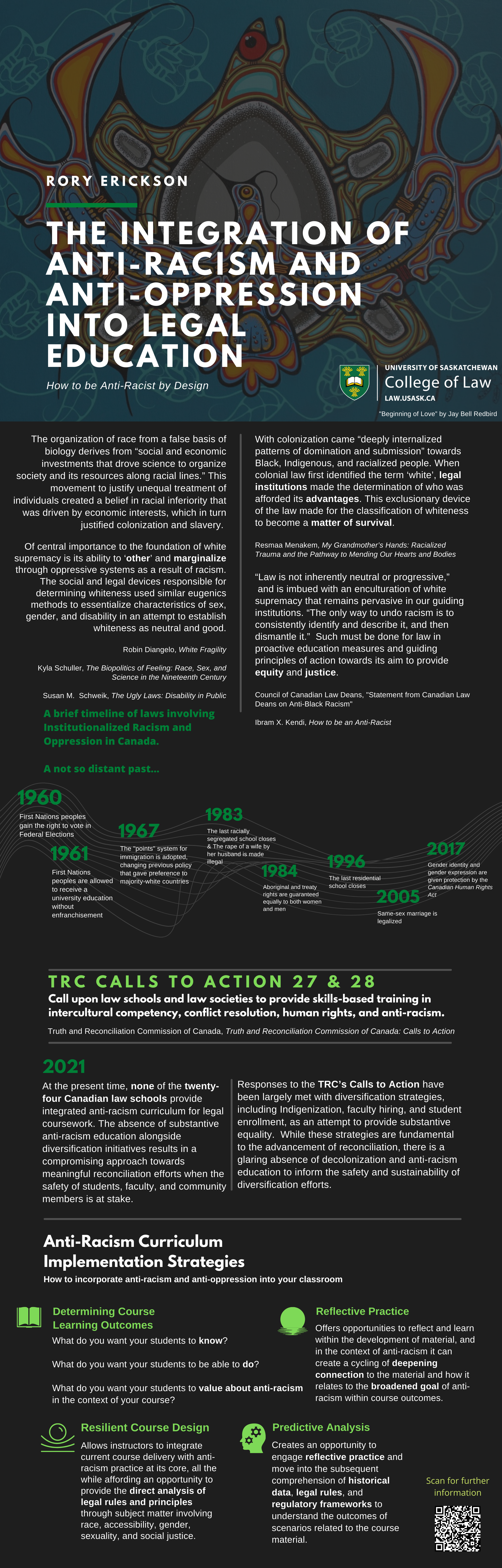
In 2021, the university signed a memorandum of understanding with the student union, committing to deliver anti-oppression and anti-racism training to staff, which was being rolled out by the next year. That initiative was led by anti-racist scholar Verna St. Denis, who has openly called for biasing university education to favour her own progressive, deeply racial worldview. St. Denis also contributed to the university’s Indigenous strategy, also released in 2021, which planned for institution-wide decolonial change.
Further, according to the originating application filed in court by Haggstrom, the university had made training materials available on the topic of “power and privilege.” The materials are no longer on the university website, but were archived online. They teach a hierarchical understanding of race (specifically, that white people have better access to education and success); they characterize meritocracy as a feature of “settler mindsets”; they state that internalized colonialism causes oppressed people to commit sexual assault; they instruct readers to “refute colonialism” (that is, the very basis of our nation) to assist in making Canada “the friendly, open, welcoming country it espouses to be.” They remark that anti-oppressive education “ought to be uncomfortable as white students begin to unlearn what they have been taught through their previous learning experiences.”
The course ends on a question: “As an individual how can you decolonize yourself and what can you do with your power and privilege to help in the betterment of Canada?”
Senior management began having to take mandatory training on these concepts starting in April of 2022, according to the university. In 2025, these courses appear to still be required for professors who wish to participate “in future tenure and search meetings.”
Despite gatekeeping the hiring process to only those who have taken a crash course in far-left thought, the University of Saskatchewan insisted in an email to me Tuesday that it “has not mandated anti-racism training,” and that the training was required as part of the faculty agreement (to which the university is a party). Spokesperson Heather Persson went on to tell me, of the university more broadly, that “There is no evidence of ‘new political objectives’ at USask,” and that “Ensuring that qualified candidates from a wide range of backgrounds are not overlooked is not a political value of the left or the right.”...
Iit’s embraced DEI, objectively a left-wing pursuit, and put a hyper-progressive critical race scholar openly in favour of politicizing education in charge of the campus rollout. Professors must literally accept lessons on race astrology as a condition for full participation in the university. The former president of the institution, Peter MacKinnon, has referred to the faculty course as a “propaganda module in which scholarly expertise and balance will not be found.” (The current university president continues to insist on providing one-sided political instruction to anyone participating in hiring.)
The law school is a lot like the rest of the university. Along with its policy of granting extra test time to certain Indigenous students which has been around since the 1990s, (specifically, those who were admitted through an Indigenous-specific pathway and attended an academic support program), the school began mandating a full-year Indigenous course for first-year students in 2018. These courses include sharing circles and personal reflection assignments, and cover colonialism, reconciliation and Indigenous legal traditions.
On top of that, the law school instituted mandatory anti-racism training for first-years in 2022, according to the court application, which was organized by another law student who had advocated for such training in the past.
All of this formed the backdrop to the law school’s affirmative action controversy, which is illustrated in the exhibits that Haggstrom filed with the court. In January 2022, some students became concerned with the doling-out of extra exam time; in response, the law students’ association president suggested investigating the matter at a meeting that month. The meeting minutes, filed with the court, recorded his concerns: “High number of students who get extra time on exams. Our numbers are higher than most college of laws (sic), is turning into an issue of equity.”
When word of this reached the law students’ Facebook group, the association president was inundated with paragraphs from students outraged that anyone would ever question the fairness of exam accommodations. A letter by the faculty’s Indigenous law students’ group invoked the “unmarked graves” of 2021 (which have not actually been found to exist), made broad accusations of “blatant racism,” demanded a public apology and insisted on mandatory anti-racism training in student governance. The law students’ association president apologized (twice). The dean promised the faculty would spend even more resources on reconciliation in the next year. (All of these comments were filed with the court.)
It was at this point that Haggstrom entered the discourse. As a classical liberal, he personally supports pluralism, tolerance, dialogue and equality. When it came to the law school, he applauded the faculty’s history of standing against racism, but was concerned that its more recent enthusiasm for racial training materials was contributing to student tension. He hypothesized that it might be corrosive to tell some students that they’re being constantly oppressed, and others that they’re constantly oppressing. Perhaps, he thought, that philosophy was a factor driving the souring state of student relations...
In the same meeting, he also questioned whether the law students’ association should add a requirement to open meetings with a land acknowledgement to its constitution (but ultimately voted in favour, according to his court filings).
This unleashed the ire of some students, who sought to punish him for expressing his views.
Classes wrapped up on April 1 that year, but faculty business continued. On April 20, a fellow student lodged a non-academic misconduct complaint against Haggstrom, alleging that he’d breached the university’s harassment policy through his letter-writing and his resistance to the land acknowledgements.
Haggstrom “made numerous attempts to spread hate throughout the College” that year, according to the complainant. She listed his letters to the faculty and the student body as prime examples of misconduct, and expressed concern with his “racist views.”
“His actions have contributed to the creation of an unsafe atmosphere for Indigenous students, myself included, within the College of Law. His various actions have had significant emotional, psychological and physical impacts on many of the Indigenous and non-Indigenous professors, teachers assistants (sic), and students alike within the College of Law.” She had made, but withdrew, very similar accusations against another student the month prior, according to Haggstrom’s court filings.
The court application notes that the complainant never went on to explain, throughout the bureaucratic process, what physical impacts his open letter had on others. No evidence of psychological harm was advanced, either.
The complaint “conveys, inter alia, a position that is against permitting dissenting dialogue, based on subjective concerns of harm experienced by the listener, including potentially creating psychological ‘safety’ concerns,” states the court application.
Nevertheless, the complaint was taken seriously by school officials, perhaps because so much of the university’s mission had been redirected towards a new goal of social transformation. University policies and documents, note the court application, “demonstrate a prioritized institutional commitment to a social or political mission.” And indeed, it was clear that the institution had embraced a cancerously aggressive stance on eradicating all forms of oppression — so it tracks that even a student’s tepid letter in favour of open-minded discussion found itself in institutional crosshairs...
One of these new accusers had contacted his employer, a Calgary law firm, about the unfolding misconduct allegations...
Haggstrom went on to file a complaint about the student who contacted his employer that fall, on Oct. 6. On Oct. 7, the university changed its mind about whether Haggstrom should be entitled to a mediated conversation with his accusers, and ordered that mediation take place — but only if he’d agree to acknowledge the “harm” he caused. He refused, so a formal mediation was once again directed...
One high-ranked diversity consultant at the university, according to the application, attended to provide “emotional support” for the six remaining complainants, a physical demonstration that the University of Saskatchewan was not a neutral party.
At the hearings, the complainants argued that Haggstrom breached the harassment policy by carrying out a discriminatory “one-sided debate” about whether “Indigenous students are deserving of exam accommodations.”"
Free expression is only to push the left wing agenda. Opposing it is
misconduct. Calling for Jews to be murdered definitely isn't harassment,
of course. and it is very important to protect freedom of expression by
letting people advocate for that.
The University of Saskatchewan is on an ideological mission
"I was employed by the University of Saskatchewan for 40 years including 13 years as president. The institution’s distinctive origins combined the development of liberal education with a responsibility to build the province’s agricultural industry, and it did the latter with world-class agricultural programs and research institutes, and with faculty and students of many backgrounds from around the globe.
Now, we are told, the academic personnel in this worldly environment require mandatory training on racism: an Anti-Racism/Anti-Oppression and Unconscious Bias Faculty Development Program. It is compulsory; those who decline its offerings will be shut out of collegial processes previously thought to be their right as tenured faculty...
“Program” is a euphemism. It is a propaganda module in which scholarly expertise and balance will not be found. It does not appear that the instructor has a university academic post and the program’s ideological hue is revealed in the two required readings, one by Idle No More co-founder Sheelah McLean whose theme is that the success of Saskatchewan’s white people is built on “150 years of racist, sexist and homophobic colonial practices.” The second is by five “racialized” faculty who claim that Canadian university systems are rigged to privilege white people. Dissent, contrary views or even nuance are neither expected nor tolerated here. Opinions that are different are not on the reading list. One participant, a law professor, was invited to leave after 30 minutes because he did not lend his voice to its purpose and orientation; he revealed that he was present because it was required. The purpose of the program is indoctrination and there is no room for dissent.
The program is part of an ideological crusade within our universities, one that includes identity-based admissions and faculty appointments, and discourages those who differ from speaking out or taking issue with its direction. It is not present to the same degree in all of these institutions, but it is visible in most and prominent in many. It disparages merit, distorts our history and rests on the proposition that a white majority population has perpetrated a wide and pervasive racist agenda against others. It takes its conclusions as self-evident and not requiring evidence. It is authoritarian and intolerant, and should have no place in institutions committed to excellence and the search for truth.
The question, of course, is what is to be done. There is a view that “this too shall pass;” it is a fad that will recede in time. But, we must note, these are public institutions supported by tax dollars, and by the contributions of time and money by alumni and supporters. We should not tolerate their politicization and sidetracking of the academic mission in favour of the ideology on display here. The pushback should begin with governments and extend to others who care about these vital institutions.
But first the ideology must be recognized. There is no public uproar and little clamour from within the institutions; dissenting professors and students fear that negative professional and personal repercussions may follow. University-governing bodies stand down or away, not wanting to be involved in controversy. Resistance must come from outside the institutions: governments must insist that the propaganda must end, and they should be joined by alumni, supporters and the general public. The credibility of our universities depends on their willingness to say no."
Tenure is only sacred if it pushes the left wing agenda. University indoctrination is a far right conspiracy theory and misinformation.
Clearly a president of three Canadian universities doesn't know anything and is a dinosaur who just needs to die so his bigotry will no longer exist and pollute the world.
Saskatchewan professor blogs through mandatory anti-racism 'boot camp'
"A University of Saskatchewan law professor provided a unique window into the equity mandates now ubiquitous at Canadian universities by blogging the details of a compulsory anti-racist “learning journey.”
The course was officially known as an Anti-Racism/Anti-Oppression and Unconscious Bias Faculty Development Session, and is a mandatory requirement of University of Saskatchewan faculty looking to participate in hiring committees.
An email announcing the program was given the subject line: “Mandatory unconscious bias and anti-racism training.”
“The training is intended to further your personal journey of learning and action, regardless of how knowledgeable or experienced you are, so attendance is mandatory irrespective of previous training or academic field of specialization,” faculty were told.
The course materials tell participants that they’ll be taught about the “systemic racism” of the university environment and how they have benefited from unearned racial privileges.
By session’s end, participants are told that they’ll be able understand their own “unconscious bias” and “reflect on and understand how power, privilege and meritocracy lead to inequities.”
One of the activities is to fill out a “power and privilege” wheel. These wheels, prepared and distributed by the Government of Canada, ask users to grade their “privileges” on everything from mental health to sexuality to skin colour. The most privileged identity, as identified by the wheel, is a white, able-bodied, heterosexual “colonizer/settler.”
Michael Plaxton, an expert in criminal law and statutory interpretation, alternately called the course a “mandatory DEI bootcamp” and a “forced march of self discovery.” He noted that it began with a declaration of “we’re not here to debate.”...
The third reading was also from the United States. A paper from the American Association of University Professors entitled Achieving Racial Equity in Promotion and Tenure. The document argues that if the racial makeup of university faculty doesn’t mirror the racial makeup of social generally, standards should be altered to “increase the number of tenured faculty members of color on campus.”
Plaxton was asked to leave the meeting after about 30 minutes, although not because he was posting its details on social media. As he detailed in a follow-up post, when a coordinator asked him why he was there, he replied, “I was there because my union made it a condition of participating in future tenure and search meetings.”...
Plaxton’s experience is now the norm. Academia has been at the sharp end of a wholesale Canadian institutional embrace of the doctrine of “anti-racism,” and everything from grant funding to hiring to promotion now hinges on a candidate’s willingness to accept the tenets of “equity, diversity and inclusion.”
In February, an analysis by the Aristotle Foundation found that nearly all Canadian academic job postings now contain a “diversity” requirement. This could be a mandatory “diversity survey” in which the applicant is required to detail their various racial and sexual identities. Or, in some cases, it could be a job that is explicitly limited to select demographics, such as a Black, Indigenous or female applicants.
It is also standard practice for research funding to be incumbent upon the racial or sexual diversity of the applicants. As far back as 2021, McGill University’s Patanjali Kambhampati went public with criticism of new guidelines from Natural Sciences and Engineering Research Council of Canada that required applicants to list the identity characteristics of research assistants they would be prioritizing.
Anti-racism is different than traditional Canadian guidelines on racial tolerance, which mostly advocated for race to be treated as an irrelevance.
Rather, anti-racism is based on the premise that any inequality of outcome is itself evidence of a racist system, and must be remedied via special treatment for groups deemed to be marginalized or “equity-deserving.”"
If there's anything universities are definitely not meant for, it's debate.