L'origine de Bert

Get email updates of new posts:        (Delivered by FeedBurner)

Thursday, June 24, 2021

Links - 24th June 2021 (2) (Anti-vaxx and minorities etc)

A Prominent Anti-Vax Group Is Spreading False Vaccine Info To Black Americans - "When a filmmaker asked medical historian Naomi Rogers to appear in a new documentary, the Yale professor didn't blink. She had done these "talking head" interviews many times before.  She assumed her comments would end up in a straightforward documentary that addressed some of the most pressing concerns of the pandemic, such as the legacy of racism in medicine and how that plays into current mistrust in some communities of color. The subject of vaccines was also mentioned, but the focus wasn't clear to Rogers...   The film draws a line from the real and disturbing history of racism and atrocities in the medical field — such as the Tuskegee syphilis study — to interviews with anti-vaccine activists who warn communities of color to be suspicious of modern-day vaccines... The film also brings up a 2014 study from the Mayo Clinic that showed Somali Americans and African Americans have a more robust immune response to the rubella vaccine than Caucasians and Hispanic Americans"    
Naturally there is no link between grievance mongering and ethnic minorities' anti-vaxx attitudes, even though liberals keeps obsessing about Tuskagee and use that to make excuses for minorities being anti-vaxx    
Weird. Liberals tell us medicine shouldn't take ethnicity into consideration because that's junk science and racist
       

Who's to blame for anti-vaxxer sentiment? - "Anti-vaxxers, so the story goes, are a morbid, proto-fascistic symptom of our populist times... the roots of the modern anti-vaccination movement do not lie on the right, let alone in the populist revolt against technocracy.  They lie, rather, in the far more respectable, largely middle-class turn against modernity, science and experimentation that simmered away for much of the second half of the 20th century, before erupting amid the political disorientation of the 1990s. This was the moment when green activists would tear through fields of genetically modified crops, on the ground that such crops were contaminating the food chain. And they were cheered on while doing so, not by right-wing nutters, but by posh nutters, such as the Guardian’s George Monbiot and Prince Charles, who declaimed in 1998, ‘What actual right do we have to experiment, Frankenstein-like, with the very stuff of life?’. This was the moment when a microbiologist, Dr Richard Lacey, could warn that eating beef contaminated with Bovine Spongiform Encephalopathy (BSE)-inducing prions could bring on the debilitating brain illness, Creutzfeldt-Jacob disease (CJD). And, despite the risk of this happening being minimal, he could be cheered on, in fearful anticipation, by large sections of the media and political class. Indeed, this was the moment when environmentalism itself started to provide the apocalyptic muzak to daily life with which we’re now all too familiar.   It was a time in which humanity’s interaction with nature in all its forms, from agriculture and industry to science and technology, was being conjured up in the public’s imagination as a source of often dire unintended consequences, from toxins in the food chain to, well, vaccine-induced illnesses and conditions. And it was being done so by those at the very centre of political and cultural life, including the heir to the throne himself.  This, then, was the proper birthplace of the anti-vaccination movement – not on the populist periphery of the 2010s, but in the bowels of an elite long disillusioned by the very modernity that had borne it aloft. What’s more, Horton knows this himself, because he played a key role in the birth of the anti-vaccination movement he now decries. For it was under his editorship that, in 1998, the Lancet published the now infamous and discredited paper by gastroenterologist Andrew Wakefield, who claimed there was a link between the MMR (measles, mumps and rubella) vaccine and autism. Horton didn’t only publish the paper. He defended it for years, only retracting it in 2010... As Dr Michael Fitzpatrick, a tireless critic of the MMR panic, noted at the time, the media were only too willing to treat Wakefield’s anti-vaxxer claims as some sort of whistle-blowing truth. In 2002, Lorraine Fraser was named Health Reporter of the Year for her anti-MMR articles in the Daily Telegraph. That same year, Private Eye published a 32-page special report, ‘MMR: The Story So Far’, pushing the anti-vaxxer line. Such was Wakefield’s veneration among sections of the cultural establishment that he was the subject of a ‘hagiographical’ ITV series, Hear the Silence in December 2003... For several years, the media and assorted celebrity campaigners had championed his anti-vaccination claims. They had painted him as a brave truth-teller, faced down by the medical establishment and Big Pharma. And, as a result, they had systematically and repeatedly undermined public trust in medical authority.   So for the likes of Horton and large sections of our political and media class to now pose as proud champions of vaccinations sticks in the craw"            

Opinion: By ridiculing and dismissing them, New Brunswick let anti-vaccination groups win - The Globe and Mail - "in contrast to the dominant narrative that vaccine opposition comes from distant aunts or uncles or conspiracy-minded old high-school acquaintances sharing extreme theories on Facebook, anti-vaccination rhetoric often comes from people who are local, relatable and believable.  In fact, this inaccurate narrative and stereotype is unhelpful in tackling anti-vaccination beliefs. In the lead-up to the public hearings, New Brunswick’s Education Minister Dominic Cardy used terms such as “losers,” “medieval propagandists” and “cranks on the internet” to describe such groups. These warnings of extreme internet activists ended up backfiring, however, when the legislative committee heard from parents who shared their emotional and believable – if scientifically unproven – stories of vaccine harm and fears. The committee members were significantly affected by those from the community who seemed completely different from the kinds of people they were expecting. Following their testimony, the legislators even applauded the parents for their “courage”; one told Ms. Smallwood that her desire to make decisions for her children “kind of explains everything.”"

Simon Schama On The Romantics | HistoryExtra Podcast - HistoryExtra - "‘All those who participate as leaders in the French Revolution are drenched in the writings of Rousseau. But they would have regarded the establishment in effect as unnatural, fashionable, corrupt, you know, the elite. What they wanted to do was actually give a sense to regular people that they also, it was, first of all, it was in their nature to be innocent, that was a big deal. And that also to be in contact with their natural instincts all the time. So, for example, things we don't think of, as we may think of, as always having been there. As we say, in the first program, a street demonstration, that's, you know, the French Revolution is the first time that a street demonstration becomes part of political life, but, you know, sort of the kind of pure force of the driven crowd is something which, you know, is first given its full measure, it can sort of change allegiance, it can change, politics can change everything. Other things like flags, national anthems, patriotic poetry, all the things that are centrally driven by emotion rather than, you know, precedent, or, or a sense of political rules. Those really are the Romantics… the other things which we deal with in the other programs are very importantly, a sense of tribal belonging. That's really, in its emotional intensity. That's, that's very definitely an invention of the Romantics...
[On Liberty Leading the People] He'd already done political paintings. These are very important painting about Greece expiring on the ruins in which again, a kind of female figure was an actual flesh and blood woman. And even though this woman is wearing this symbolic hat, she is very recognizably full bodied. She is, she's topless for a start. And she has hairy armpits, something I absolutely forgot to mention in the piece East Cameron [sp?]. You can't have an allegory with hairy armpits, with armpit hair by definition. So, she is absolutely in every sense embodied as she leads the crowd, over the barricade and towards the, the unseen royal troops...
‘In Delacroix’s case, I’d say the state bought his painting in order that people should not see it. So this is an ultimate backhand compliment’...
‘When you actually push the emotions, and when your mind starts looking at itself, when you actually push everything to the edge, the danger is that you'll go right over the edge. And Schmann as someone who was the casualty of going right over the edge, and he ends his life very tragically, in a mental asylum, he tries to commit suicide. There is a strong, you know, there is a certain kind of suicide strain as a kind of occupational risk upon the romantics. So Mary Wollstonecraft tried to kill herself, then does die in childbirth. Not intentionally, of course, but so there is this sort of sense of embracing the darkness, which is, you know, it's a terrible hazard. I mean, so many of them do end up in this extremely dark place. Coleridge ends up, in his later years, completely addicted to a terrifying degree, to opium, to drugs. And many of them end up in this, in this very difficult, frightening place. Wordsworth we have at the very end of the program, which is the second program called Chambers of the Mind, as the one person who really doesn't actually surrender, doesn't really go over the edge, and it’s partly because, very beautifully expressed in in Tintern Abbey, he discovers that the thing to do is actually rather than being trapped inside, endlessly looking at the interior of your own head, you dissolve yourself into the larger entity of nature. So he, his high, his sort of sense of universal revelation is of the human mind as part of the cosmos, you know, of the all embracing universe, and that actually keeps him steady.’"

Barry Cunliffe On The Scythians | HistoryExtra Podcast - HistoryExtra - "‘One of their great delights, was chasing hares and across the steppe and trying to kill them... there is a famous story told when the Scythian, group of scythians meet Darius the Great, the Persian king, Darius the Great in the steppe. And Darius is sort of chasing them, and they're moving away all the time. And Darius is really fired up because he wanted a good pitched battle with them. And eventually they came together for a pitched battle. It looked to the Scythians were ready to attack him. And he reckoned he could do well in that sort of confrontation. And a hare ran in front of the Scythian warriors, and they forgot about the Persians and started chasing their hare, much, much to the annoyance of the Persians who had lost their, didn't have their battle after all, couldn't get people to confront them... They were much more gender flexible than then we have, Western societies until comparatively recently. They, the women among some of the Scythians, they were powerful, there were powerful women. There are Queens mentioned as well as kings. One Queen killed Cyrus the Great and chopped off his head. And the Sarmatians, we’re told, one particular group of the, these Scythian-like peoples had the rule that a female could not marry until she had killed an enemy first. So that and this is where we get the idea of the Amazon you know, the who cauterizing the breast so that doesn't get in the way of the the bow string"

The Suffragettes: Everything You Wanted To Know | HistoryExtra Podcast - HistoryExtra - "‘How violent did the protests and activity to the suffragettes get?’
‘Well, they became extremely militant, in a way it's a reaction. You know, in the first few years, they're like publicity stunts. It's a bit, it's a bit joke. It's a bit comic. It's a bit pestering politicians and knocking their hats off and shouting out. That's quite harmless. But once the reaction to Black Friday kicks in, and that's when about hundred and 50 women are physically and sexually assaulted on a big demonstration at Parliament Square in November 1910. Once that sinks in, and the levels of violence are understood, Mrs. Pankhurst says we can't go to Parliament like this. It's just too dangerous. We have to go underground, we have to wage a guerrilla war against this government and they were her words. So in a way the suffragettes are responding to violence, police violence in Parliament Square that day. Very heavy handed policing of their previous meetings, and also what's going on in prison. That's a big part of it. Because a lot of suffragettes are going, and women who get kind of, you know, go on meetings and they get caught up in arrested, go to prison. They get radicalized in prison because of the violence that's going on in prison, through forced feeding. So it's a complex thing. It's a dynamic and evolving situation where the suffragettes are responding to police brutality on the streets, and sexual violence on that particular day. And what's happening in prisons around the country when suffragettes are going on hunger strike and being force fed. And what they say that force feeding is torture’...
‘It would be good to know the truth about the suffragettes, not just the sugar coated stories we’re told about how heroic they were. Should we consider them urban terrorists? They did carry out a campaign of bombings. What do you think to that?’
‘Well, I think terrorists, you know, as we understand terrorism, the aim is always to take human life. That's, that's just goes without saying. But the time of the suffragettes, they called themselves terrorists. They said they were terrorists. They said, we are terrorizing this Liberal government for its oppression of women, within what basic human rights that this government will not give it to them. But they never ever intended to cause any loss of human life. That was never their intention. And they never did. And most of the violence that was experienced was at the hands of the police against the suffragettes. It was not the other way around. So terrorism is, is a, it's a big conversation. But the suffragettes I don't think we could ever regard them as terrorists in the same way that we have come to understand and experience terrorism.’"
Justifying and whitewashing suffragette terrorism. Of course, she doesn't mention the assassination attempts
Ironically a previous episode had a (female) guest who was talking about how they were terrorists and admitted that they were terrorists

Ben Macintyre On Agent Sonya | HistoryExtra Podcast - HistoryExtra - "‘She's undoubtedly a remarkable and brave woman, but how should we view someone who spied against her own country for one of the worst regimes of the 20th century?’
‘Well, I mean, you know, I'm, do we take a moral view of history? Is that, is that what historians are here to do? I know that is, that is very much a modern take on how we should see the past, that we should be banging our fingers and saying: bad, naughty, that was, that was not a good thing. You know, that was a good thing. We'll, we'll celebrate that, we’ll. So you have to see history in context. It seems to me that, from pulling down statues to, you know, to reassessing our relationship, you know, you can't divorce the way people behave from the context that they're in. And we also tend to look back on history of trying to establish a template, a kind of shape to put it in, and most lives change over time. Yes, Ursula initially was the servant of a well, initially, in fact, it was a much purer engagement. I mean, she was there to try to battle fascism. She was a ferocious, anti Nazi operative. You know, very few of us would have stood up and said, we don't think Ursula should be doing that. I mean, she was, you know, she was she was a proper dyed in the wool anti fascist campaigner. And that is true of most of the first half of her, of her life. And she would say throughout. I mean, her job was to fight this scourge of Nazism that was not only destroying her, her beloved Germany, but killing her family. So, you know, in that respect, we are on her side. And what makes her so interesting, I think, is that the Cold War pivots her. You know, the word that the world pivots around her, if you like, and she does end up serving a brutal, philistine, cruel regime. And her realization of that in later life, is very telling. Now, do we take a moral stand on that? Ursula never killed anybody. Ursula would never have been involved in anything like that. She never betrayed anybody. In some ways, she's a fairly pure soul. That we looking back in history do not ideologically agree with where she came from, that's that's the perspective that we're lucky enough to have with history. But would you have wished to have been on Ursula’s side in Weimar Germany in the 1920s? Would you have wanted to oppose fascism? Or would you have been on the other side? I think we know, morally, which side of that argument we would have found ourselves on. So I think one needs to be careful with with trying to fit her into an ideological template, if you like, that we have inherited... With the Spanish Civil War raging and fascism on the march and, you know, Naziism, you know, clearly in the ascendence in Germany, I think many of us might have said, you know what? The only way to stop this is communism. It was a perfectly respectable ideological position to take in the 1930s, is the only way to stop this, the only way to stop this horror is to go left and to go radically left. She was not alone. Again, it's a part of history that because of the cold war is slightly occluded from us’"

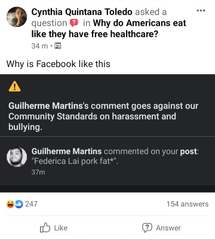
The most ridiculous Zucc so far

This probably beats Plymouth Hoe:


"Why is Facebook like this"
"Guilherme Martins's comment goes against our Community Standards on harassment and bullying.
Guilherme Martins commented on your post: "Federica Lai pork fat*"."

Of course, this post in the group also got zucced. Apparently people were talking about their most ridiculous zuccs.

Links - 24th June 2021 (1)

French Police Thought There was A Dead Body When Malaysian was Cooking Belacan in Paris

VICTORY: Stockton clears student investigated after using Zoom background of Trump, posting political Facebook status - "Stockton University administrators on Tuesday dropped the final charge pending against a student investigated for a political post on Facebook and a Zoom background of President Donald Trump."

Faisal Saeed Al Mutar - Posts | Facebook - ""is the U.S. any different from communist China," she typed with zero fear whatsoever of government censorship or reprisal"
At least she wasn't a tankie, claiming that the US is an awful dictatorship but China is a glorious People's Democratic Republic

Facebook - "Trivia of the Japanese backpack ′′ Randoseru ′′
- Has 6 year warranty to be used during 6 years of elementary school
- Protect against drowning. She floats and turns a float so the child doesn't drown.
- It's designed in a way so that if the child falls on their back doesn't hit their head on the ground.
You can say there's a great chance you'll fall back in a car accident.
Thanks to its thickness, the back of the head doesn't hit the ground.
- If an earthquake and shingles occurs and other objects fall off the top, putting a backpack on your head is the best way to protect it.
- Brilliant material has seen reflectors protect children from cars where it is difficult to see children at evening."

Indian Muslims and liberals are trapped in a toxic relationship - "India’s Muslims and liberals are withering in each other’s embrace. The liberal discourse in India has come in for sharp criticism not only from the Right-wing but also the non-partisan centrists for being unprincipled in its tacit indulgence of minorityism, which might have widened the chasm between the majority and minority communities where the former is always a bully and the latter always has its back to the wall. It has been often said that despite mouthing the platitude of mainstreaming the minority, liberals helped in institutionalising minorityism. It cocooned liberals in a paternalistic aura... The first instance of mollycoddling was to sanitise the history of Muslim rule. In the history books, the testimony of contemporary chroniclers such as Ziauddin Barani, Abdul Malik Isami and Ferishta, etc. was ignored in order to paint an idyllic picture of cultural confluence. In a travesty of secularisation, acts of temple destruction, Jizya tax imposition, and forced conversion would be presented as inspired by political exigency, not religious fanaticism... Although done with the good intention of not letting the bad blood of the past spill onto the present, a total whitewashing didn’t let the people develop the maturity to face up the past and recognise its wrongs. One is not answerable for what their real or adopted ancestors did, but they shape their own attitude towards the past. If one sees glories in the good of it, they would have to partake of its bad too.The second trope was the romanticisation of Islam as an egalitarian religion and Muslims as a casteless society. Conversion to Islam was credited to the equality in Muslim society. The fact, however, was that people carried their caste into the new religion and remained at the same level as earlier. The Muslim ruling class adopted the caste system and placed itself at the apex. In fact, their emphasis on foreign lineage as a mark of superiority infused a fresh racial element into it. Besides caste, gender issue was the main area of social reform in Hindu society. True, Muslims didn’t have a Sati system, but they had all other patriarchal discriminations. In fact, purdah among the Hindu upper class was an influence of Muslims.It became conventional wisdom that Muslims didn’t need to introspect, reform or liberalise. And so, when independent India’s most ambitious social reform programme was undertaken, and Hindu Code Bills were introduced, the Muslim Personal Law was left untouched on the plea that the push for reform had to come from within the community. It never came, and instead became the basis of identitarian politics as was seen during the Shah Bano and triple talaq cases. The sanitised history repeated itself first as a tragedy and next as a farce. The tragedy was the liberal argument in the Babri Masjid-Ram Janmabhoomi case that there was no proof that the mosque in Ayodhya was built on a demolished temple. Its implication for such mosques as were clearly built on demolished temples was not weighed in. And, the farce was in the revisionist historiography of Partition, which invisibilised the fact that, in the end, it was the Muslim League that demanded Pakistan, and had it. Such historiography helped in reviving the same old pernicious narrative. The dictum that minority communalism was a lesser evil was myopic inasmuch as it ignored its ability to inflame majoritarian. The paternalistic minorityism of liberals made them equivocate on burning issues. So, in one kind of bomb blast, terror had no religion; but in another, it did. The discourse of ‘hurt sentiment’ became normalised as demands to ban now a book and now a movie became the norm. The Right-wing learnt fast, and how. In spite of all this, no organic relationship could develop between liberals and Muslims. Both treated each other as tactical allies rather than ideological kin. In the Muslim repertoire of grievances against the present dispensation, there is hardly one that has not been levelled against liberals since the late 19th century (Sir Sayyid Ahmad Khan’s speech at Meerut, 16 March 1888 ). The Islam-in-danger rhetoric, paranoia of subjugation by Hindus, neglect of Urdu, under-representation in services, bias in the behaviour of state machinery, particularly that of police during riots, and myriad other complaints of discriminations are century-old tropes. Muslims love Hindu liberals conditionally, and together they hate the microscopic Muslim liberals unconditionally. Muslims love liberals because the latter don’t question their narratives, and liberals value Muslims because they are their only support left. In an India where two kinds of Hindus are debating how to engage with Muslims, the liberals represent them without questioning why Muslims are unable to represent themselves, and whether the 200-year-long liberal hegemony of public discourse has any responsibility for it."

Thread by @a_centrism on Thread Reader App – Thread Reader App - "Want to improve diversity in NYC specialized schools? One way is to stop caring about students being absent or late, says a city council member.Why would that improve diversity? The graph tells the story.
Until today I didn't realize that racism causes school absences. Racism is even more powerful than I had imagined.What's the Hecht-Calandra Act that the councilman wants repealed?It's a law that requires NYC's most selective public schools to admit students based on a test progressives say "reinforces white supremacy" even though it produces student bodies that are overwhelmingly Asian."

Mary Poppins branded ‘racist’ by US academic over soot scene - "An American academic has criticised Mary Poppins for projecting racial stereotypes, saying Dame Julie Andrews’s character wears “blackface” during one scene. Writing for The New York Times, Professor Daniel Pollack-Pelzner – a gender studies professor at Linfield College, Oregon – sharply criticises the scene where Mary Poppins joins Dick Van Dyke’s chimneysweep Bert to dance on a rooftop... “Here’s one thing I’ve learned about the alt-right, after I wrote this article and received a zillion hate messages in response: they sure like Mary Poppins!”"
Getting backlash for grievance mongering is surely the fault of the "alt-right"

I,Hypocrite - Cosmo, then & now | Facebook
Maybe that's why Singapore unbanned it. But engaging promiscuity isn't as bad as promoting woke poison and glorifying obesity

Natives should have total power and control over their homeland and decide what to do with it. : AgainstWoke - "Natives should have total power and control over their homeland and decide what to do with it
Africa - "OMG YES!"
Europe - "Well, actually... *wall of text*"

Jenna🦋 on Twitter - "can you just let us have this?!?!!? why do you wanna take away what gives so many entertainment?"
"Question. Are you ok with the fact Wonder Woman raped a man who was essentially in a coma? Because that's what happened when she had sex with Chris Pine. The man who's body that was could not consent."
"answer. men cannot be raped by women bc of the difference in power dynamics. just like a black person cannot be racist to a white person."
Feminism is sexism

Michael Malice on Twitter - "It's not that they "fucking love science." It's that they fucking love things to be settled for them, so that they can avoid the responsibility that making moral choices entails."
"Most of them claim to be free-thinking atheists, but love to treat pop-culture scientists like infallible preists or prophets."
"The whole point of the scientific method is questioning what we think we know. Saying the science is settled is anti-scientific because it discourages further questions."
Scientism!

NPR - Posts | Facebook - "Casino magnate Sheldon Adelson, one of the most prolific donors in conservative politics, died Monday night at the age of 87."
So many vile people in the comments rejoicing at his death, despite his being Jewish and pro-choice and his newspaper's editorial board criticising Trump's election fraud claim. The hatred for conservatives is unchecked

Book Returned To Library In Ontario Is More Than 50 Years Overdue - "The Fergus Library in Ontario recently received a copy of Martin Chuzzlewit by Charles Dickens in their return box, which they estimate is more than 50 years overdue."

Heroes and victims: social perceptions and peacebuilding - "Status is important. Our research shows that in low-income countries, claims based on ‘victim’ or ‘hero’ status provide resources that lead to economies of entitlement. This matters in peacebuilding and justice, because in post-conflict situations victims and heroes struggle for exclusive entitlements based on their feeling of deserving something, as just and fair redress for past suffering or as reward for glorious deeds. We find that the exclusive character of such entitlement claims in the long run potentially leads to injustices which can undermine peacebuilding... Generally, people tend to understand their fate as zero-sum, so that the feeling of entitlement as reward or compensation can be transferred from the ‘original’ scene to completely different areas... Social psychologist Vamik Volkan, for example, has shown that nation-states tend to develop ‘selfish’ or expansive behaviour after victimising experiences, driven by the feeling to balance their unpleasant fate... The question “where have you been while we fought in the trenches” became the maxim for the feeling of entitlement of Swapo. This excluded other actors and finally led to a government unresponsive to criticism which lapsed into corruption. Government positions are consequently occupied by former leaders of the liberation struggle, and political opposition parties are either discredited as being “boers” (the white) or traitors (if they are former Swapo members). Namibia represents an example of heroes’ entitlement where the brave fighters for independence felt entitled to rule the country"
An obsession with colonialism is unhealthy

People from ethnic minorities less likely to accept Covid vaccine, says poll - "Numerous studies have shown Covid death rates in the UK for most ethnic minorities to be higher – significantly so in some cases – compared with white ethnic groups... People on lower incomes are also less likely to take the vaccine"... The poll found that men (80%) were more likely to get the jab than women (73%)
Presumably racism is also why poor people are less likely to take the vaccine, and sexism is why women are less likely to get it"

'Vast Majority' of Online Anti-Vaxxers Are Women
Damn sexism, making more women anti-vaxx!

Sociodemographic Predictors of Vaccination Exemptions on the Basis of Personal Belief in California - "Higher income, White population, and private school type significantly predicted greater increases in exemptions from 2007 to 2013"
Presumably racism is why white people are more anti-vaxx. Apparently Tuskegee can't explain everything

Anita Anand on the 1919 Amritsar massacre | History Extra Podcast - HistoryExtra - [On The Patient Assassin] "He goes to India, in 1885. And he’s sent to the north of India, to Punjab, which is where my family originally is from, and he loves India. Absolutely loves it, he loves, well sort of loves India, he loves India apart from the Indians. So, he loves the Raj very, very much, he loves the pith helmet situation, he loves the fun and games, he loves the Kiplings, he loves it when Indians know their place, but what he cannot stand is when these Indians cross the boundary of, I suppose you could call it caste, when they start asking for more than he thinks that they are entitled to... One thing that Sir Michael O'Dwyer said constantly was you lose India, you lose the whole game. And he was right. Cos India funded so much of the Empire and once you'd lost that cash cow, it was unsustainable. And the other thing was that the massacre in Jallianwalla Bagh was the end, beginning of the end for the Empire, because it radicalized so many young men. It turned even the peaceful leaders like Gandhi from somebody who said, look, give us a little more power to get out and get out now. People just decided they couldn't trust the British anymore. There's a man called Tagore. I don't know how familiar you are with him. Rabindranath Tagore, Nobel Prize winning writer who had a knighthood. Well he returned it. He said, I don't want anything, any metal that's touched your hands. I don't want anything to do with it and sent it back. So that from that moment on, we don't trust you anymore. So that was, I think, the start of the end.’"

Isabel Wilkerson On Caste In America | HistoryExtra Podcast - HistoryExtra - "When anyone were, you know, once the, once the caste system, the hierarchy of the New World, then we're talking about the colonies, the American, what would what would become the United States of America. Once that hierarchy was in place, any newcomer had to find out where did they fit in. And once they arrived, they discovered that they fit in, and they were assigned a place based upon what they look like, based upon their heredity, based upon the manifest, the physical manifestation of their heredity. And that meant that people coming from Europe found that they were actually viewed as the exact same group, once they got here. They were viewed as the same racial category. And so, so that people from Denmark and people from, from Romania, people from the Ukraine and people from, from Germany, and you know, people from Belgium, would have found themselves all in the, viewed as the same. They were all assigned to the same queue, whether they had things in common back home, and the mother countries or not... ‘This idea of policing and surveilling and controlling and containing those who were assigned to the bottom is a long, is a very long concept and thread that runs throughout American history. So much so that, in fact, a lot of those slave patrols and people might be deputized, ordinary people who were not themselves constables, but ordinary people were, who were in the dominant caste, were expected to police and surveil and control and maintain the caste line. So this was something that, this was an idea that ran through, was an accepted wisdom of how the hierarchy would be maintained. And this might have been without the word ever being used, I mean the word caste was not being used. But this was a maintaining of boundaries and, and restrictions as to who could do what and who could be where and who was expected to be where. And so that follows through to the current era where again, the words that may not be used, but we have seen videos, that surface, you know, every other week, that show ordinary people surveilling people who would be assigned, viewed as the subordinate caste in the United States, African Americans on a regular basis, you know, where there was, there have been so many cases that it's hard to even know where, which one to choose from. But there was one in which a young woman, for example, was studying in her dorm at Yale, and a woman of African descent was studying in her dorm at Yale, and I think she, she took a break, and rested her head on her book, and someone came, and, you know, and accused her of, of trespassing. Of not belonging there. That was something that was an ordinary person, policing the boundaries of who would be expected… this was just one out of many, many, many examples, many examples, and, of course, the most extreme examples end in, in brutality, and sometimes people losing their lives as a result of the policing of these boundaries’...
‘One thing that is often said about people who are marginalized, they will often say, well, they're playing a particular card. They’re playing the race card and I guess maybe there's a gender card, and I would say and wish to tell everyone that that is absolutely the last thing that anyone wants to do. People wake up every morning and hope that it will be a good daym that they will get the things done that they need to get done and enjoy doing it, they want all to go well, and they want to be be happy and successful. Everybody wants that when they wake up in the morning, they don't look for these things to be happening, and they do not want these things to be happening to them’
Amazing. Apparently the Irish, Italians and Polish were always considered White. What an amazing discovery. It will surely make her name as a revolutionary historian
Of course she repeats the myth of the Yale Dorm "Napping While Black" incident
Presumably being shot by the police has nothing to do with attacking the police - just boundaries being policed
I guess the many people who fake hate crimes are masochistic, since an instance of discrimination is absolutely the last thing that anyone wants

The rise and fall of the American “melting pot” by Julia Higgins - "Nativist partisans have a long history in America, but began to emerge as a major national political force in the 1850s, becoming major opponents to immigration as they stressed the importance of pure “American values.” Though Irish immigrants adapted easily to many facets of American life, for example, nativists denounced their Catholic religion as un-American, put up store-window signs reading “No Irish Need Apply” blocking them from prospective jobs, and tried to stem the flow of immigration from Ireland. Many immigrants — especially those with Italian and Irish roots — were plainly seen as inferior, and depicted as ape-like in media from the era."
Clear evidence all white people belonged to the same caste in the US

Viral Racist Videos Gone Wild - "The “napping while black” scandal at Yale
I have previously written about the real story behind this widely reported incident from May 2018, in which a white graduate student, Sarah Braasch, was said to have called the police on a black classmate for sleeping in a common lounge in their dorm. The black student, Lolade Siyonbola, live-streamed part of her encounter with Braasch and her conversation with the police on Facebook.In fact, Braasch’s call to campus police stemmed from her belief that the lounge next to her isolated dorm room was being used to harass her — as she had repeatedly complained to housing staff in the preceding weeks — and that Siyonbola was one of the harassers. This fiasco also had a long prehistory of conflicts related to Braasch’s fears for her personal safety, some due to valid concerns and some to mental health issues. (The previous year, she had made almost certainly unfounded allegations of stalking by a white maintenance worker she had seen near her room.)Braasch has made many over-the-top, evidence-free claims about being the victim of a deliberate setup abetted by the Yale administration. But the fact remains that her life was upended by a mobbing that smeared her as a rabid bigot based on an out-of-context video and that the media amplified the smear."

America isn’t a melting pot anymore - "The worst thought crime is the one you don’t realize you are committing.So it was with NBC News legend Tom Brokaw, who didn’t understand that assimilation is now a third rail of American politics.He caused a furor with comments on “Meet the Press” over the weekend, including his statement that “the Hispanics should work harder at assimilation.”The condemnations were swift. And they were a sign that being a beloved media figure, who has never before said anything that could be considered bigoted, is no defense when the furies descend.It was Presidential Medal of Freedom to white hood in one sound bite. A group called Latino Victory hit Brokaw for allegedly giving “credence to white supremacist ideology.”... The head of the National Association of Hispanic Journalists rejected the very idea of assimilation, which he decried as “denying one culture for the other.” It is astonishing that in that formulation “the other” is American culture. We are perhaps the only nation in world history that has sought to “otherize” its own culture.It has also been a trope to accuse Brokaw, as Democratic Rep. Joaquin Castro did, of xenophobia. But saying immigrants should assimilate is the opposite of xenophobia — it is an expression of a belief that they can be and should be fully part of the American mainstream.The old American ideal of the melting pot is that immigrants become wholly American (learning the language, embracing the folkways and traditions, becoming deeply patriotic), but also make a distinctive contribution to our national culture, which is organic and open to a variety of influences. It is wrong to view this dominant culture as hateful or exclusionary. As Michael Lind wrote in his brilliant 1995 book, “The Next American Nation,” “the common culture of the American nation is a unique blend of elements contributed by Algonquian Indians and Midwestern Quakers and black Americans and Mexican mestizos and New England patricians. The national culture is not a white culture; black Americans have shaped it far more than the most numerous white immigrant group, German-Americans.”... The real problem is that we have fashioned an immigration system that isn’t geared toward assimilation.In 1920, when we were absorbing another historic wave of immigrants, the newcomers were evenly distributed across nationalities. No single group predominated. In contrast, the wave of the last few decades has been heavily tilted toward Mexico in particular and Latin American countries in general.By 1924, we had also reduced the overall number of immigrants, facilitating the breakup of ethnic communities and a de-emphasis on ethnic identity.We have never tapped the brakes on the current wave. A National Academy of Sciences study noted that Spanish-speaking immigrants are acquiring English more slowly than other immigrant groups: “A major reason is the larger size and frequent replenishment of the Spanish-speaking population in the United States.”"
Identity politics and victim culture mean once you integrate, you lose political capital

Tuesday, June 22, 2021

Links - 22nd June 2021 (2) (Scottish Independence etc)

The babies who nap in sub-zero temperatures - "The theory behind outdoor napping is that children exposed to fresh air, whether in summer or the depths of winter, are less likely to catch coughs and colds - and that spending a whole day in one room with 30 other children does them no good at all.Many parents also believe their children sleep better and for longer in the open, and one researcher in Finland - outdoor napping is popular in all the Nordic countries - says she has evidence from a survey of parents to back this up."Babies clearly slept longer outdoors than indoors," says Marjo Tourula. While indoor naps lasted between one and two hours, outdoor naps lasted from 1.5 to three hours."Probably the restriction of movements by clothing could increase the length of sleep, and a cold environment makes swaddling possible without overheating," she says."

MP: 2 months after wedding, frogs divorced to stop rains in Bhopal - "The frogs were wedded on July 19 in drought-stricken Bhopal in a belief that it would please Lord Indra (Hindu god of rains) and bring rains in the region. However, in view of the heavy rains lashing Madhya Pradesh, the, er, "couple" had to be divorced to stop the rains."
Praise Lord Indra!

Shitposting in Asia Ironically™ | Facebook - "Facebook is temporary.
The ZUCC is inevitable."
Archiving a Facebook group before it gets zucced seems a better solution than repeatedly creating new ones

Marine Corps Forces Europe and Africa commander fired - "Neary allegedly asked junior Marines how they felt about the N-word while they were conducting physical training with rap music using the word on in the background, “which prompted Neary to ask the junior Marines how they would feel if he said it,” and then said it"
How is the US going to fight the next war?
Of course, the NYT article left out crucial context in its headline and description on Facebook in a bid to manipulate readers into getting upset

Jennifer Schulte, ‘BBQ Becky’: 5 Fast Facts You Need to Know - "Snider said the woman told them it was illegal to have a charcoal barbecue in the area where they were having their cookout. According to KRON, an Oakland Parks and Recreation map shows that the area is not a designated charcoal area, but is an area where portable non-charcoal grills can be used. Lake Merritt has three areas with stationary charcoal grills for public use, according to the map"
Being black means that you can flout regulations and anyone who complains is racist

James Lindsay - Posts | Facebook - "Mama, how do we know when we've crossed from the ocean to another?"
"Borders are socially constructed and you should be wary of anyone who takes them too seriously"
"This, from a children's book, says so much more than it means to. Besides the political ramifications, it suggests that social constructs (and what can be called a social construct) shouldn't be taken seriously.Full social constructivism would still be wrong, often dangerously, if it were used responsibly by the social constructivists by studying them for what they really are, but it almost never is (and they lie constantly about this). Mostly, it's done by *critical* constructivists.Borders, for example, are social constructs. In fact, they're political constructs, and a serious study of them would investigate what they do (good and bad), why they exist, what they imply, why they matter, etc., not do critical theory trash talk or postmodern dismissal."

Durex condom sales jump after virus rules relaxed - "The sale of Durex jumped when social-distancing rules were relaxed in the summer, says maker Reckitt Benckiser.The consumer goods giant said growth in its health arm, which includes condoms and "sexual wellbeing products", rose 12.6% in the last three months."

Police mistakenly beat undercover cop during Jambi jobs law protest - National - The Jakarta Post - "A video showing Jambi riot police fighting among themselves after an undercover officer was mistaken for a protester and beaten by a fellow officer has gone viral on social media amid widespread reports of police brutality during the protests... A man in the crowd wearing a grey hoodie, allegedly another undercover police officer, shouts, “Don’t hit him! That’s a police officer!”The man in the hoodie and the officer in riot gear then begin trading blows before being separated by other police officers."

Dominatrix shocks the world after walking man on leash through supermarket - "Shoppers at an LA grocery store were left with their jaws dropped after witnessing a kinky public display of a dominatrix taking her slave on a walk on all fours, to buy some necessities."

Woman Exasperated To Find Out She Has Been Paying Her Neighbour's TNB Bills For 5 Years
Malaysia Boleh!

Maple Ridge Halloween display raises concerns about racism, suicide - "Neighbours in a Maple Ridge area are taking issue with some of the Halloween decorations on display on the front lawn of a home.One woman who prefers not to be named tells NEWS 1130 the grisly display includes two dummies hanging by nooses, a guillotine, and a body cut open that wriggles when a sensor is activated.The woman takes particular issue with setting up a public display featuring hanging bodies, which can be especially painful for Black people to see because of the history of lynching. During a year that has seen a global reckoning on racism sparked by deadly acts of racist violence, the woman says the display is a “slap in the face.”"
???

Rapidly declining body temperature in a tropical human population - "Normal human body temperature (BT) has long been considered to be 37.0°C. Yet, BTs have declined over the past two centuries in the United States, coinciding with reductions in infection and increasing life expectancy. The generality of and reasons behind this phenomenon have not yet been well studied. Here, we show that Bolivian forager-farmers (n = 17,958 observations of 5481 adults age 15+ years) inhabiting a pathogen-rich environment exhibited higher BT when first examined in the early 21st century (~37.0°C). BT subsequently declined by ~0.05°C/year over 16 years of socioeconomic and epidemiological change to ~36.5°C by 2018. As predicted, infections and other lifestyle factors explain variation in BT, but these factors do not account for the temporal declines. Changes in physical activity, body composition, antibiotic usage, and thermal environment are potential causes of the temporal decline."

City Of Paris Is Fined 90,000 Euros For Naming Too Many Women To Senior Positions - "In 2018, 11 women and five men became senior officials. That meant 69% of the appointments were women — in violation of a rule that dictated at least 40% of government positions should go to people of each gender."
Most people on the NPR Facebook were upset about this. The law doesn't matter when you want to fulfil progressive ends. And sexism is only bad when it's against women

Kim Iversen - Posts | Facebook - "In the past 4 years, the only thing Trump did that directly impacted my life was lower my corporate tax (which was unnecessary). Democrats, on the other hand, have shut down the businesses around me, shut down the businesses of my family and have actively censored me. Why would I continue to flank with a party that actively works against my best interests?"

Meme - "The children, Orwell writes in 1984, "were systematically turned against their parents and taught to spy on them and report their deviations. The family has become in effect an extension of the Thought Police."
"Maybe if they didn't think shitty thoughts, we wouldn't need to police them, If they are doing nothing wrong, they have nothing to fear."
The left, once again, taking 1984 as an instruction manual

Meme - "College Sophomore: "Eat the rich!"
The house they grew up in"
Comment (elsewhere): "Aint it funny how the most staunchly zealous communists come from rich, well-off means? It's almost like the entire ideology requires you to be disconnected from reality to make any sense at all."

Raj🇲🇾 on Twitter - "why do men start podcasts instead of going to therapy"
"The same reason females start an OnlyFans instead of dealing with daddy issues"

‘Bonjour-Ho’ Might Not Be The Great Greeting The Bloc Quebecois Thinks It Is - "In Quebec, it’s considered controversial to greet people by saying “Bonjour-Hi,” because many politicians believe that using the English word — even after the French one — is too much of a concession to anglophones.So the Bloc Québécois found a completely clear and uncontroversial holiday alternative: “Bonjour-Ho.”"

James Lindsay - Posts | Facebook - "Jesus of Nazareth, real victim of cruel injustice: "Father, forgive them. They know not what they do."
Wokie of Harvard, pretend victim of imaginary injustice: "Cancel them." Wokeness carries an inverted cross."

Seattle weighs 'poverty defense' for misdemeanor crimes - "Seattle lawmakers are considering a law that would excuse suspects from most misdemeanor crimes if they can be linked to poverty or mental illness... The push comes as crime has spiked in Seattle this year, including during the Capitol Hill Occupied Zone protests in the city"
The crime rate is going to soar again

Peru: Police conduct drugs raid dressed as Santa Claus and elf - "The country's police have used disguises during raids for some time and say the method is an effective tactic.They have been known to dress up as homeless people and street sweepers in the past"

Scotland's deficit seven times higher than UK as a whole last year - "Scotland ran a deficit seven times higher than the UK as a whole last year, despite again cutting its overspend on public services... Mackay suggested the SNP would not try to cut public spending after independence but would instead focus on economic growth to cut the revenue gap. However, he was unable to say how quickly GDP would need to grow to avoid spending cuts."
I hope they become independent, because they'll go bankrupt. Even after they're forced to tap North Sea oil despite their virtue signalling

Trident costs a fraction of Scotland’s deficit - "Every time clear evidence appears, such as the annual GERS report, of the deficit Gordian Knot that an independent Scotland would face, rather than face the reality of massive cuts and tax rises, SNP ministers, spin doctors and apologists trot out the old canards of “we wouldn’t have the cost of Trident or the new aircraft carriers and we could grow the economy to close the deficit gap”. In fact the annual running costs of Trident will be around £2 billion a year and £200 million for the aircraft carriers.Scotland’s share of this will be less than £200 million, compared to a total budget spend of £71bn.This is equivalent to £40 per year, or two cigarettes (80p a week) per inhabitant, or six days of the annual £13bn NHS budget.And as for trebling economic growth to get our deficit down from 8.5% of GDP to the EU entry benchmark of 3%, Scotland’s GDP would need to be more than £400bn, not the current £160bn.This would take almost 35 years on current growth rates, or 10 years at 11%, a level which only China and India have ever achieved."

Higher income taxes and public spending in Scotland? - "The overall tax burden in Scotland is indeed higher... devolved public spending is around £1,300 per capita higher in Scotland than equivalent spending in the UK as a whole... in the past three years, growth has been more buoyant in rUK than it has been in Scotland. So whilst the Scottish Government has increased Scottish tax rates, the tax base has grown relatively more weakly than the rUK tax base... But if the Scottish income tax policy is contributing only around £8 per capita to the spending differential of more than £1,400, what accounts for the remainder?The answer is that the block grant provides Scotland with a relatively more generous settlement."
Scotland already has higher taxes and higher spending than the rest of the UK. Good luck raising taxes even more and/or lowering spending without English money, especially given a weaker economy (I checked and it's been the case for a lot more than 3 years)
Devolved spending excludes Scotland's share of Trident or debt, so that excuse is invalid

An independent Scotland? The economics point to brutal austerity and a trade hit bigger than Brexit - "The case against independence after Brexit rests on Scotland’s deep trading ties with the rest of the UK and its dreadful public finances. In 2014 independence would have meant little change on trade but the UK’s exit from the EU means friction would be almost inevitable.“The two economies are so interlinked it would make Brexit seem like a walk in the park,” warns Thomas Pugh, economist at Capital Economics.Scottish exports to the rest of the UK are more than three times higher than those to the 27 EU countries... “If trade barriers and a lack of access to your biggest trading partner is a problem, then leaving the UK and rejoining the EU to have trade barriers with the UK surely causes an economic hit,” warns David Phillips, IFS economist. “In the short to medium that is likely to be larger than the hit to Scotland from having trade barriers with the rest of the EU.”... GDP – could be aided by allowing higher immigration or pursuing a more pro-business and growth-friendly agenda. The latter could be politically difficult for the left-wing SNP. Big spending giveaways by the SNP and a plunge in revenue from North Sea oil have caused Scotland to lag behind the rest of the UK on deficit reduction in recent years.The 2014 independence referendum was held against a backdrop of Brent crude prices close to $100 a barrel.In the year after the referendum oil prices collapsed and have failed to recover fully. A referendum held now would mean prices 43pc below where they were at the last vote. Government revenue from North Sea oil has completely collapsed from £12.5bn in 2008/09 to just £1.2bn in 2018/19... Tough choices would therefore have to be made by the Scottish government after independence, according to Pugh: “Scotland would either have to cut spending, raise taxes or run a really, really big deficit, which for a small, newly-independent country doesn’t necessarily make sense.”That could wipe the shine off the SNP if it is forced to scrap or water down its flagship policies, such as free university tuition and free care for the elderly... For Sturgeon that could mean imposing austerity measures on Scotland despite blasting the Conservatives’ spending cuts.However, the IFS' Phillips says the SNP has shown “more realism” by setting up the Sustainable Growth Commission, which suggested keeping spending increases capped at 0.5pc for the next decade.He says there would “be austerity for many parts of the public sector” as costs elsewhere rise, such as health and social care. An independent Scotland would face tough spending decisions.Rejoining the EU does not make the economic case for Scottish independence add up as the nationalists are likely to claim"

Scotland Will Be The First Country To Make Period Products Free
Good luck financing this if they declare independence
How come men don't get free stuff?

The hollowness of Scottish independence - "Come Friday, this one-time party of cranks, having been confined to the margins of Scottish politics for much of its 80-odd years of existence, will have won its fourth successive parliamentary election. Its opponents are nowhere... The SNP’s electoral success is even more remarkable when one considers how dismal its governance has been, especially in those key areas of devolved policymaking: education and health. It has overseen a seemingly inexorable fall in standards of literacy and numeracy, with Scotland now the worst performing educationally of the home nations, continuing to slip down the PISA rankings. And the attainment gap between well-off and poor pupils, which it had promised to tackle in 2016, remains as wide as it has ever been. The SNP has also managed the decline of ‘our NHS’, as it insists on calling it, spending far less on it than even the parsimonious Tories down south, and allowing waiting-times targets to be repeatedly missed. And as reported in The Economist, Scotland’s drug-death rate per person is now three times higher than the rest of the UK, and 10 times that of Europe. Even its pandemic response has not been the success the SNP’s cheerleaders would have you believe. Yes, first minister Nicola Sturgeon has proven a more convincing communicator than prime minister Boris Johnson – largely because the authoritarian regulation of everyday life sits more easily with the nanny-statish instincts of Sturgeon than it does with the liberal-ish sentiments of Johnson. But the SNP was still guilty of making the same egregious mistakes as the Tories in England, in particular the shameful decision to discharge vulnerable elderly people from hospitals into care homes at the peak of the first wave. Not that this poor record in government will hurt the SNP. It continues to do what it has always done since it came to power in 2007 — play the blame game. Its failings are always those of hated ‘Westminster’; its struggles the product of its membership of the Union; its failings the fault of the English Tory establishment. The SNP may be in power in Scotland, but it is in its opposition to power in England that its appeal lies. Even more so, of course, since Brexit – which the SNP presents as an English, Tory imposition on a largely Remain-supporting Scotland, and the main justification for its pledge to hold a new independence referendum within the first half of its prospective five-year term. And it has worked. Brexit has fuelled the SNP’s continued ascendancy north of the border... ‘To escape Brexit.’ That is how it conceives of the value of independence. Not positively, in terms of the potential of self-determination and of the possibilities of nationhood, but negatively, in terms of freedom from evil Tories and from Brexit and all those who voted for it. Independence, for the SNP, has become merely another way for it to express its opposition to Westminster and English voters; another way for it to continue to mine its long-standing anti-political vein, while expressing its equally long-standing anti-democratic tendencies. But then, the SNP – certainly in its post-devolution incarnation (the SNP opposed European Communities membership in the 1975 referendum) – has never really taken independence seriously. If it had, it would not be committed to leaving one Union only to subsume itself within the far larger, far more undemocratic European Union. It is a commitment that makes a mockery of the SNP’s claims to want economic control, as a means to resist, as Sturgeon put it recently, Tory austerity measures. After all, not only would EU membership entail entry into the Eurozone and a loss of monetary control; the EU is also a long-standing champion of, well, austerity measures. Just look at what it has done to Greece. Worse still, by framing independence predominantly as a way to ‘escape Brexit’, the SNP avoids having to debate or outline its vision of an independent Scotland. When harder questions of currency or borders, let alone democratic deficits in the EU, are raised, the SNP and other so-called nationalists dismiss them as daft or as scaremongering. But perhaps the ultimate exposure of just how hollow is the SNP’s independence talk lies in its treatment of the Scottish people themselves. From the moment it assumed power all those years ago, it has subjected them to sin taxes on booze, nudges on food, endless lectures about their lifestyles, and increasingly brazen attacks on their freedom of speech. It has repeatedly shown that it doesn’t trust people to make basic decisions about their own lives, or even to have private conversations. No wonder it doesn’t really trust people to govern an independent nation, preferring instead the managerial embrace of Brussels."

How would Scotland work inside the EU? Five years on from Brexit, nationalists still don’t have a clue - "Seven years ago it was uncertain whether the Scottish government could have maintained a single market and customs union as well as the Common Travel Area with rUK by securing Scottish EU membership on the same terms as the UK. Now, the choices are painfully clear: since the UK is outside the EU, Scotland and the rUK can only share a single market and customs union as the United Kingdom. Faith in future oil and gas revenues has also evaporated. Global oil prices are a third lower than in 2014 and investment in the oil sector is in crisis. Rather than banking on a fossil fuel fiscal bonanza, the Scottish government has a net-zero greenhouse gas emissions target for 2045. The 2014 referendum defeat also proved consequential for Scotland’s internal politics. Most of those pressing for Scottish secession have concluded that ongoing monetary union with rUK is a non-starter. Since a post-independence currency, EU membership and Scotland’s fiscal position are all connected, everything around Scottish independence has had to be rethought... For Sturgeon, Scotland must become a member of the EU while forsaking any monetary sovereignty. This would leave the Scottish government free to borrow in sterling but without a future Scottish central bank having the capacity to enact a programme of quantitative easing to support that debt. Without a national currency that could be placed in the Exchange Rate Mechanism, it would also mean trying to negotiate EU membership with an opt-out from joining the euro. Leading his new breakaway party, Alba, Salmond damns this form of independence as strategically hopeless, as if Sturgeon is not serious about obtaining anything other than more fiscal resources from Westminster. He thinks Scotland should do the opposite of what his successor proposes: start devising its own currency and give up on the idea of EU membership... It was the start of the eurozone crisis in 2009 that dissuaded the SNP from betting on the euro as Scotland’s future currency. It was the same crisis that unravelled David Cameron’s attempts to reboot the UK’s EU membership with a referendum. Brexit, then, increased the desire in Scotland for secession but made any version of independence inside the EU more difficult to realise – it created the spectre of an economic border running from the Solway Firth to Berwick... Compared to 2014, the Anglo-Scottish Union is now part of the political contest at Westminster."

Scottish households 'will lose £5,200 a year' under Alex Salmond's debt ultimatum - "Scottish households would be forced to pay £5,200 more a year in mortgage payments if Alex Salmond implements his threat not to take any UK debt after independence, the Chief Secretary to the Treasury said yesterday. Danny Alexander cited analysis by Jefferies investment bank that found a separate Scotland would face far higher interest rates on borrowing in a backlash from financial markets. He warned that even if Scotland did take its share of UK public debt there would be a £1,700 increase in annual mortgage payments for Scots after independence... An independent analysis by Jefferies bank released yesterday found the damage to Scotland’s reputation with the international markets would see interest rates on bond yields increase by five percentage points... Cathy Jamieson, Scottish Labour's treasury spokesperson, said that “everyone knows” failing to pay debts triggers an increase in the cost of future borrowing."
From 2014. Relevant given Salmond's renewed threat

Can Scotland afford independence? - "As a second independence vote becomes more likely (be it legal or otherwise), any image of how the economy of an independent Scotland would look remains murky. Since 2014, Scotland’s deficit has increased, it has lost EU membership status and a worldwide recession has been caused by the Covid-19 pandemic. Alongside this, what was once perhaps the great hope of an independent Scottish economy – oil and gas – is no longer a safe bet to be relied upon to see the country through any turbulence. Oil prices have been volatile at best in recent years and there is a growing global appetite for renewable energy for ethical and quota-fulfilling purposes... A study done by Hanwei Huang, Thomas Sampson and Patrick Schneider from the London School of Economics (LSE) found that Scotland’s income per capita is set to decline by at least 2% from the ramifications of Brexit alone. That is before any calculations regarding a potential independence are taken into account... The LSE team also ran both a high and low-cost scenario – with the high-cost being more pessimistic and expecting a 30% increase for Scotland in trading costs with the rest of the UK. The low-cost was estimating half of that, with a 15% increase. Both scenarios in the report predicted that Scottish independence would cost two to three times more than Brexit alone, in terms of income per capita. It should also be noted that the report’s predictions rely heavily on the assumption that the rest of the UK would continue to be Scotland’s most important trade partner, which is not something that should be taken for granted. Predictions aside, Scotland’s budget deficit has grown since 2014. Government Expenditure and Revenue Scotland (GERS) figures show that Scotland’s budget deficit increased to 8.6% of GDP in 2019–20, about six percentage points higher than the UK average... although Covid-19 has had an impact, this disparity between Scotland’s deficit – particularly in comparison with other regions in the UK – is set to continue. The report credits higher levels of public spending per capita (largely into public services) and slightly lower than average levels of tax as the main reasons for this. The report then advises that should Scotland become independent, tax rises and spending cuts would be required to offset the imbalance... “The EU is eight to ten times bigger than the UK, that is true, but the fact of the matter remains that Scotland sells most of its goods and services to the rest of the UK,” he says. “It hasn’t yet really penetrated Europe – it is still fairly marginal to its export drive.”... Andrew Marr interviewed First Minister Nicola Sturgeon and questioned her policies regarding trade and borders. Sturgeon replied: “It is not the SNP that raises the issues of borders, this issue only transpires because of the UK government’s Brexit obsession and the fact that we have ripped Scotland out of the EU against our will… Of course we want to keep trade flowing between Scotland and the rest of the UK.”... “She says no one wants a hard border,” he says. “Well, she should have thought of that before because the fact of a hard border is that it will be the result of her party’s policy. England and the rest of the UK are not imposing a hard border, the result of leaving the UK will impose a hard border, and we just don’t know what losses that will lead to.”... “[If Scotland rejoined the EU] it would have access to the bloc’s markets. European countries, like countries everywhere, will be trying to recover from the effects of Covid in different ways and at different speeds. That will mean that EU countries will tend to look inward, and to favour their own projects rather than going for big export drives... “While it is legally part of the UK, the Scottish government cannot negotiate with the EU. But the EU can declare that, because Scotland has already long been part of the EU, should it become legally and democratically independent, it need not apply as a ‘new’ accession candidate. Instead, the EU and its member states should make a unilateral and open offer of membership – an exceptional proposal to match Scotland’s exceptional circumstances.” Lloyd is dubious about the letter’s content. “[The letter and this strategy] will not work,” he says. “It is not that the EU necessarily wants to keep Scotland out, I think it is mostly ambivalent about it. It is largely because it doesn’t want to encourage other breakaways in Belgium or Spain or elsewhere. “Also, the other 27 members will immediately object if one country is getting special deals or subsidies that they are not – it simply won’t work. So, Scotland will have a difficult task, and a lengthy one, to get into the EU. There will be some kind of hard border, at least initially. Maybe later on Scotland can have some kind of Norway-style agreement with the EU. Hopefully that would happen.” If Scotland were to rejoin the EU, the question of whether it would adopt the euro as its currency would again be raised. Murphy believes that Scotland adopting the euro is highly unlikely. “The idea of the euro has died,” he says. “I think that people realise that it is never going to be enforced. Look at Sweden – it gave a commitment to join the euro in 1995, and here we are in 2021 with the country making no effort to honour the commitment. It never will. For Scotland, I would strongly recommend EU membership, but not the euro.” Which leaves Scotland with yet another question to ponder: if Boris Johnson is unlikely to grant Scots a second referendum, would he (or any successor) be likely to allow the newly independent country permission to use the pound. What, then, would line the pockets of Scots after independence?... Murphy believes that if Scotland were to continue using sterling, or indeed any other currency, it would leave the country’s economy vulnerable to the power of the money markets. Indeed, these money markets, and Scotland’s banks, create yet another complex issue for independence, that of banking. Lloyd highlights that Scotland no longer owns its largest banks. “Both the Bank of Scotland and the Royal Bank of Scotland had to be saved with enormous injection of funds from the UK government, ironically by two Scots in Gordon Brown and Alistair Darling,” he says. “They have, to a degree at least, recovered but both have been swallowed up by larger banks.”... Despite this growth in financial services GVA, Lloyd says: “Scotland’s economy is quite diverse. There is no real central motor of the economy, which can drive Scotland’s success. If and when it went independent, it would have quite a difficult job, in the short and medium term, to become a successful economy. It possibly could do it; there are good universities, good research centres and a talented workforce, but it will take some time, and it would take a number of policies quite different from those that the SNP is presently [putting forward].” In 2014, Scotland’s oil and gas reserves were the safeguard of the country’s economy. That is no longer the case. Oil prices have been dropping alongside demand and a global desire to embrace renewable energy over climate-harming fossil fuels has left the industry with an uncertain future. Lloyd believes that this adds to the ‘no central motor’ economic problem Scotland would face as an independent country... Outside renewable energy, there are a diverse range of sectors in Scotland that have seen promising growth in the past decade, such as life sciences, advanced manufacturing, construction, financial services and creative industries such as video games. All of these sectors have the advantage of doing business in a domestic market that is 66 million people strong, and stands as the sixth-largest economy in the world. Independence would cut this domestic market to 5.5 million and the economy would dramatically shrink. So is Scotland too small to survive and thrive on its own?"
It's interesting how Brexit is supposed to be a bad thing because of how expensive it is, but Scottish independence isn't

Britain goes to War (WWII)

Alan Allport On Britain's Road To WW2 | HistoryExtra Podcast - HistoryExtra (Part 1)

"‘What kind of country was Britain in 1938, early 1939?’

‘That's a great question. And of course, it, the answer, I suppose, is, well, it depends which Britain you're talking about. Again, there is a sort of powerful myth, which is invoked in a lot of literature and cinema, during the war itself, and then immediately after the war, which presents Britain as the peaceable kingdom, as some historians have called it. Again, the kind of Shirefolk idea of event, very gentle, parochial, inward looking civilization, uniquely meek and mild in lots of ways and a little bit naive as a result, perhaps, but one that is unprepared for violence, that is repelled by violence, finds it mystifying, hard to understand. And again, you know, that there are elements of pre war British life, that sort of that, that have an association with that.

It's not that it's completely untrue. Certainly, you know, we look back at the 1930s today, and we look at the aggregate crime statistics, and so forth. And we do see a country which in many ways, seems very much more at peace with itself. On the other hand, however, of course, that leaves out an enormous amount. One of the reasons why the book begins with a few chapters, which you might call this sort of State of the Nation...

One of the reasons why I start the first chapter deliberately not in England, or indeed in Great Britain at all, but I start it in Northern Ireland, is because it's a part of the story, which gets almost completely overlooked. Northern Ireland was just as much a constituent part of the United Kingdom in 1939, as Yorkshire or Surrey, or or anywhere else. And yet, it's a very different story. That this is not a Shirefolk land. This is a place of sectarian division, of a great deal of violence, much of which is inspired by the state, or at least, the state turns a blind eye to it. It's a country of state mandated apartheid, in lots of ways, in which the Catholic population is very much treated as a second class, second class population with second class citizenship, it's a surveillance state, which has extraordinary powers of policing and the ability to intervene in the lives of ordinary people. It's a place in lots of ways which looks an awful lot more like Mussolini's Italy. Than, for example, of Franco’s Spain, than it does this kind of image of a very gentle liberal Britain. Now it's not the Whole Truth any more than anything else is the whole truth but it is a different way of thinking about Britishness.

Plenty of people thought, the Second World War for a kind of idea of Britishness, which most of us would probably find unrecognizable today. And it's not that that version of Britishness was any more authentic or inauthentic than the one that we have. It was just, it was different. And we need to understand, you know, historians, of course, are always banging on about the fact that, you know, we need to remember that, you know, the people of the past were not like us, even though some of the language and phraseology and images that they may have used were maybe very similar, but they, they understood these things in different ways. The British in 1939, did not fight the Second World War for exactly the same set of values that we regard as being paramount today. And we need to understand that in order to be able to understand how they got into the war in the first place, and to some extent, ultimately, just to understand how they got through it...

There appears to be only two politicians, historical politicians who exist anymore, Churchill, and Chamberlain, and they exist in this sort of permanent kind of Manichaean opposition to one another. So if a politician is compared with favorably, with someone in the past, they're compared with Churchill, if they're compared unfavorably they're compared with Chamberlain, and no, but it seems like nobody else actually exists…

There is this idea that [Chamberlain] sort of exemplified some of the worst characteristics of the Shirefolk, you know, overly gentle, overly naive, too willing to believe the, you know, the lies of others and so forth. Chamberlain is not, that is not the Chamberlain, that people saw at the time. One of his contemporaries in the Commons described him as a man of steel. And that was very much the way that both his, his friends and his enemies actually saw him. A man of extremely uncompromising values. He was a tyrant, in many ways over the Conservative Party, and over the House of Commons. Someone described his debating style in the Commons as being dropping a bunch of bricks on top of you and seeing what happens…

Chamberlain had many of the characteristics that we now regard as being those that politicians ought to have. He's a principled, I mean, he's a man, he's a man of conviction. He is a man who believes very much in his own iron will, and his own destiny. He believes, just as Winston Churchill believed that he and he alone is the man who was destined to save the British Empire…

The sort of popular view of Chamberlain is that he completely neglected all military preparations for the war, that he sort of naively assumed that everything would be for the best, and that Britain found itself completely wrongfooted when it actually found itself at war in September 1939. Well, this is an enormous caricature. Chamberlain had been, had embarked upon a very ambitious rearmament program, which had gone on for several years and was really beginning to hit its stride by 1938. Indeed, you know, one of the reasons why Chamberlain was so eager to try and still find the deal with Hitler, by 1938 was because of the cost of Britain's rearmament program and because of the fact that he was terrified about the effect that this was gonna to have on the economy and on society as a whole’...

‘David Reynolds has described the Fall of France famously as the fulcrum point of the 20th century. And I think that I agree with him. I think the thing about the Fall of France is that in some ways, it's the most over determined event in the Second World War in the, in the sense that people tend to write it off as an inevitability, they tend to assume that in some ways, it was bound to happen right from the very beginning. That it's, you know, the, the opening months of the war are just this sort of prologue that we need to get through in order for France to inevitably fall, inevitably collapse, and then get on with the, with the main events. Now, that's certainly not the way it was seen at the time. And I don't think that the evidence stacks up well, with regard to that either. France had the most powerful army in the world, in 19, certainly in 1939. France was one of the great powers of the world, France had gone through an enormous ordeal, military ordeal in the First World War and had prevailed. And in many ways, what happens in 1940, is that the Germans take an enormous risk in attacking France at a point in which they are, in many ways, much weaker in 1940 than they had been say in 1914…

France was one of the great powers of the world, France had gone through an enormous ordeal, military ordeal in the First World War and had prevailed. And, in many ways, what happens in 1940, is that the Germans take an enormous risk in attacking France at a point in which they are, in many ways, much weaker in 1940 than they had been say in 1914. For instance. Hitler is aware of the fact, that, he is very well aware of Germany's weaknesses, that it doesn't really have, the army that he would like, that Germany is facing in a number of economic difficulties. And he feels that he must strike out. He must take this all or nothing gamble, which is very much his approach to war and politics. And risk all on the throw of a dice. And as it turns out, the dice come up in his favor. The French for, although in many ways, they do have a strong position in 1940, their weaknesses, I think is greatly exaggerated.

But they make a number of operational decisions, which prove to be extremely unfortunate, given the decisions that the Germans have made, essentially, everything the Germans do just happens to turn out in the right way. And everything that the French do, just happens to turn out in the wrong way. It's not difficult, however, to see a few small relatively minor decisions that had gone the other way, that the Battle of France would have turned out very differently. And to sort of get back really to your original question about why this is so consequential. I think if you, if you think about an alternative 1940, I think that helps to explain a little bit about why it's so consequential.

Imagine that France does not fall in the late spring, early summer of 1940, which I make the case certainly in my book, and I'm not alone in this in thinking is entirely plausible, this is not a far fetched counterfactual. If France does not fall. Well, first of all, it probably means that Germany falls, not too long later. Germany's chances in a war in which it fails to defeat France in 1940are probably not very good. And you could, it's very easy to imagine the war ending in some form or another in say, late 1940, or 1941, or something like that. But the more important point, I think, is that, the the war does not end, as it does, of course, in real life, with the military domination of the United States and Soviet Union, in Europe. The war ends with the original Alliance partners, Britain and France, remaining, in many ways, the fulcrum of European power, and, for that matter, world power, much less diminished in their imperial power than they were in real life, because of the, you know, the very drawn out difficult circumstances of the war that actually happened.

I think you also see a different story elsewhere in the world as well. If France does not fall, then the future of the British and French empires remains much less clear. Because it's unlikely, for instance, that Italy, would have gotten involved in the war, which, which expanded the Second World War into the Mediterranean, into Africa. And second of all, perhaps even more importantly, it's much less likely that Japan would have taken its great gamble at creating an autarkic empire in East Asia. And therefore, you would not have seen the conquest of French Indo-China, of British Malaya, Singapore, of Burma, and so on and so forth’...

'The popular memory of 1940 is one in which French defeat is almost seen as being a good thing. It's seen as something that allows the British to return to their own native genius, to be able to fight the war on their own terms, rather than those of having to rely on a very unreliable, continental partner. And, you know, during the last few years, with the Brexit debate, this was brought up in often in not very subtle, subtle terms'...

'There is an argument... that at the time, the British always sort of knew that they were not really alone, that of course, there was this thing called the British Empire that was out there, that was, you know, one quarter of the world's land surface and was an enormous, you know, global power in its own right... that there was the role of the the emigre powers, the governments and military forces that have come from Europe and so forth. We know people knew about this, they weren't, they were not naive. And one of the reasons why the government was willing to fight on in 1940, it was because of the fact that it was well aware of the fact that it was it was not just Britain fighting against the, against Germany...

On the other hand, I think people also drew a kind of ironic consolation, from the idea of fighting on alone. After all, plenty of British historical myth draws on this idea of, you know, the gallant, particularly the English, it doesn't fit quite so well with, with a conception of Britain but, but certainly the English I think, can sink think of themselves as having been through this experience many times before. They had been there in 1588 with the Spanish Armada, they had been the against Louis XIV, they had been there, against Napoleon, of course, in 1805. And there was a, I think there was a kind of way of being able to mobilize history in 1940, and say, don't panic, we've been here before, we actually fight better when we're alone. Again, this harks back to this idea that the French Alliance had been a mistake in some ways… when it seems like the 11th hour, when all appears to be falling apart, actually, you know, this is when our own native genius really shines through…

[This] tends to leave out the United States. We tend to focus about this exclusively about the British Empire and about, you know, the Poles and the, and the Free French and so on. We don't talk very much about the Americans. And yet it was the assistance and the cooperation of the United States, which was regarded by the British government in the summer of 1940 as being the single most important factor in being able to continue the war. The Chiefs of Staff, were relatively confident that they would be able to hold out for the time being. So the Battle of France is kind of over determined, you know, everybody just assumes it was a foregone conclusion. I think, in some ways, the Battle of Britain is probably under determined, in the sense that everybody's convinced that it was a close run thing, that, you know, almost certainly could have gone wrong, that that's probably an exaggeration. I mean, it's not as though victory was absolutely guaranteed. But Britain was actually in a, in many ways, in a pretty strong situation in the summer of 1940, in terms of Germany's aerial threat and the possibility of an invasion, and the government sort of knew this, they knew that that for the for the time being, they were probably going to be okay. The bigger question, though, was what would happen in the longer term…

The Chiefs of Staff warn Churchill that unless continued American assistance, can be guaranteed that there is no long term ability to actually imagine a victory. And this is very precarious, for a couple of reasons. One is because in the summer of 1940, America's neutrality laws mean that any material assistance that continues to come from the United States has to be paid for in hard currency, so gold, or dollars, and Britain very simply is running out of gold and dollars, by the late summer, early, early autumn of 1940. And whether the United States will continue to assist Britain once it runs out of hard currency is not at all clear. It certainly doesn't have to, and whether it's willing to do so is largely is largely going to be determined on whether the Americans decide that Britain is a good bet. That continuing to assist the British ultimately is in the American interest. And there are voices in Washington that are raising real concerns about this, that you know, that you know, continuing to assist Britain is just throwing good money after bad that, you know, maybe the British are washed up anyway. And surely, at a time when of course, the the United States military forces badly need material, you know, equipment and resupply of their own, surely the focus should be on on dealing with that first and then worrying about the British later. Surely, the, the best thing for the United States to do is to focus on Western hemispheric defense’"


Alan Allport On Britain's Road To WW2 | HistoryExtra Podcast - HistoryExtra (Part 2) 

"‘The thing that the German invasion of the Soviet Union does is that in some ways, it makes it much more possible for Britain to actually bring the war to a victorious conclusion. On the other hand, it also means that the world will never be so morally straightforward, ever again. Neville Chamberlain had gone to war in September 1939, against the totalitarian powers of, the chief totalitarian power of Europe, which was very much in league with the Soviet Union. Now, of course, Britain is on the side of one of Europe's great totalitarian powers, one in which, you know, Stalin has had no compunction about murdering millions of his fellow citizens’...

'The question of the Australians and the New Zealanders. If Singapore falls, if Malaya falls, this will jeopardize greatly Australia's security situation. Now, Churchill had before the war, and actually in the early stages of the war, had always reassured the Australia and New Zealand governments that if the, if the situation finally arose in which Britain had to make a decision between defending, say, Egypt on the one hand, or Singapore on the other, that it would always defend Singapore, because ultimately, Egypt falling would be, would be a major defeat, but it wouldn't necessarily mean the end of the British Empire. Whereas a defeat in East Asia might potentially lead to a Japanese invasion of Australia or New Zealand. And so he reassures the Dominion governments, that this is one of the reasons why they're willing to send troops to fight the Italians in the Mediterranean, because they know that ultimately Britain will back them.

Now Churchill's changed his mind. By early 1941. He's ultimately decided, if he can't defend everywhere, he will skip defending Singapore. His argument is that, first of all, the Germans and the Italians are not in Singapore, they're in Egypt, that is where the war is actually going on. And he has to deal with the war that's actually taking place, not a speculative war against the Japanese that might happen in six months or a year, or might not. He has to impress the Americans, remember that the Americans are still, you know, are still a little cagey about, you know, Britain's long term chances. He has to impress the Americans with the idea that Britain is serious about winning the war, which means continuing to fight in the only place in which it's really possible, which is Egypt in early 1941. Which means sending the bulk of supplies which are available to the Mediterranean and not to East Asia…

Singapore is not in a position to defend itself, if the Japanese launch a full throated invasion. Churchill hopes that it won't happen, that ultimately the Japanese are bluffing. And that even if they're not bluffing, well, maybe the United States will step in anyway and ultimately defend Britain's territories in East Asia...

How are we going to win the war and survive as a great power? Neville Chamberlain's great fear, about war with Germany had never in a way been about defeat, he had always, just as Churchill, you know, had always believed that Britain would be victorious. Well, in a, in a funny kind of way, Chamberlain did, too. He always actually had confidence that ultimately, Britain would prevail in a long war against Germany. What he was frightened of wasn't defeat, but it was what would victory look like? Chamberlain had always worried that Britain would be so diminished by the cost of victory, it emerged, the British Empire would never be the same again, that ultimately, real power would move, would shift towards Moscow and Washington DC, that they would you know, the Soviet Union and America would be the real victors.'"

Related Posts Plugin for WordPress, Blogger...

Latest posts (which you might not see on this page)

powered by Blogger | WordPress by Newwpthemes